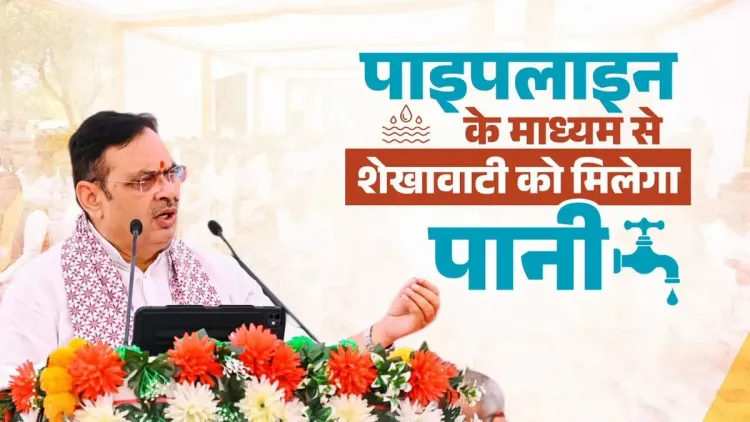
CM Bhajan Lal Pushes Pipeline Water Supply Across Shekhawati
Synopsis
Rajasthan Chief Minister Bhajan Lal Sharma on 25 October 2026 announced that pipeline-based drinking water infrastructure is being strengthened across the semi-arid Shekhawati region, covering Jhunjhunu, Sikar and Churu districts, under the state government's commitment to household tap connections.
Key Takeaways
CM Bhajan Lal Sharma posted on 25 October 2026 that pipeline water supply infrastructure is being actively strengthened across the Shekhawati region.
Shekhawati covers the districts of Jhunjhunu, Sikar, and Churu in northern Rajasthan — among India's most water-stressed semi-arid zones.
The state government's push aligns with the central Jal Jeevan Mission , launched in 2019 , to deliver functional household tap connections across rural India.
Rajasthan holds roughly 10 percent of India's land area but only about 1 percent of its surface water, making pipeline infrastructure critical rather than supplementary.
Successive Rajasthan governments have drawn on sources including the Indira Gandhi Canal and Bisalpur Dam to extend surface-water pipelines into the state's arid belt.
Progress reports on coverage and tap-connection counts in the three Shekhawati districts, and future budget allocations, will serve as the real benchmarks of delivery.
Across the semi-arid stretches of Shekhawati — a region that has historically relied on open wells and hand-dug tankas (underground cisterns) for survival — Rajasthan Chief Minister Bhajan Lal Sharma says the state is actively laying pipelines to deliver clean drinking water directly into homes, signalling a push to end one of the region's oldest deprivations.
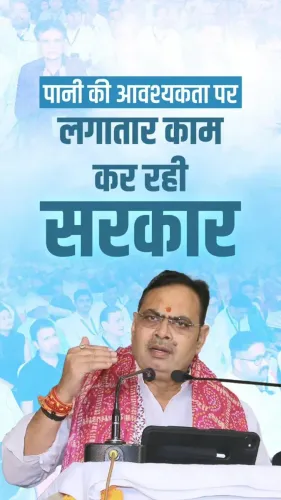
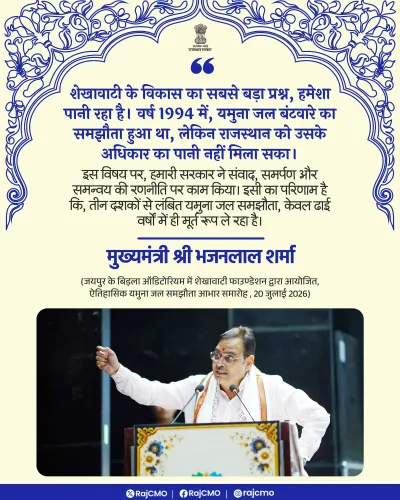
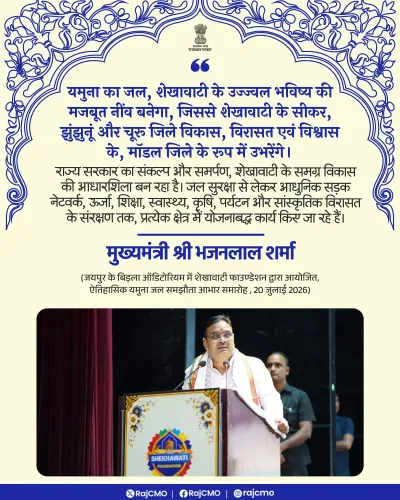
Posting on Sunday, 25 October 2026, CM Sharma wrote: 'Shekhawati kshetra mein pipeline ke madhyam se peyajal ki uplabdhata sunishchit kar jalapoorti vyavastha ko sudridh kiya ja raha hai.' — 'Water supply infrastructure is being strengthened in the Shekhawati region by ensuring availability of drinking water through pipelines.' He added that his government is 'committed to delivering clean drinking water to every household and making life easier for the people of the state.'
Shekhawati's Long Fight Against Thirst
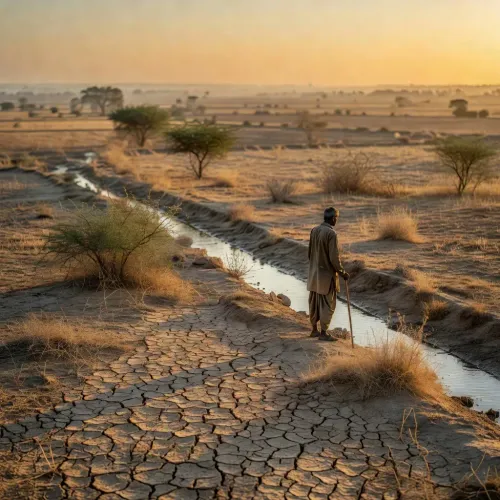
Shekhawati spans the three northern Rajasthan districts of Jhunjhunu, Sikar, and Churu — a semi-arid belt where erratic monsoons and rapid groundwater depletion have made safe, reliable drinking water a persistent challenge. For generations, communities here depended on seasonal groundwater and traditional storage systems. Surface-water pipelines, drawing from sources such as the Indira Gandhi Canal and Bisalpur Dam, have been the state's long-term answer — successive governments have extended these networks district by district.
The problem is structural: Rajasthan holds roughly 10 percent of India's geographical area but only about 1 percent of its surface water. In the Shekhawati belt specifically, decades of intensive agriculture and population growth have stressed groundwater tables, making household tap connections from surface pipelines not a convenience but a necessity.
Jal Jeevan Mission: The Central Frame Behind the State Push
The infrastructure effort CM Sharma is highlighting fits within the Jal Jeevan Mission, the 2019 central government programme designed to deliver functional household tap connections for safe drinking water to every rural home across India. The scheme provides central funding that states co-implement through their Public Health Engineering Departments, making the Rajasthan government's role one of execution, last-mile reach, and state co-financing.
Rajasthan's geography has always made this mission harder here than almost anywhere else in the country. Piping water across rocky, arid terrain to dispersed rural settlements demands sustained capital and institutional follow-through — which is precisely why CM Sharma's framing of 'commitment' is politically as much as operationally significant.
What Households in the Three Districts Are Waiting For
The real test of the announcement will come in pipeline coverage data and functional tap-connection counts from Jhunjhunu, Sikar, and Churu. Analysts watching the sector will look for state budget allocations in subsequent sessions and tender announcements for further pipeline phases as the clearest indicators of how far the stated commitment translates into physical infrastructure on the ground.
For now, CM Sharma has placed clean water at the centre of his government's delivery narrative — and in Shekhawati, where a glass of tap water has never been a given, the stakes for getting it right could not be more concrete.
Point of View
Where water scarcity is an election-cycle issue that has historically punished incumbent governments. By anchoring the message in a specific, named geography — Shekhawati — rather than a generic statewide claim, the BJP administration is trying to demonstrate granular delivery focus, not just headline intent. The framing also keeps the Jal Jeevan Mission credit equation visible: state execution of a central scheme allows the BJP to claim ownership at both levels. The real political risk lies in the gap between announcement and pipeline-on-the-ground — in Shekhawati, residents have heard the promise of taps before.
NationPress
25 Oct 2026
Frequently Asked Questions
What is CM Bhajan Lal Sharma doing for drinking water in Shekhawati?
CM Bhajan Lal Sharma has announced that the Rajasthan state government is strengthening pipeline-based drinking water infrastructure across the Shekhawati region — covering Jhunjhunu, Sikar and Churu districts — to ensure clean tap water reaches every household.
Which districts are covered under Shekhawati water pipeline project in Rajasthan?
The Shekhawati region comprises three northern Rajasthan districts: Jhunjhunu, Sikar, and Churu — all classified as semi-arid and historically dependent on groundwater and traditional storage systems.
What is Jal Jeevan Mission and how does it relate to Rajasthan's water supply?
Jal Jeevan Mission is a central government scheme launched in 2019 to deliver functional household tap connections for safe drinking water to all rural homes in India. Rajasthan implements the scheme through its Public Health Engineering Department, with the state's arid geography making it one of the more challenging deployments nationally.
Why is Shekhawati facing water scarcity?
Shekhawati is a semi-arid belt where erratic monsoons, rapid population growth, and decades of intensive agriculture have depleted groundwater tables significantly. Rajasthan as a whole holds about 10 percent of India's land but only around 1 percent of its surface water, making the region especially vulnerable.
What water sources supply the Rajasthan pipeline network?
Rajasthan's surface-water pipelines draw from major sources including the Indira Gandhi Canal and Bisalpur Dam, which successive state governments have extended to improve supply reliability across the arid and semi-arid districts.