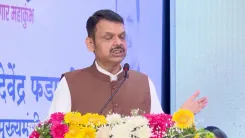
CM Bhajan Lal Marks 11 Years of Digital India
Synopsis
Rajasthan Chief Minister Bhajan Lal Sharma on 1 July 2026 marked 11 years of the Digital India programme, crediting PM Modi with transforming governance through UPI, DBT, rural connectivity and over 2,500 mobile government services to empower crores of citizens.
Key Takeaways
Digital India completed 11 years on 1 July 2026 , launched originally by PM Narendra Modi on 1 July 2015 .
Rajasthan CM Bhajan Lal Sharma credited the programme with making governance more transparent, accountable and citizen-centric.
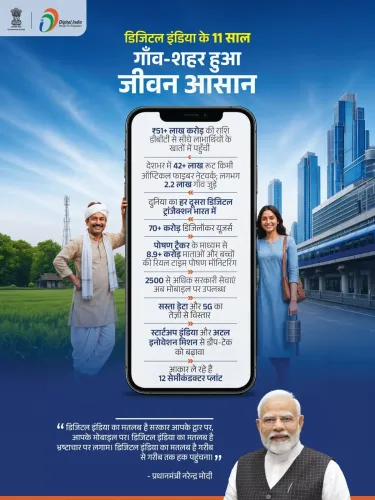
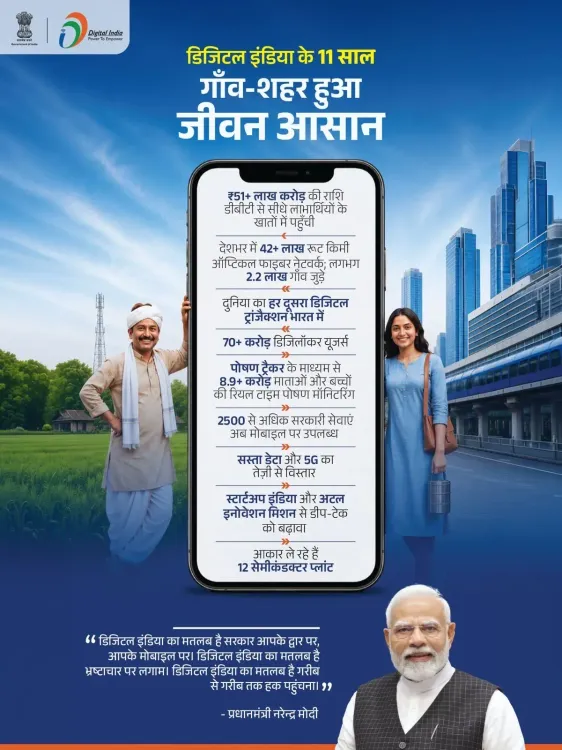
DBT has reportedly transferred more than ₹51 lakh crore directly to beneficiaries, eliminating intermediaries (figure cited by CM Sharma; not independently verified).
UPI , rolled out in 2016 by NPCI, is cited as a cornerstone of India's rise as a global fintech model.
Rural connectivity through BharatNet optical fibre and more than 2,500 mobile-based government services have expanded digital access across India.
Affordable data, 5G expansion and Startup India are highlighted as positioning India as an inspiration in digital innovation globally.
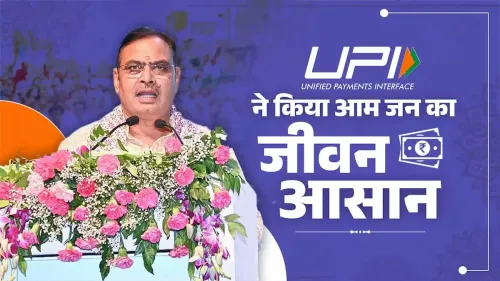
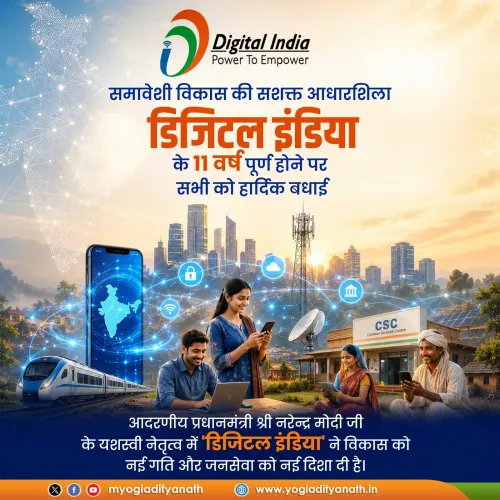
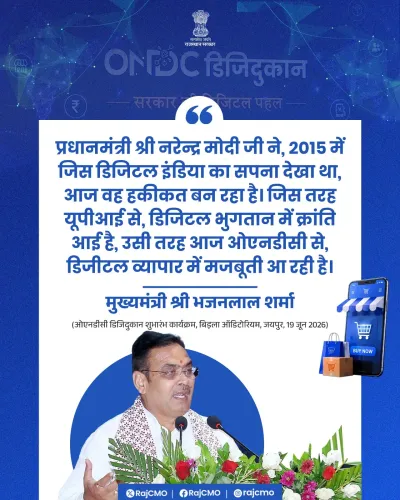
Rajasthan Chief Minister Bhajan Lal Sharma on Wednesday, 1 July 2026 lauded the Digital India programme on the completion of its 11th anniversary, crediting Prime Minister Narendra Modi with transforming governance through technology and making public services more transparent, accountable and citizen-centric over the past decade.
Context
Posting on X, CM Sharma wrote in Hindi that the Digital India campaign, launched under PM Modi's leadership, has become the identity of a new India. He noted that over 11 years, technology has been linked to public service delivery, making governance more transparent and citizen-focused — 'नए भारत के आत्मविश्वास और सुशासन की सशक्त अभिव्यक्ति' (a strong expression of new India's confidence and good governance).
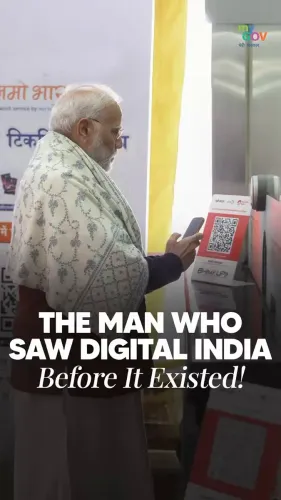
The Digital India programme was formally launched on 1 July 2015 by Prime Minister Narendra Modi, with the stated goal of transforming India into a digitally empowered society and knowledge economy. The anniversary is now observed annually as a milestone in India's technology-driven governance push.
Policy Backdrop
CM Sharma highlighted that the Unified Payments Interface (UPI), developed by the National Payments Corporation of India and rolled out in August 2016, gave new momentum to digital payments across the country. He also cited the Direct Benefit Transfer (DBT) mechanism, through which, he stated, more than ₹51 lakh crore has been transferred directly to beneficiaries without intermediaries — though this specific cumulative figure has not been independently verified.
The post further credited the BharatNet optical fibre project — which received renewed impetus under Digital India — with extending connectivity to lakhs of villages, empowering rural India. Services such as DigiLocker, eSanjeevani, online education platforms, and over 2,500 mobile-based government services were cited as having simplified life for crores of citizens, though the precise count of 2,500-plus mobile services is a recent statistic not independently verifiable.
The programme built on the JAM trinity — Jan Dhan accounts, Aadhaar identity and Mobile connectivity — which successive phases have used to digitise identity, expand broadband and promote indigenous payment rails. Affordable data, the rapid rollout of 5G, and initiatives like Startup India (launched in 2016) were also cited by CM Sharma as establishing India as an inspirational model in digital innovation and fintech globally.
Stakeholders and Impact
The beneficiaries of the decade-long push span rural citizens gaining broadband access, welfare recipients receiving subsidies directly into bank accounts, fintech startups scaling on UPI rails, and urban and semi-urban users accessing government services on mobile. Rajasthan, with its large rural population and ongoing state-level e-governance efforts, has been among the states that have sought to align with the central Digital India framework.
CM Sharma expressed confidence that the campaign would continue to set new standards in good governance, transparency and public convenience, and would provide fresh energy to the goal of a 'विकसित भारत' (Developed India) by empowering every citizen digitally.
What's Next
Attention will now turn to the next phase of the BharatNet project and 5G rollout targets reflected in state budgets, as well as any parliamentary or audit reviews of DBT savings and service delivery outcomes. The anniversary messaging from state leaders like CM Sharma signals continued political investment in Digital India as a governance brand ahead of future electoral cycles. How the programme's next phase addresses last-mile digital literacy and inclusion for the most marginalised communities will be a key measure of its continued impact.
Point of View
Reinforcing the narrative that the post-2014 governance revolution is both durable and expanding. By foregrounding specific metrics — DBT transfers, UPI scale, rural fibre reach — the message attempts to convert abstract 'digital transformation' into tangible citizen benefit, a framing that has proved electorally resonant. The anniversary also serves as a soft launch pad for the next phase of Digital India, with 5G and Viksit Bharat providing the forward-looking hook. For opposition parties, the challenge remains offering a credible counter-narrative on digital exclusion and data privacy rather than contesting the programme's headline numbers.
NationPress
29 Sept 2026
Frequently Asked Questions
When was Digital India launched and by whom?
Digital India was formally launched on 1 July 2015 by Prime Minister Narendra Modi with the aim of transforming India into a digitally empowered society and knowledge economy.
What did Rajasthan CM Bhajan Lal Sharma say about Digital India?
CM Bhajan Lal Sharma posted on X on 1 July 2026 congratulating citizens on 11 years of Digital India , highlighting achievements in UPI, DBT, rural connectivity, DigiLocker, eSanjeevani and 5G expansion.
How much money has been transferred through DBT under Digital India?
CM Sharma stated that more than ₹51 lakh crore has been transferred directly to beneficiaries through the Direct Benefit Transfer (DBT) mechanism, though this cumulative figure has not been independently verified.
What is the JAM trinity and how does it relate to Digital India?
The JAM trinity refers to Jan Dhan bank accounts, Aadhaar identity and Mobile connectivity, which together form the infrastructure backbone that Digital India used to deliver welfare directly and digitise public services.
What is BharatNet and what has it achieved?
BharatNet is a government optical fibre project — originally called NOFN — that received renewed impetus under Digital India to bring broadband connectivity to lakhs of villages across rural India.