CM Bhajan Lal Highlights Rajasthan's Millet Push Under Modi
Synopsis
Rajasthan Chief Minister Bhajan Lal Sharma declared on 20 July 2026 that the state's double-engine government is championing Shri Anna millet production and agricultural modernisation under PM Narendra Modi's leadership, positioning Rajasthan as a frontrunner in climate-resilient farming.
Key Takeaways
Rajasthan CM Bhajan Lal Sharma reaffirmed the state's commitment to farmer welfare on 20 July 2026 .
Sharma credited PM Narendra Modi 's leadership for driving agricultural modernisation in Rajasthan.
Rajasthan is positioned as a leading state in the production of Shri Anna (millets).
The 'double-engine government' framing underscores coordination between state and central agricultural schemes.
The push integrates modern technology and scientific innovation into millet cultivation.
Millet promotion in Rajasthan targets farmer income, nutritional security, and climate adaptation simultaneously.
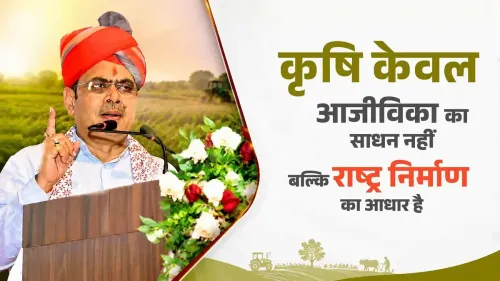
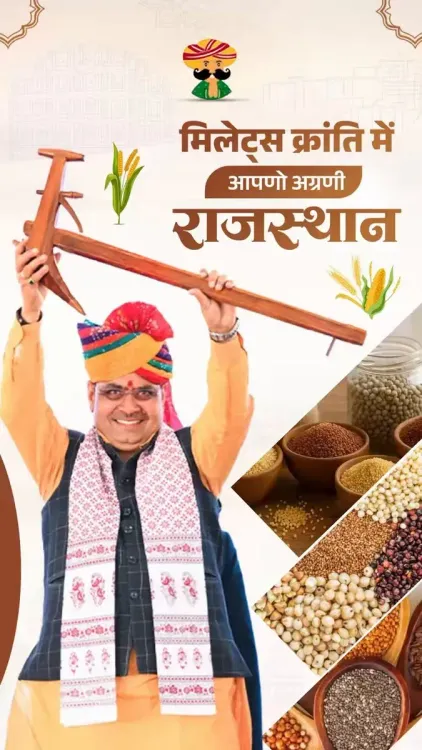
Rajasthan Chief Minister Bhajan Lal Sharma on Monday, 20 July 2026 reaffirmed the state government's commitment to farmer welfare and agricultural modernisation, crediting Prime Minister Narendra Modi's vision for driving what he called a new chapter of growth in the farm sector. Sharma highlighted Rajasthan's leading position in the production of Shri Anna (millets) and said the state's double-engine government is integrating modern technology and scientific innovation into agriculture.
In his post, Sharma wrote — 'माननीय प्रधानमंत्री श्री नरेंद्र मोदी जी के दूरदर्शी नेतृत्व में राजस्थान की डबल इंजन सरकार अन्नदाताओं की समृद्धि के लिए निरंतर कार्यरत है' — meaning: 'Under the visionary leadership of honourable Prime Minister Narendra Modi, Rajasthan's double-engine government is continuously working for the prosperity of farmers.' He added that the state, already a frontrunner in Shri Anna production, is now writing a new story of development through modern technology and scientific innovations in agriculture.
Context
The post arrives as millet promotion remains a central plank of agricultural policy in India. Rajasthan, with its vast arid and semi-arid tracts, is among the country's most significant millet-growing states, particularly for crops such as bajra and jowar that thrive in low-rainfall conditions. Chief Minister Sharma has consistently used the 'double-engine government' framing to signal alignment between state-level execution and central government priorities.
The term Shri Anna — literally 'honourable grain' — was coined by the central government to rebrand millets and elevate their cultural and nutritional status. The branding underpinned India's push during the UN International Year of Millets in 2023, when New Delhi positioned nutri-cereals as climate-resilient alternatives to water-intensive staples.
Policy Backdrop
The promotion of millets sits at the intersection of three national priorities: farmer income enhancement, nutritional security, and climate adaptation. Semi-arid states like Rajasthan have been encouraged to shift acreage toward dryland crops that require less irrigation, reducing dependence on groundwater. Scientific interventions — including improved seed varieties, soil health management, and post-harvest value addition — have been flagged as key levers to raise both yield and farmer returns.
The BJP governments at the Centre and in Rajasthan have framed millet promotion as a coordinated effort, with central schemes providing the policy architecture and state machinery handling ground-level implementation. Sharma's reference to 'modern technology and scientific innovations' signals an intent to deepen this approach beyond awareness campaigns into production-side upgrades.
Stakeholders and Impact
The primary beneficiaries of a robust millet push are dryland and smallholder farmers across Rajasthan's arid districts, who have historically grown millets as subsistence crops with limited market linkage. Elevating Shri Anna to a commercially viable commodity — through better procurement, processing infrastructure, and export potential — could meaningfully improve incomes for this segment.
Consumers stand to gain as well: millets carry a high nutritional profile and are increasingly sought after in urban health-food markets. Stronger state-level support for millet value chains could bridge the gap between rural producers and urban demand, creating a more integrated market.
What's Next
Observers will watch for concrete state-level announcements translating Sharma's messaging into policy action — including potential technology missions focused on millet cultivation, revisions to minimum support price frameworks, or expanded procurement targets ahead of the upcoming agricultural season. The emphasis on scientific innovation also raises the prospect of partnerships with agricultural universities and research institutions based in Rajasthan. How the state converts this political commitment into measurable outcomes for farmers will be the true test of the double-engine coordination Sharma has repeatedly invoked.
Point of View
Tying state-level agricultural performance directly to the Prime Minister's brand. By invoking Shri Anna — a centrally coined term — he signals ideological alignment while claiming credit for on-ground execution in Rajasthan. The emphasis on 'modern technology and scientific innovations' is notable: it shifts the messaging from subsistence-level millet growing toward a more commercially ambitious framing, which could presage policy announcements. Broader context suggests this is part of a sustained BJP effort to recast semi-arid farming states as leaders in climate-smart agriculture ahead of electoral cycles.
NationPress
21 Jul 2026
Frequently Asked Questions
What is Shri Anna and why is Rajasthan significant for it?
Shri Anna is the Indian government's branding for millets, aimed at boosting their cultivation and consumption. Rajasthan is one of India's top millet-producing states due to its large arid and semi-arid tracts where crops like bajra grow well with minimal water.
What did Rajasthan CM Bhajan Lal Sharma say about farmers on 20 July 2026?
CM Bhajan Lal Sharma said that under PM Narendra Modi's visionary leadership, Rajasthan's double-engine government is continuously working for farmer prosperity and is writing a new story of agricultural development through modern technology and scientific innovation.
What is the double-engine government concept in Rajasthan?
The double-engine government refers to the BJP's framing of having the same party in power at both the Centre and the state, which it argues enables faster and more coordinated implementation of schemes — including agricultural and farmer welfare programmes.
How does millet promotion help Rajasthan farmers?
Millet promotion helps Rajasthan farmers by improving market linkages for crops they already grow in dryland conditions, potentially raising incomes through better procurement prices, value addition, and access to urban health-food demand for nutritious millets.
What was the International Year of Millets?
The United Nations observed 2023 as the International Year of Millets, with India playing a leading role. The initiative positioned millets as climate-resilient, nutritious crops and helped elevate global and domestic demand for these grains.