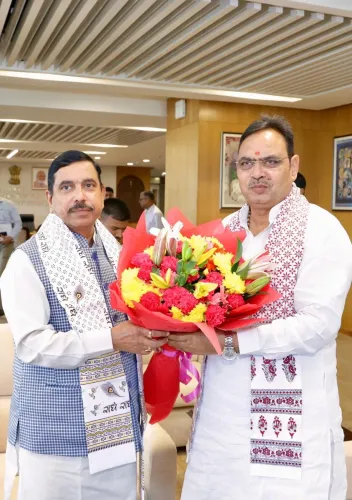
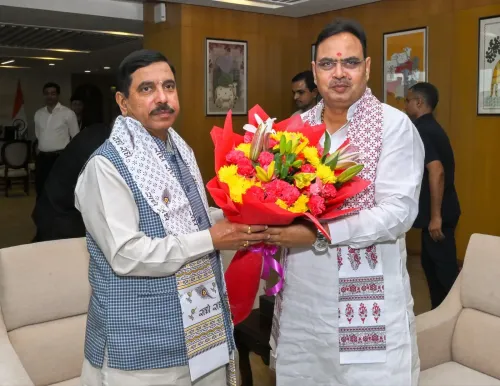
CM Bhajan Lal meets Union Minister Pralhad Joshi on Rajasthan energy, education
Synopsis
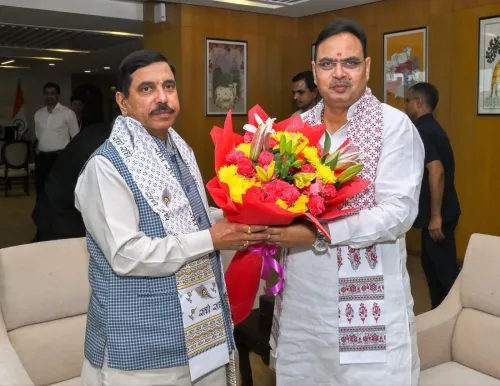
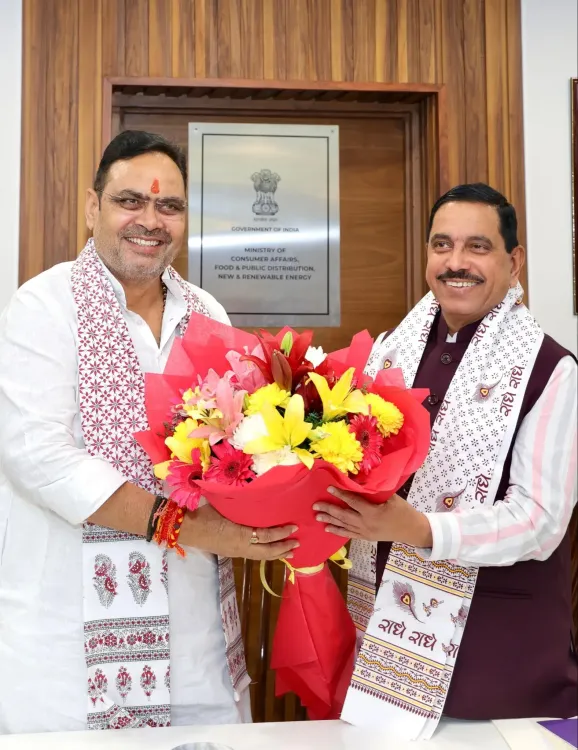
Rajasthan CM Bhajan Lal Sharma met Union Minister Pralhad Joshi in New Delhi on October 15 for talks on expanding renewable energy capacity, meeting the state's power needs, and strengthening education — seeking faster central support under the BJP's 'double engine government' framework.
Key Takeaways
Rajasthan CM Bhajan Lal Sharma met Union Minister Pralhad Joshi in New Delhi on October 15, 2026 .
Discussions covered renewable energy expansion , meeting Rajasthan's power demand, and reinforcing the state's education system .
Pralhad Joshi holds the dual portfolios of New and Renewable Energy and Education — both directly relevant to the CM's agenda.
Rajasthan is a high-priority state under the National Solar Mission (2010) due to its exceptional solar potential.
The meeting aligns with state-level implementation of the National Education Policy 2020 and the push for central funding support.
Sharma framed the initiative within PM Modi's 'double engine government' model of coordinated centre-state governance.
Rajasthan Chief Minister Bhajan Lal Sharma carried a two-point agenda to New Delhi on Thursday, October 15 — more renewable energy and stronger schools — meeting Union Minister Pralhad Joshi to push for accelerated central support on both fronts. The sit-down signals Jaipur's intent to move faster on the state's energy transition and education overhaul before the next budget cycle.
What the CM took to Delhi's table
Sharma described the talks as 'productive discussions' on expanding new and renewable energy capacity in Rajasthan, meeting the state's rising power demand, and reinforcing the education system. In his own words: 'सकारात्मक चर्चा हुई' — a positive discussion took place — on how central government support can accelerate development and create better opportunities for the state's youth.
Joshi holds an unusually broad brief: the Union Ministry of Education and the Ministry of New and Renewable Energy — precisely the two domains Sharma came to address. That overlap made this a single meeting covering ground that would ordinarily require two separate ministerial calls.
Rajasthan's renewable energy ambition and the solar window
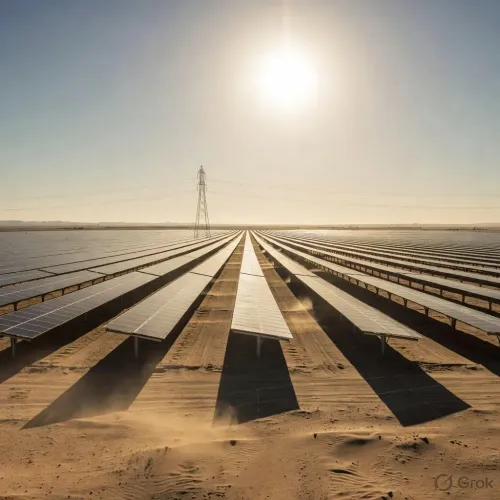
The timing is deliberate. Rajasthan sits on one of the world's largest solar irradiation belts, and the state has consistently been a priority geography under the National Solar Mission, launched in 2010 to scale up clean energy capacity across states. Yet translating that geographic advantage into commissioned capacity — and into reliable power for households and industry — requires sustained central funding, grid investment, and project clearances that only New Delhi can unlock.
Rising electricity demand across the state has added urgency. The CM's push for faster renewable deployment is simultaneously a climate move and a practical energy-security one: more solar and wind capacity means less dependence on expensive imported fossil fuels.
Education reform: aligning Rajasthan with NEP 2020
On the school and higher education side, the meeting fits into the national rollout of the National Education Policy 2020, which redesigned curriculum, assessment, and institutional frameworks but left implementation — and a significant share of financing — to state governments. Rajasthan, with a vast rural student population and persistent infrastructure gaps, has sought central resources to build that implementation machinery.
Sharma's pitch to Joshi on 'strengthening the education system' and creating 'better opportunities for youth' maps directly onto that funding and technical-support gap.
The 'double engine' logic at work
Sharma closed his post by invoking Prime Minister Narendra Modi's 'double engine government' framing — the BJP's recurring argument that states with a BJP government enjoy faster, friction-free access to central schemes because both engines (state and centre) are pulling in the same direction. The political pitch doubles as a governance claim: joint implementation, shared priorities, quicker disbursements.
The concrete test of that claim will come in follow-through — new renewable park approvals, fresh allocations for school infrastructure, or specific project clearances flowing from today's conversation. Those details will emerge in budget documents and cabinet approvals in the weeks ahead.
Rajasthan has the sun, the policy framework, and now a fresh ministerial conversation. Whether that conversation converts into commissioned megawatts and new classrooms is the only scoreboard that matters.
Point of View
But converting ministerial conversations into commissioned capacity has historically been where the gap appears. On education, the state faces the classic NEP 2020 implementation challenge: ambitious national policy, uneven state-level execution capacity, and a funding model that demands proactive central engagement. Sharma's willingness to personally carry both files to Delhi in a single visit suggests Jaipur is under some internal pressure to show tangible deliverables on development before the next electoral cycle.
NationPress
15 Oct 2026
Frequently Asked Questions
Why did Rajasthan CM Bhajan Lal Sharma meet Pralhad Joshi in Delhi?
CM Sharma met Union Minister Pralhad Joshi on October 15, 2026, to seek central government support for expanding renewable energy capacity in Rajasthan, addressing the state's power requirements, and strengthening the education system.
What portfolios does Union Minister Pralhad Joshi hold?
Pralhad Joshi is the Union Minister for Education, Consumer Affairs, Food and Public Distribution, and New and Renewable Energy — covering both sectors Sharma discussed during the meeting.
What is the 'double engine government' Bhajan Lal Sharma referred to?
The 'double engine government' is a BJP political and governance framework arguing that states led by the BJP get faster and more effective implementation of central schemes because both the state and central governments share the same political direction and priorities.
What is Rajasthan's potential in renewable energy?
Rajasthan is one of India's most solar-rich states and has been a priority under the National Solar Mission since 2010. Its vast arid terrain and high solar irradiation make it a natural hub for large-scale solar and wind energy projects.
How does the National Education Policy 2020 affect Rajasthan?
NEP 2020 overhauled India's school and higher education framework, but implementation depends heavily on state governments. Rajasthan has sought central funding and technical support to build the infrastructure and institutional capacity needed to roll out the policy's reforms.