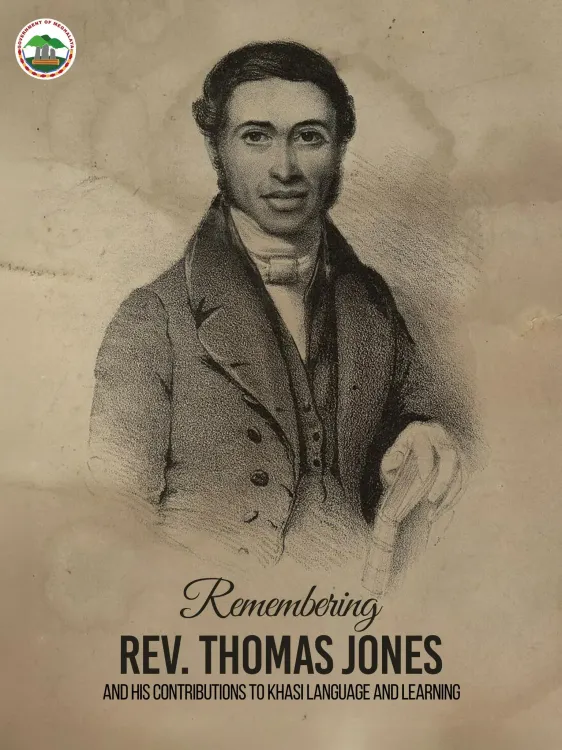
CM Conrad Sangma Pays Tribute on Thomas Jones Day
Synopsis
Meghalaya Chief Minister Conrad Sangma marked Thomas Jones Day on 22 June 2026, paying tribute to Rev. Thomas Jones, the Welsh missionary who devised the Khasi alphabet in 1841, enabling Khasi literature, education and language preservation across the Khasi Hills.
Key Takeaways
Thomas Jones Day is observed annually in Meghalaya to mark the arrival of Rev.
Thomas Jones to the Khasi Hills .
Thomas Jones devised the Khasi alphabet using Roman script after arriving in 1841 , enabling the first printed Khasi texts.
Chief Minister Conrad Sangma credited Jones with giving life to Khasi literature, education and language preservation .
The observance reflects Meghalaya's broader policy of promoting mother-tongue education rooted in 19th-century missionary literacy work.
Northeast India states regularly commemorate missionaries who created scripts and schools, anchoring tribal cultural identity in public life.
Meghalaya Chief Minister Conrad Sangma, who also serves as national president of the National People's Party, on Monday, 22 June 2026, paid tribute to Rev. Thomas Jones on Thomas Jones Day, honouring the Welsh missionary credited with creating the Khasi alphabet and transforming the linguistic landscape of the Khasi Hills.
Context
Thomas Jones Day is an annual observance in Meghalaya that marks the arrival of Rev. Thomas Jones to the Khasi Hills in 1841. The day serves as a formal occasion for the state's leadership and the Khasi community to acknowledge the missionary's foundational role in creating a written form of the Khasi language using the Roman script.
Chief Minister Sangma stated that Jones's contributions 'gave life not only to the language but to literature, education and preservation of the Khasi language,' reflecting the broad cultural weight the observance carries across Meghalaya.
Policy Backdrop
Before Rev. Thomas Jones devised the Khasi alphabet in 1841, the language had no standardised written form. His Roman-script adaptation enabled the first printed Khasi texts, including Bible translations, and laid the groundwork for Khasi-medium schooling and a print culture that subsequent state education policies in Meghalaya built upon.
The Meghalaya government's education framework continues to promote mother-tongue instruction alongside English, a policy lineage that traces directly to the literacy infrastructure Jones helped establish nearly two centuries ago. India's Constitution recognises linguistic diversity, and state-level programmes across the Northeast have formalised such commemorations as anchors for language-preservation efforts.
Stakeholders and Impact
The primary stakeholders of Thomas Jones Day are the Khasi community and language educators across Meghalaya. For them, the observance is not merely ceremonial — it reinforces the legitimacy of Khasi as a language of formal education, governance and cultural expression.
The broader pattern across Northeast India is notable: tribal-majority states regularly commemorate 19th-century missionaries who created scripts and schools, producing the first generation of literate tribal elites. These observances illustrate the continuing public role of cultural heritage in the region's politics and identity.
What's Next
Attention will now turn to whether the Meghalaya government uses this occasion to announce concrete steps on integrating Khasi into digital governance platforms or expanding its footprint in school curricula. Any policy announcement tied to future Thomas Jones Day observances would signal the state's intent to move beyond commemoration toward active language planning.
As Meghalaya navigates questions of cultural preservation alongside development, the annual tribute to Rev. Thomas Jones remains a marker of how deeply 19th-century missionary work continues to shape the state's educational and linguistic identity in the 21st century.
Point of View
Sangma connects the NPP-led government to a deep civilisational narrative that resonates far beyond ceremonial politics. The tribute also signals the state's intent to keep language-preservation at the centre of its cultural agenda, even as pressures of digital governance and English-medium education mount. For a Chief Minister who also leads a national party, such gestures reinforce regional credibility while projecting sensitivity to Northeast India's distinct linguistic identities.
NationPress
22 Jun 2026
Frequently Asked Questions
Who is Rev. Thomas Jones and why is he important to Meghalaya?
Rev. Thomas Jones was a Welsh Presbyterian missionary who arrived in the Khasi Hills in 1841 and devised the first Khasi alphabet using Roman script, enabling printed Khasi texts, Bible translations and the foundation of Khasi-medium education.
What is Thomas Jones Day and when is it observed?
Thomas Jones Day is an annual observance in Meghalaya that commemorates the arrival of Rev. Thomas Jones to the Khasi Hills and his foundational contribution to the Khasi language and literacy.
What did Conrad Sangma say about Thomas Jones Day 2026?
Chief Minister Conrad Sangma stated that Rev. Thomas Jones's contributions to the Khasi alphabet 'gave life not only to the language but to literature, education and preservation of the Khasi language.'
How did the Khasi alphabet come into existence?
The Khasi alphabet was devised by Rev. Thomas Jones in 1841 using Roman script, giving the Khasi language its first standardised written form and enabling print culture and formal schooling in the Khasi Hills.
What is the significance of language preservation in Meghalaya?
Meghalaya's education framework promotes mother-tongue instruction rooted in the literacy infrastructure established by 19th-century missionaries, and the state's observances reflect India's constitutional recognition of linguistic diversity in tribal-majority regions.