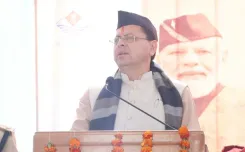
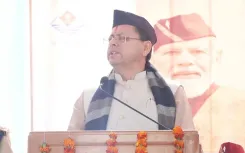
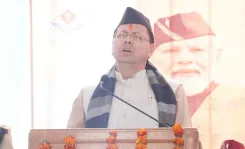
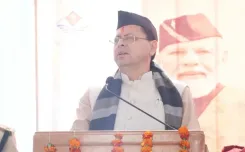
CM Dhami Announces Digital Libraries, Grid Links, Farm Relief
Synopsis
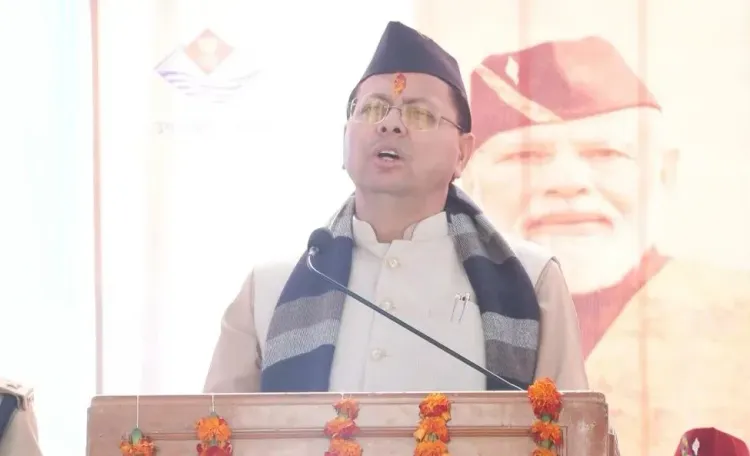
Chief Minister Pushkar Dhami has announced four governance measures for Uttarakhand: digital libraries at every district HQ and municipal area, power grid extension to off-grid revenue villages, simplified land purchase for out-migrants, and electricity surcharge waivers for small farmers.
Key Takeaways
Digital libraries and reading rooms will be set up at every district headquarters and municipal area across Uttarakhand's 13 districts .
Revenue villages currently dependent on off-grid power sources will be connected to the main power grid .
The land purchase process will be simplified for non-resident Uttarakhandis (migrants) looking to buy property in the state.
Electricity surcharges on power bills of small farmers will be waived, easing agricultural costs.
The announcements were made by Chief Minister Pushkar Singh Dhami and shared via the official CMO account on 9 November 2026 .
Four policy commitments — digital libraries at every district headquarters, power grid connections for off-grid revenue villages, easier land purchase for Uttarakhand's diaspora, and electricity surcharge waivers for small farmers — landed in a single announcement from Chief Minister Pushkar Singh Dhami's office on Monday, 9 November 2026, signalling a broad welfare push targeting the state's most underserved constituencies.
Quoting Chief Minister Pushkar Dhami directly, the official CMO account posted: 'Digital libraries and reading rooms will be established in every district headquarters and municipal area of the state. Revenue villages that still receive electricity through alternative means will be connected to the power grid. The land purchase process will be made easier for migrant brothers and sisters. The surcharge levied on electricity payments of small farmers will be waived.'
A reading room in every district — and a grid for every village
Uttarakhand spans some of India's most rugged Himalayan terrain, where public infrastructure has historically lagged far behind the plains. The digital library pledge targets every district headquarters and nagar palika (municipal) area — a move that would, in one stroke, plant a digitally-enabled public learning space across all 13 districts of the state.
Alongside that sits a grid-connectivity drive for revenue villages still dependent on micro-hydro units, solar micro-grids, or diesel generators — the 'alternative means' the announcement references. Connecting these villages to the main power grid would bring round-the-clock supply reliability that off-grid sources rarely guarantee in the mountains.
Land rights for the diaspora, surcharge relief for small farmers
Uttarakhand's story is inseparable from out-migration. Tens of thousands of families have left hill districts for cities across India, yet many retain emotional and economic ties to their ancestral villages. Successive state governments have grappled with how to channel diaspora investment back home; easing the land purchase process is a direct answer to that pressure, removing procedural friction that has long discouraged non-resident Uttarakhandis from buying property.
For those who stayed, the electricity surcharge waiver for small farmers addresses a pinch point that cuts directly into slim agricultural margins. Surcharges on power bills — added for delayed payment or under regulatory mechanisms — have been a recurring grievance among cultivators in the state's hill and Terai belts.
Four promises, one pattern
Taken together, the four announcements follow a logic that Dhami's administration has pursued since 2021: knit remote Uttarakhand tighter into national infrastructure networks while simultaneously making the state more hospitable to both its resident population and its large out-migrant community. What remains to be tested is the pace of execution — budget allocations, tendering timelines, and any legislative amendments to land laws will determine whether these commitments translate into ground-level change.
Four commitments, one morning, one message: Uttarakhand's hills are no longer an afterthought on the policy map.
Point of View
Digital libraries) to signal modernity while deploying targeted financial relief (surcharge waivers) and diaspora-friendly policy to retain political goodwill across a fragmented electorate. For Dhami, who has anchored his tenure on development optics, bundling these commitments together amplifies headline impact even before a single rupee is allocated. The harder test will come at the budget and tender stage — Uttarakhand's fiscal headroom is constrained and remote terrain makes grid extensions and civil construction expensive. If timelines slip, the same announcements that build momentum today could become accountability liabilities tomorrow.
NationPress
9 Nov 2026
Frequently Asked Questions
Where will digital libraries be set up in Uttarakhand?
Digital libraries and reading rooms will be established at every district headquarters and in all municipal (nagar palika) areas across Uttarakhand, covering all 13 districts of the state.
What is the electricity surcharge waiver for Uttarakhand farmers?
Chief Minister Pushkar Dhami has announced that the surcharge levied on electricity bill payments of small farmers in Uttarakhand will be waived, reducing their power costs.
How will Uttarakhand make land purchase easier for migrants?
The state government has committed to simplifying the land purchase process for non-resident Uttarakhandis (migrants living outside the state), though specific procedural changes are yet to be detailed.
Which Uttarakhand villages will get power grid connections?
Revenue villages that currently receive electricity through alternative means — such as micro-hydro units or solar micro-grids — will be connected to the main power grid under the new announcement.
Who announced the new welfare schemes for Uttarakhand?
Chief Minister Pushkar Singh Dhami made the announcements, which were shared by the official Chief Minister's Office account on 9 November 2026.