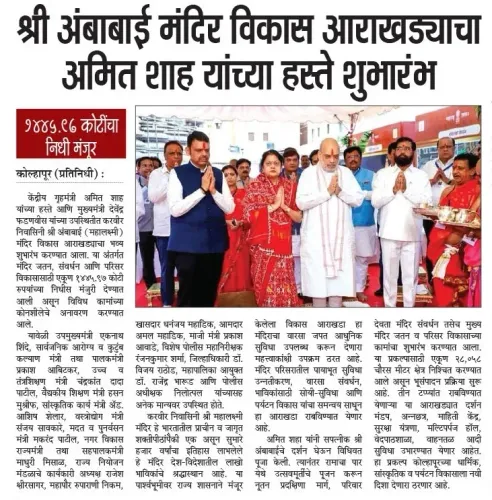
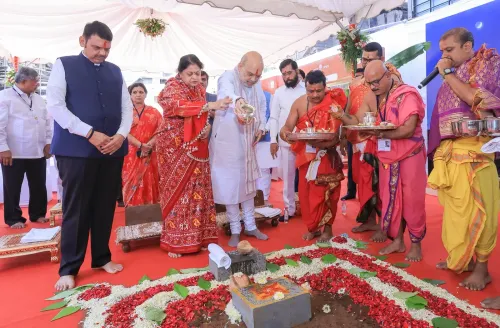
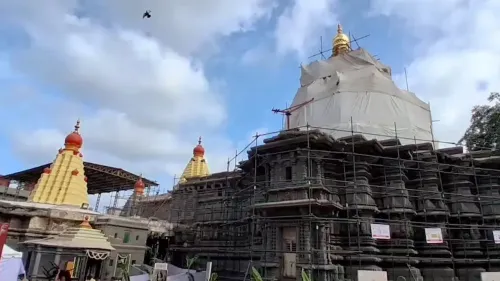
CM Fadnavis Announces ₹1,445.97 Cr Ambabai Temple Revamp
Synopsis
The Chief Minister's Office of Maharashtra announced a ₹1,445.97 crore redevelopment of the Ambabai (Mahalakshmi) Temple in Kolhapur — one of India's 18 Shakti Peethas — signalling a major state push for pilgrimage tourism infrastructure under CM Devendra Fadnavis.
Key Takeaways
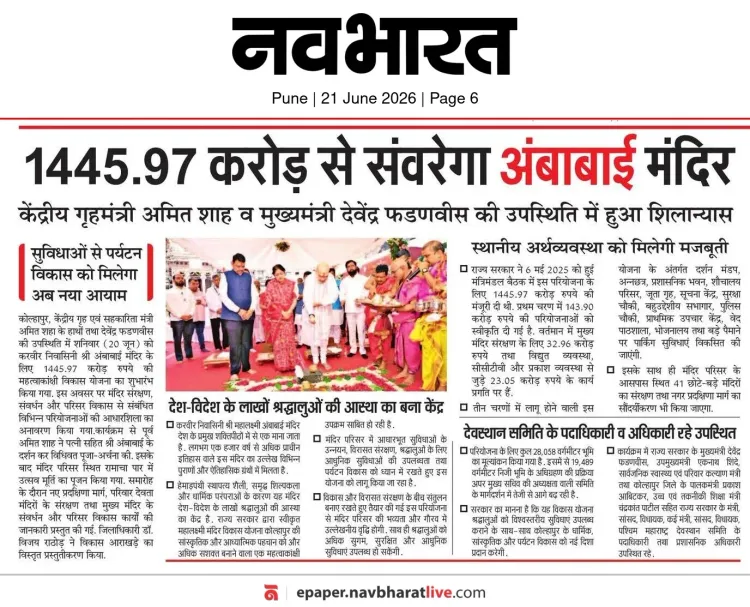
The CMO Maharashtra announced ₹1,445.97 crore for the redevelopment of the Shri Mahalakshmi (Ambabai) Temple in Kolhapur on 21 June 2026 .
The Ambabai Temple is one of India's 18 Shakti Peethas and one of Maharashtra's most visited pilgrimage sites.
Union Home Minister Amit Shah was tagged in the announcement, indicating possible central-state coordination.
The project follows a broader BJP-ruled-state pattern of large-scale temple corridor investments seen in Uttar Pradesh and Madhya Pradesh.
Key next steps include tender issuance, project committee formation, and phased fund release by state departments.
Local traders and pilgrims in Kolhapur are the primary expected beneficiaries of improved infrastructure.
The Chief Minister's Office of Maharashtra announced on Sunday, 21 June 2026 that the iconic Shri Mahalakshmi (Ambabai) Temple in Kolhapur will be redeveloped at a cost of ₹1,445.97 crore, marking one of the largest single-site religious heritage investments in the state's recent history.
Context
The post, shared by the CMO Maharashtra handle and tagging Union Home Minister Amit Shah and Chief Minister Devendra Fadnavis, announced the redevelopment in Hindi: '₹1445.97 करोड़ से संवरेगा करवीर निवासिनी श्री महालक्ष्मी (अंबाबाई) मंदिर' — meaning 'The Karvirvasini Shri Mahalakshmi (Ambabai) Temple will be beautified with ₹1,445.97 crore.' The hashtags #Kolhapur and #DevendraFadnavis accompanied the announcement, signalling the state government's intent to publicly associate the project with the Chief Minister's development agenda.
The Ambabai Temple in Kolhapur is one of India's 18 Shakti Peethas — among the most sacred sites in the Hindu tradition — and draws millions of pilgrims annually from across Maharashtra and beyond.
Policy Backdrop
Maharashtra governments have periodically announced redevelopment packages for major religious sites since the early 2010s, combining heritage conservation with pilgrimage tourism infrastructure. The scale of the ₹1,445.97 crore allocation, however, places this project in a category of its own for a single temple site in the state.
Across BJP-ruled states, public investment in temple corridors — covering access roads, pilgrim amenities, lighting, and structural conservation — has become a recurring policy pattern. Projects such as the Kashi Vishwanath Corridor in Uttar Pradesh and the Mahakal Lok in Madhya Pradesh have set a benchmark that Maharashtra appears to be referencing with this announcement. The tagging of Amit Shah suggests potential central-state coordination in funding or approvals.
Stakeholders and Impact
The most immediate beneficiaries of the redevelopment will be the lakhs of pilgrims who visit the Ambabai Temple each year, particularly during peak festivals such as Navratri and Lalita Panchami. Improved infrastructure — wider access paths, better sanitation, crowd-management systems, and conservation of the temple's centuries-old architecture — is typically the focus of such projects.
Local traders, hospitality providers, and transport operators in Kolhapur stand to benefit significantly from increased pilgrimage footfall that upgraded amenities are expected to attract. The city, already known for its Maratha heritage and the Kolhapuri chappal craft, could see a measurable boost in religious tourism revenue.
What's Next
The announcement marks the beginning of the administrative process. Issuance of tenders, formation of project committees, and phased release of funds — likely through the Maharashtra Public Works Department or the state tourism board — will be the key milestones to watch in the coming months.
If the project follows the timeline of comparable temple corridor developments elsewhere in India, groundbreaking activities and visible construction could begin within six to twelve months of formal tender awards. The scale of investment signals that the Fadnavis government intends to make the Ambabai Temple a flagship pilgrimage destination of national significance, with implications for Kolhapur's long-term urban and tourism planning.
Point of View
445.97 crore announcement for the Ambabai Temple is not merely a heritage project — it fits squarely into a deliberate political economy of temple corridor development that BJP-led governments have pursued as both governance and cultural messaging. By tagging Amit Shah, the Fadnavis government signals an intent to frame this as a central-state partnership, lending the project national visibility ahead of future electoral cycles. Kolhapur's deep Maratha identity makes the choice of site strategically resonant, allowing the government to simultaneously appeal to religious sentiment and regional pride. Whether the announcement translates into ground-level execution at the speed implied will be the real test of its policy substance.
NationPress
21 Jun 2026
Frequently Asked Questions
What is the Ambabai Temple in Kolhapur?
The Ambabai Temple, formally known as the Shri Mahalakshmi (Ambabai) Temple, is located in Kolhapur, Maharashtra. It is one of India's 18 Shakti Peethas and one of the most revered Hindu pilgrimage sites in the country, dedicated to Goddess Mahalakshmi.
How much money has Maharashtra announced for the Ambabai Temple redevelopment?
The Maharashtra government announced ₹1,445.97 crore for the redevelopment and beautification of the Ambabai (Mahalakshmi) Temple in Kolhapur, as stated by the Chief Minister's Office on 21 June 2026.
Why was Amit Shah tagged in the Ambabai Temple announcement?
Union Home Minister Amit Shah was tagged by the CMO Maharashtra in the announcement, suggesting potential central-state coordination in the project's funding or approvals, though the exact nature of central government involvement has not been formally detailed.
What will the Kolhapur Ambabai Temple redevelopment include?
The exact project scope has not been officially detailed yet. Based on comparable temple corridor projects in India, redevelopment typically covers pilgrim amenities, access infrastructure, crowd management, lighting, and structural conservation of the heritage site.
When will the Ambabai Temple redevelopment in Kolhapur begin?
No formal start date has been announced. The next steps involve issuance of tenders and formation of project committees by the Maharashtra Public Works Department or the state tourism board, which will determine when ground-level work commences.