CM Himanta: 22 Lakh Assam Families Benefit from PMAY-G
Synopsis
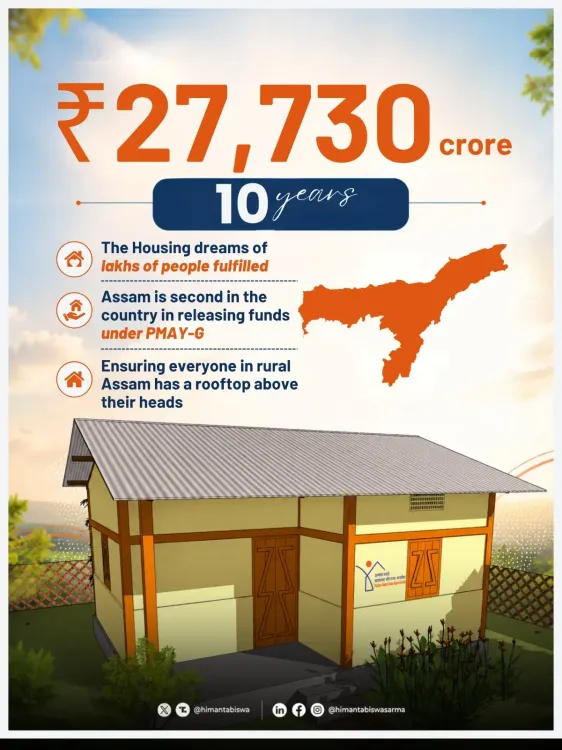
Assam Chief Minister Himanta Biswa Sarma announced on 4 July 2026 that 22 lakh families in the state have benefited under the PMAY-G rural housing scheme, crediting Prime Minister Modi's vision and tagging the Ministry of Rural Development as Assam advances its 'Housing for All' goal.
Key Takeaways
22 lakh families in Assam have reportedly benefited under the Pradhan Mantri Awas Yojana-Gramin (PMAY-G) scheme.
CM Himanta Biswa Sarma made the announcement on 4 July 2026 , tagging the Ministry of Rural Development .
PMAY-G was launched in 2016 as the rural component of the Housing for All mission, replacing the Indira Awas Yojana.
The scheme provides financial assistance for construction of pucca houses with basic amenities to eligible rural households.
Assam's progress is cited as part of a broader pattern of convergence between NEDA-coordinated states and centrally sponsored welfare schemes.
The next periodic review by the Ministry of Rural Development will assess physical and financial targets across all states including Assam.
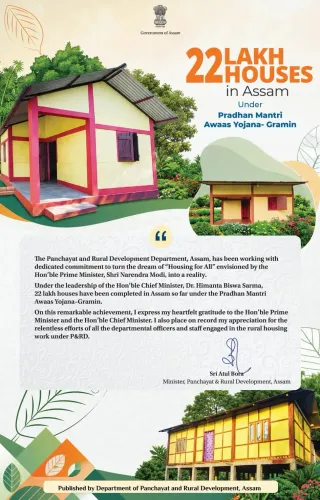
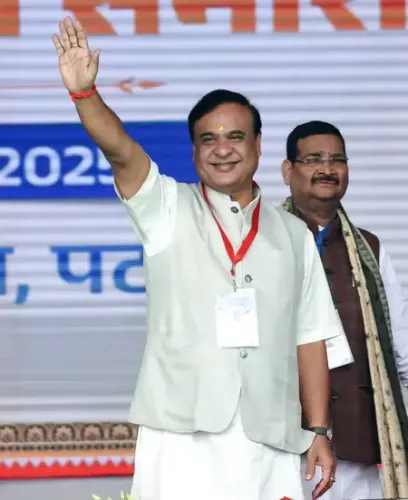
Assam Chief Minister Himanta Biswa Sarma on Saturday, 4 July 2026, highlighted the state's progress under the Pradhan Mantri Awas Yojana-Gramin (PMAY-G), stating that 22 lakh families in Assam have benefited from the centrally sponsored rural housing scheme. The Chief Minister credited Prime Minister Narendra Modi's vision for the milestone, framing the achievement as part of Assam's broader push toward 'Housing for All'.
Context
In his post, CM Sarma wrote: 'Assam's journey towards Housing for All is setting new benchmarks. 22 lakh families have benefited from Hon'ble Prime Minister Shri Narendra Modi Ji's vision. We continue to benefit immensely from the outstanding PMAY-G scheme.' The post was directed at the Ministry of Rural Development (@MoRD_GoI), the Union ministry responsible for the scheme's nationwide rollout and funding.
The statement underscores the BJP-led state government's alignment with centrally sponsored welfare programmes, a recurring theme in the administration's public communications. Assam's invocation of the 'Housing for All' goal reflects the national target that has anchored rural housing policy for over a decade.
Policy Backdrop
PMAY-G was launched in 2016 as the revamped rural component of the Housing for All mission, replacing the earlier Indira Awas Yojana. The scheme provides financial assistance to eligible rural households for the construction of pucca houses with basic amenities. Prime Minister Narendra Modi had anchored the broader Housing for All mission at its inception in 2015, setting a long-term target for universal rural housing coverage.
Under PMAY-G, the central and state governments share the cost of house construction, with the Ministry of Rural Development tracking physical and financial progress through a dedicated management information system. Cumulative beneficiary counts are a standard performance metric used by both state and union governments to assess scheme saturation.
Stakeholders and Impact
The primary beneficiaries are rural households in Assam who were previously without pucca housing. With 22 lakh families reported as beneficiaries, the scale of coverage represents a significant share of the state's rural population, though the precise remaining target and saturation level have not been independently confirmed. For the state government, the figure serves as a marker of administrative delivery under a flagship central scheme.
The post's tagging of @MoRD_GoI signals an institutional acknowledgement of the Union ministry's role and may be intended to highlight Assam's implementation record ahead of the next periodic review of PMAY-G targets. Chief Minister Sarma, who also serves as convenor of the North-East Democratic Alliance (NEDA), has consistently positioned Assam as a model for convergence between central schemes and northeastern state governments.
What's Next
The Ministry of Rural Development conducts periodic reviews of PMAY-G physical and financial targets across all states, and Assam's reported figures are likely to feature in the next such assessment. Any supplementary housing assistance announced in the state budget or additional central allocations would determine how quickly the remaining gap — if any — is closed.
Broader progress on 'Housing for All' in the Northeast will remain a closely watched indicator of how NEDA-coordinated states leverage central welfare architecture. For CM Sarma, sustaining this momentum is also a political priority as Assam heads into the next electoral cycle.
Point of View
A pattern that has become standard practice in BJP-governed states seeking to demonstrate alignment with New Delhi's flagship schemes. By tagging the Ministry of Rural Development alongside a specific beneficiary figure, the communication simultaneously claims implementation credit and signals performance readiness ahead of the next federal review cycle. The 22-lakh figure, while unverified by independent sources, anchors a political narrative around welfare delivery in a state that has historically struggled with housing deficits in its rural and flood-affected districts. For Sarma, who positions Assam as the Northeast's administrative leader through NEDA, such milestones serve a dual purpose: reinforcing the state's record at the national level and building a welfare-delivery argument for the next assembly election.
NationPress
4 Jul 2026
Frequently Asked Questions
What is PMAY-G and how does it work in Assam?
PMAY-G, or Pradhan Mantri Awas Yojana-Gramin, is a central government scheme launched in 2016 that provides financial assistance to eligible rural households for constructing pucca houses. In Assam, the scheme is implemented jointly by the state government and the Union Ministry of Rural Development, with costs shared between the two.
How many families have benefited from PMAY-G in Assam?
According to Assam Chief Minister Himanta Biswa Sarma's post on 4 July 2026, 22 lakh families in the state have benefited from the PMAY-G scheme. This is a state government figure and has not been independently verified.
What is the 'Housing for All' mission in India?
'Housing for All' is a national mission launched by the central government in 2015 under Prime Minister Narendra Modi, aimed at ensuring every eligible household in India has access to a pucca house. PMAY-G is its rural component, while a separate urban component covers cities and towns.
What replaced the Indira Awas Yojana?
The Pradhan Mantri Awas Yojana-Gramin (PMAY-G) replaced the Indira Awas Yojana in 2016, bringing in revised eligibility criteria, enhanced financial assistance, and a more structured monitoring framework under the Ministry of Rural Development.
What is NEDA and what is Himanta Biswa Sarma's role in it?
The North-East Democratic Alliance (NEDA) is a BJP-led political alliance of parties governing states in India's northeastern region. Himanta Biswa Sarma, the Chief Minister of Assam, serves as its convenor and has used the platform to coordinate policy and political alignment across the region.