CM Himanta shares India's toy export rise under Make in India
Synopsis
Assam CM Himanta Biswa Sarma amplified India's toy sector turnaround story via the NaMo App, spotlighting how Make in India and quality control policies have shifted the country from toy importer to global exporter.
Key Takeaways
Assam CM Himanta Biswa Sarma shared an article on 10 July 2026 highlighting India's toy manufacturing transformation via the NaMo App .
India has moved from heavy dependence on Chinese toy imports to becoming a competitive global exporter under the Make in India initiative.
The Quality Control Order for toys , notified in 2020 , enforced BIS standards and curbed substandard imports, creating room for domestic producers.
The Atmanirbhar Bharat Abhiyan (announced May 2020 ) placed explicit focus on self-reliance in the toy sector and MSMEs.
Regional leaders amplifying these narratives signals coordinated state-centre communication on manufacturing policy outcomes.
Next milestones include annual trade data and potential extension of production-linked incentives for toys in upcoming budgets.
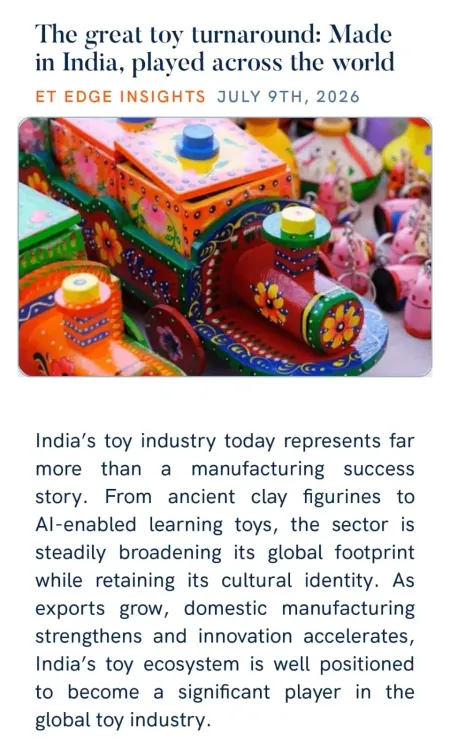
Assam Chief Minister Himanta Biswa Sarma on Friday, 10 July 2026, shared an article highlighting India's remarkable transformation in the toy manufacturing sector, amplifying the narrative of domestic production replacing imports and reaching global markets — a story he circulated via the NaMo App.
Context
The post, titled 'The great toy turnaround: Made in India, played across the world', underscores how India has shifted from being a net importer of toys — largely dependent on China — to an increasingly competitive exporter. CM Sarma's decision to amplify this story via the NaMo App, the official digital platform of Prime Minister Narendra Modi, signals coordinated messaging between state and central leadership on economic achievements.
The toy sector's revival is widely cited as one of the more visible successes of the Make in India campaign, which was launched in September 2014 to encourage domestic manufacturing and reduce import dependence across consumer goods, including toys.
Policy Backdrop
The turnaround in India's toy industry did not happen in isolation. A series of targeted policy interventions set the stage: the Atmanirbhar Bharat Abhiyan, announced in May 2020, placed explicit focus on self-reliance in toys and micro, small and medium enterprises. Around the same time, a Quality Control Order for toys was notified, enforcing Bureau of Indian Standards (BIS) norms and effectively curbing the inflow of substandard imports.
These measures collectively raised the bar for products entering the Indian market while simultaneously creating space for domestic manufacturers to grow, invest, and compete. The sector's story mirrors similar import-substitution successes seen in electronics, pharmaceuticals, and apparel.
Stakeholders and Impact
The primary beneficiaries of this policy push are Indian toy manufacturers — many of them small and medium enterprises clustered in states such as Karnataka, Rajasthan, and Uttar Pradesh — as well as Indian exporters who are now accessing markets that were once dominated by Chinese producers. For consumers globally, 'Made in India' toys are increasingly becoming a recognisable and trusted label.
Regional leaders like CM Sarma amplifying these economic narratives on national platforms reflects a broader pattern of coordinated communication, where state governments participate actively in projecting central policy outcomes as shared achievements.
What's Next
The next key indicators to watch will be annual trade statistics on toy exports and imports, as well as any extension of production-linked incentives or cluster development schemes for the toy sector in upcoming central budgets or NITI Aayog reports. If the growth trajectory holds, India's toy industry could serve as a template for other import-dependent sectors seeking to pivot toward export orientation under the Make in India framework.
Point of View
Ensuring that manufacturing success stories reach a curated, politically engaged base. The toy sector's turnaround — built on quality regulation and import substitution — is being positioned as proof of concept for the broader Make in India vision ahead of budget cycles where PLI extensions may be on the table. Regional leaders echoing these narratives lend the story a pan-India credibility that purely central messaging cannot achieve alone.
NationPress
10 Jul 2026
Frequently Asked Questions
Why is India's toy sector in the news in 2026?
India's toy sector has gained attention because domestic manufacturing has grown significantly under Make in India and Atmanirbhar Bharat policies, reducing dependence on Chinese imports and boosting exports to global markets.
What did Assam CM Himanta Biswa Sarma post about toys?
CM Himanta Biswa Sarma shared an article titled 'The great toy turnaround: Made in India, played across the world' via the NaMo App on 10 July 2026, highlighting India's shift from toy importer to global exporter.
How did India reduce toy imports from China?
India enforced a Quality Control Order in 2020 requiring toys to meet Bureau of Indian Standards (BIS) norms, which effectively restricted substandard Chinese imports and gave domestic manufacturers a competitive advantage.
What is the NaMo App and why was it used to share this article?
The NaMo App is the official mobile platform of Prime Minister Narendra Modi used to disseminate policy updates and success stories; sharing content through it signals alignment with the central government's Make in India messaging.
Which policies helped India's toy industry grow?
The Make in India initiative (launched 2014), the Atmanirbhar Bharat Abhiyan (2020), and the Quality Control Order for toys (2020) collectively boosted domestic production and positioned Indian manufacturers for export growth.