CM Majhi Links PM Surya Ghar Scheme to Housing Yojanas
Synopsis
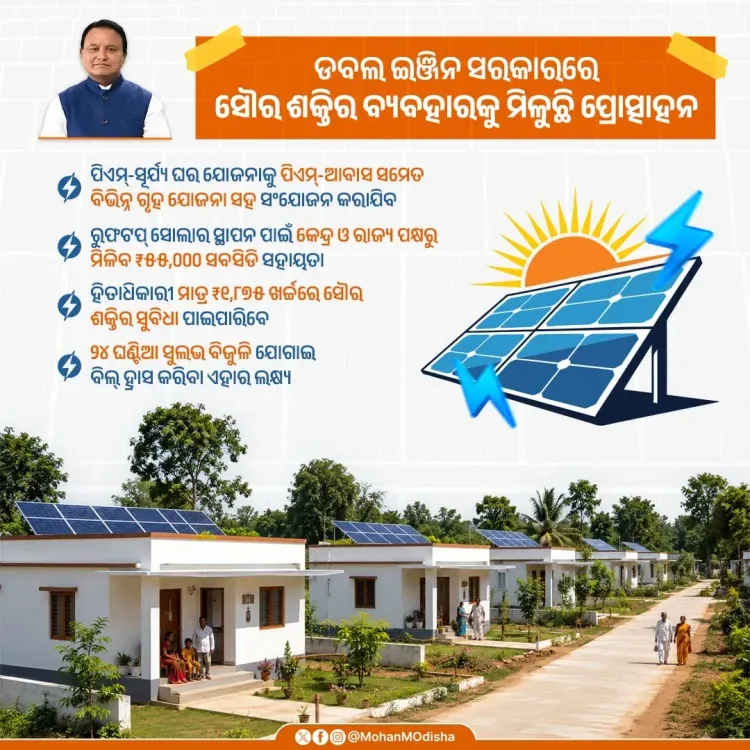
Odisha CM Mohan Charan Majhi has announced convergence of PM Surya Ghar Yojana with PM Awas Yojana and other housing schemes, enabling beneficiaries to get rooftop solar installations for as low as ₹1,875 after combined central and state subsidies of ₹55,000.
Key Takeaways
PM Surya Ghar Yojana will be formally integrated with PM Awas Yojana and other housing schemes in Odisha .
Combined central and state subsidy of ₹55,000 will be provided for rooftop solar installation.
Beneficiaries will need to pay only ₹1,875 out of pocket for a rooftop solar unit.
The scheme targets 24-hour affordable electricity supply and reduced monthly power bills.
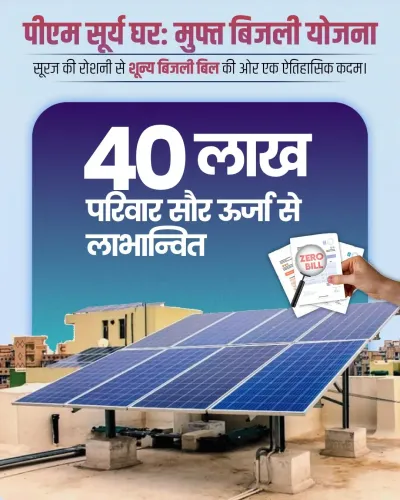
The move is part of the broader national goal to install rooftop solar in one crore households under PM Surya Ghar Muft Bijli Yojana.
Odisha follows a wider BJP-state pattern of converging housing and renewable energy programmes with central schemes.
Odisha Chief Minister Mohan Charan Majhi announced on Thursday, 9 July 2026 that the state government will integrate the PM Surya Ghar Yojana with PM Awas Yojana and other housing schemes, offering rooftop solar installations to beneficiaries at a combined central and state subsidy of ₹55,000, leaving households to pay as little as ₹1,875.
Context
Posting in Odia on 9 July 2026, Chief Minister Majhi described the move as 'ଡବଲ ଇଞ୍ଜିନ ସରକାରଙ୍କ ଆଉ ଏକ ଦୃଢ଼ ପଦକ୍ଷେପ' — 'yet another firm step by the double-engine government' — underscoring the alignment between the BJP-led state administration and the Union government. The stated goals are round-the-clock affordable electricity supply and a measurable reduction in monthly power bills for ordinary households.
The integration means that beneficiaries already enrolled under PM Awas Yojana or similar housing programmes will be able to receive rooftop solar panels without navigating a separate application process, collapsing two welfare pipelines into one.
Policy Backdrop
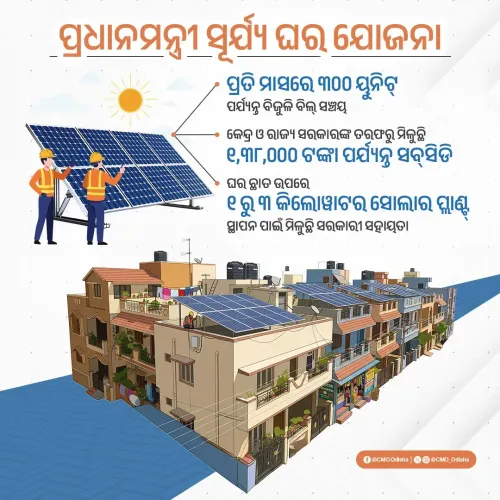
The PM Surya Ghar Muft Bijli Yojana was announced in the Union Budget 2024 with the ambition of installing rooftop solar systems in one crore households across India, providing up to 300 units of free electricity per month to each enrolled family. The scheme sits within India's broader target of reaching 500 GW of non-fossil fuel energy capacity by 2030, as revised under the National Solar Mission in 2023.
PM Awas Yojana, running since 2015 in both urban and rural variants, has long included provisions for convergence with renewable energy components, making the formal linkage announced by Majhi a logical extension of existing guidelines rather than a structural departure.
Stakeholders and Impact
The primary beneficiaries are Odisha households enrolled under housing assistance schemes — a population that often belongs to lower-income brackets with limited capacity to absorb upfront solar installation costs. By channelling a combined subsidy of ₹55,000 from the central and state governments, the scheme aims to bring the net cost down to ₹1,875 per household, making rooftop solar financially accessible at scale.
The pattern mirrors efforts in other BJP-ruled states since 2024, where state administrations have aligned local housing and energy programmes with central schemes to accelerate distributed renewable generation. For Odisha's electricity distribution network, a wider base of rooftop solar users could reduce peak-load pressure while cutting subsidy burdens on the power sector over time.
What's Next
State-level implementation guidelines detailing how beneficiary lists will be merged, installation timelines, and quarterly targets are expected to follow the announcement. The pace of on-ground rollout — including vendor empanelment and grid-connectivity approvals — will determine whether the scheme's affordability promise translates into measurable reductions in household electricity bills across Odisha.
The convergence model, if successful, could serve as a template for other states looking to simultaneously advance housing and renewable energy goals under existing central frameworks.
Point of View
875 net cost figure is politically potent: it converts a complex subsidy architecture into a single, memorable number for low-income voters. The convergence with PM Awas Yojana is strategically sound, since housing beneficiaries are already verified and administratively reachable, reducing rollout friction. Whether the announcement translates into installations at scale will depend on state-level execution capacity and grid-connectivity infrastructure, both of which have historically been bottlenecks in rooftop solar programmes across India.
NationPress
9 Jul 2026
Frequently Asked Questions
What is PM Surya Ghar Yojana and how does it work in Odisha?
PM Surya Ghar Muft Bijli Yojana is a central government scheme launched in 2024 to install rooftop solar systems in one crore Indian households, providing up to 300 units of free electricity per month. In Odisha, CM Majhi has announced it will be linked with PM Awas Yojana so housing beneficiaries can access solar installations with a combined subsidy of ₹55,000.
How much will beneficiaries pay for rooftop solar under the Odisha scheme?
Beneficiaries in Odisha will pay only ₹1,875 for a rooftop solar installation after receiving a combined central and state government subsidy of ₹55,000.
Which housing schemes will be linked with PM Surya Ghar Yojana in Odisha?
According to CM Majhi's announcement, PM Surya Ghar Yojana will be integrated with PM Awas Yojana and various other housing schemes run by the central and state governments.
What does 'double engine government' mean in the context of this solar scheme?
'Double engine government' is a BJP phrase referring to alignment between a BJP-ruled state government and the BJP-led Union government. CM Majhi used it to highlight that both the central and Odisha state governments are jointly funding and implementing this solar-housing convergence initiative.
What is the broader goal of linking solar and housing schemes in Odisha?
The stated goals are to widen rooftop solar adoption, ensure 24-hour affordable electricity supply, and reduce monthly electricity bills for ordinary households, in line with India's national target of 500 GW non-fossil fuel capacity by 2030.