CM Nitish Exempts Private Vehicles from State Highway Tolls
Synopsis
Bihar Chief Minister Nitish Kumar has announced that toll tax on state highways will be charged only from commercial vehicles, relieving private vehicle users. He also highlighted the Gorakhpur–Siliguri four-lane and Kosi–Mechi project as drivers of development in the historically underserved Seemanchal region.
Key Takeaways
Bihar CM Nitish Kumar announced that toll tax on state highways will be levied exclusively on commercial vehicles , exempting private vehicle users.
The announcement was made via the Chief Minister's Office of Bihar on 7 July 2026 .
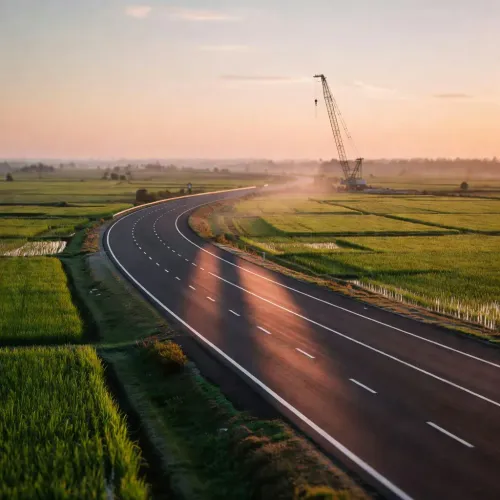
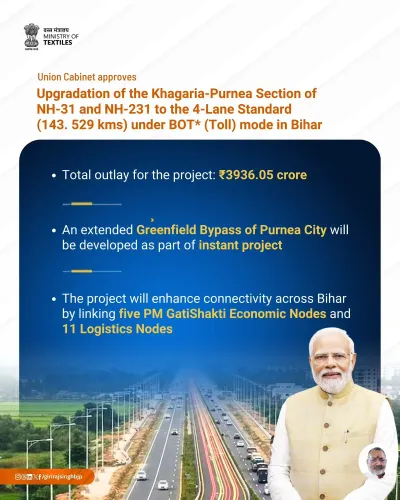
The Gorakhpur–Siliguri four-lane highway is a multi-state corridor aimed at linking eastern Uttar Pradesh, Bihar, and northern West Bengal.
The Kosi–Mechi project targets river linking, irrigation, and road connectivity in flood-prone eastern Bihar.
Both projects are positioned as giving 'new momentum' to Seemanchal — covering districts of Purnia, Katihar, Araria, and Kishanganj.
A formal government order detailing the toll exemption's enforcement date and scope is yet to be issued.
The Chief Minister's Office of Bihar announced on Tuesday, 7 July 2026 that Chief Minister Nitish Kumar has declared that toll tax on state highways will henceforth be levied only on commercial vehicles, providing direct relief to ordinary citizens. The announcement also highlighted two major infrastructure projects — the Gorakhpur–Siliguri four-lane highway and the Kosi–Mechi project — as catalysts for accelerated development in the Seemanchal region of eastern Bihar.
Context
The official post, shared from the Chief Minister's Office account, states: 'माननीय मुख्यमंत्री जी ने घोषणा की कि राज्य सरकार के स्टेट हाईवे पर केवल व्यावसायिक (कॉमर्शियल) वाहनों से ही टोल टैक्स लिया जाएगा' — 'The honourable Chief Minister announced that on state government highways, toll tax will be collected only from commercial vehicles, providing relief to common citizens.' The post further quotes the Chief Minister as saying that the Gorakhpur–Siliguri four-lane and the Kosi–Mechi project will give 'new momentum' to Seemanchal's development.
The toll exemption, if implemented uniformly across all state highways, would benefit private car, two-wheeler, and non-commercial vehicle users who currently pay tolls at various state highway collection points across Bihar. Commercial operators — trucks, buses, and goods carriers — would continue to be liable for toll charges.
Policy Backdrop
Chief Minister Nitish Kumar, who has led Bihar since 2005 (with brief interruptions), has consistently prioritised road infrastructure as a pillar of the state's development agenda. The Bihar government has progressively expanded and four-laned its state highway network over two decades, relying partly on toll-based financing to fund maintenance and upgradation.
Earlier state-level announcements had signalled a distinction between commercial and private traffic in toll policy, and Tuesday's declaration appears to formalise that approach across state highways. Successive state budgets have allocated funds for highway upgradation alongside river-linking and irrigation schemes, reflecting a dual focus on connectivity and flood mitigation — particularly relevant for eastern Bihar.
Seemanchal: Stakeholders and Impact
Seemanchal — encompassing districts such as Purnia, Katihar, Araria, and Kishanganj — is historically one of Bihar's most underdeveloped and flood-prone regions. The Gorakhpur–Siliguri four-lane highway is a proposed multi-state corridor intended to improve connectivity between eastern Uttar Pradesh, Bihar, and northern West Bengal, passing through or near Seemanchal.
The Kosi–Mechi project focuses on river linking, irrigation, and road connectivity to address the twin challenges of flooding and poor infrastructure in the same belt. Together, the two projects are positioned by the state government as transformative for a region long left behind in Bihar's growth story. Residents, farmers, and small traders of Seemanchal stand to benefit most directly from improved road access and reduced flooding risk.
For private vehicle users across Bihar more broadly, the toll exemption on state highways reduces travel costs for daily commuters, rural households, and small vehicle owners who are not engaged in commercial transport.
What's Next
The formal government order detailing the toll exemption mechanism — including its enforcement start date, the list of highways covered, and the vehicle categories defined as 'commercial' — is awaited. Observers will also watch for state budget allocations and tendering timelines for the Gorakhpur–Siliguri and Kosi–Mechi projects, which will determine how quickly the promised 'new momentum' translates into on-ground construction activity.
Bihar's approach of ring-fencing commercial traffic for toll revenue while exempting private users could serve as a model for other states seeking to balance highway financing with public relief — particularly as infrastructure spending pressures mount ahead of state electoral cycles.
Point of View
Visible relief to the far larger constituency of ordinary motorists. By pairing this with the Gorakhpur–Siliguri and Kosi–Mechi announcements, Chief Minister Nitish Kumar is simultaneously addressing two persistent criticisms of his tenure: inequitable toll burden and neglect of Seemanchal. The dual announcement fits a well-established Bihar pattern of bundling fiscal relief with infrastructure optics ahead of electoral cycles. Whether the toll exemption is backed by a compensatory revenue mechanism — or simply reduces state highway receipts — will be the real test of its fiscal sustainability.
NationPress
7 Jul 2026
Frequently Asked Questions
Will private cars have to pay toll on Bihar state highways?
No. Chief Minister Nitish Kumar has announced that toll tax on Bihar state highways will be collected only from commercial vehicles; private vehicle users will be exempt.
What is the Gorakhpur–Siliguri four-lane highway project?
The Gorakhpur–Siliguri four-lane is a proposed multi-state highway corridor designed to improve connectivity between eastern Uttar Pradesh, Bihar, and northern West Bengal, passing through the Seemanchal region.
What is the Kosi–Mechi project in Bihar?
The Kosi–Mechi project is a Bihar infrastructure initiative focused on river linking, irrigation improvement, and road connectivity in the flood-prone eastern districts of the state, particularly in Seemanchal.
Which districts are covered under Seemanchal in Bihar?
Seemanchal broadly covers the eastern Bihar districts of Purnia, Katihar, Araria, and Kishanganj — a region historically marked by underdevelopment and recurring floods.
When will the Bihar toll exemption for private vehicles come into effect?
The Chief Minister's announcement has been made, but a formal government order specifying the enforcement date and the exact list of highways covered is yet to be issued.