CM Bhupendra Patel Urges Pre-Marital Sickle Cell Screening

Synopsis
Gujarat Chief Minister Bhupendra Patel marked World Sickle Cell Awareness Day on 19 June 2026 by urging mandatory pre-marital screening for young couples, reinforcing PM Modi's national pledge to eliminate sickle cell anaemia from India by 2047, with tribal communities at the centre of the mission.
Key Takeaways
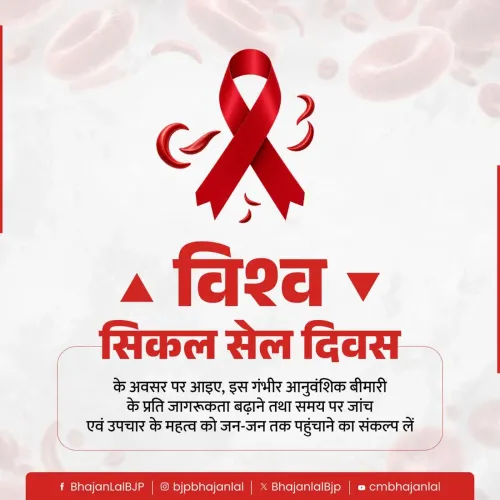
World Sickle Cell Awareness Day is observed on 19 June each year to promote public understanding of the hereditary disease.
Gujarat CM Bhupendra Patel called for mandatory pre-marital sickle cell screening for young couples as a preventive measure.
PM Narendra Modi launched the National Sickle Cell Anaemia Elimination Mission on 1 July 2023 , targeting eradication by 2047 .
Sickle cell disease predominantly affects tribal (Adivasi) communities in states including Gujarat , Madhya Pradesh and Chhattisgarh .
The disease is caused by a genetic mutation that deforms red blood cells, leading to chronic pain and organ damage.
Pre-marital screening is positioned as a tool to prevent intergenerational transmission of the disease.
Gujarat Chief Minister Bhupendra Patel on Friday, 19 June 2026 marked World Sickle Cell Awareness Day by calling for mandatory pre-marital screening of young couples as a frontline step toward eliminating sickle cell anaemia from India by 2047. Patel underscored that early awareness can prevent the hereditary disease from passing to future generations, aligning his message with the national elimination mission championed by Prime Minister Narendra Modi.
Context
World Sickle Cell Awareness Day, observed every year on 19 June, is a global platform to spotlight the burden of sickle cell disease — a genetic condition in which abnormally shaped red blood cells cause chronic pain, organ damage and reduced life expectancy. In India, the disease disproportionately affects tribal (Adivasi) communities across states including Gujarat, Madhya Pradesh and Chhattisgarh.
Patel's post, written in Gujarati, described the day as one meant to 'સામાજિક જાગૃતિનો સંચાર કરવાનો' — 'spread social awareness' — about a condition that, he noted, is primarily seen in tribal communities due to its hereditary nature.
Policy Backdrop
Prime Minister Narendra Modi launched the National Sickle Cell Anaemia Elimination Mission on 1 July 2023, committing the country to eradicating the disease by 2047 — the centenary of India's independence. The mission targets population-level screening, early diagnosis and integration with reproductive and child health services across high-burden districts.
Patel echoed this resolve, noting that Modi had taken a 'સંકલ્પ' — a solemn pledge — to eliminate sickle cell disease from its roots. The Chief Minister framed pre-marital screening as a 'small but precise step' (નાનું પણ સચોટ પગલું) in that larger national effort, arguing that if awareness is exercised from the outset, transmission of the hereditary illness to the next generation can be prevented.
Stakeholders and Impact
Tribal communities bear the heaviest burden of sickle cell disease in India, where the sickle cell trait is prevalent in certain population clusters. Mandatory pre-marital screening, if implemented, would directly affect young couples in high-prevalence regions, enabling informed reproductive decisions before marriage.
India's broader public-health strategy combines awareness campaigns with genetic counselling and screening infrastructure, particularly in states with concentrated tribal populations. Gujarat has been identified as one of the key states for mission-mode rollout under the national programme.
What's Next
Attention will now turn to whether Gujarat formalises pre-marital sickle cell screening through state-level guidelines or health department circulars. Periodic coverage reports from high-burden districts under the National Sickle Cell Anaemia Elimination Mission will serve as benchmarks for progress toward the 2047 target.
Patel closed his message with a forward-looking note: that collective action today will become the inspiration for gifting future generations a healthy and secure tomorrow.
Point of View
Reinforcing BJP's broader narrative of mission-mode public health governance ahead of 2047. By spotlighting pre-marital screening — a behavioural intervention that costs the state little but signals policy seriousness — Patel positions Gujarat as a proactive partner in the national programme. The focus on tribal communities also carries political salience in a state where Adivasi constituencies have been a contested electoral terrain. The real test will be whether the advocacy translates into enforceable state guidelines or remains aspirational communication.
NationPress
19 Sept 2026
Frequently Asked Questions
What is World Sickle Cell Day and when is it observed?
World Sickle Cell Awareness Day is observed every year on 19 June to promote global awareness about sickle cell disease, its prevention and the need for early screening.
What did Gujarat CM Bhupendra Patel say on World Sickle Cell Day 2026?
CM Bhupendra Patel urged young couples to undergo mandatory sickle cell screening before marriage, calling it a precise step toward preventing the hereditary disease from passing to future generations.
What is the National Sickle Cell Anaemia Elimination Mission?
The National Sickle Cell Anaemia Elimination Mission was launched by PM Narendra Modi on 1 July 2023 , with the goal of eliminating sickle cell disease from India by 2047 through population screening and integration with health services.
Which communities are most affected by sickle cell disease in India?
Sickle cell disease in India primarily affects tribal (Adivasi) communities , with high prevalence in states such as Gujarat , Madhya Pradesh and Chhattisgarh .
Why is pre-marital screening important for sickle cell disease?
Because sickle cell disease is hereditary, pre-marital screening helps identify carriers among couples, enabling informed reproductive decisions that can prevent transmission of the disease to the next generation .