CM Pema Khandu Backs APPSC's Fair Recruitment Drive

Synopsis
Arunachal Pradesh Chief Minister Pema Khandu on 21 July 2026 commended the APPSC for transparent and credible recruitment exams, highlighting that even unsuccessful candidates have expressed faith in the process — a rare governance endorsement in a competitive state jobs landscape.
Key Takeaways
CM Pema Khandu publicly praised the APPSC on 21 July 2026 for conducting fair and transparent recruitment examinations.
Even candidates who did not clear the exam have reportedly expressed confidence in the recruitment process, according to Khandu 's post.
The APPSC was constituted in 1988 , a year after Arunachal Pradesh attained full statehood in 1987 .
Government employment is a primary career aspiration for many in Arunachal Pradesh , making APPSC 's credibility a high-stakes public concern.
The Chief Minister's endorsement raises the institutional bar for the APPSC to sustain standards in future recruitment cycles.
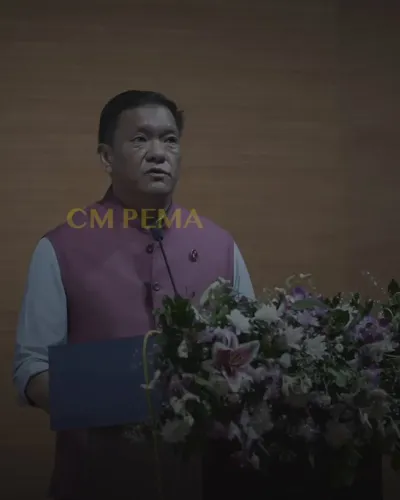
Arunachal Pradesh Chief Minister Pema Khandu on Tuesday, 21 July 2026, publicly commended the Arunachal Pradesh Public Service Commission (APPSC) for conducting recruitment examinations with transparency and integrity, noting that even unsuccessful candidates have expressed confidence in the process.
Context
In his post, CM Khandu stated that 'the commitment of the APPSC towards conducting recruitment exams in a transparent, fair, and credible manner is encouraging, as even those who were unable to make it through are expressing confidence in the recruitment process.' He added that he appreciates 'the efforts of APPSC and all concerned officials in upholding the highest standards of integrity and credibility.'
The endorsement from the Chief Minister is notable because it signals that the commission's recent recruitment cycle has generated broad public acceptance — a metric that is often harder to achieve than the exam itself.
Policy Backdrop
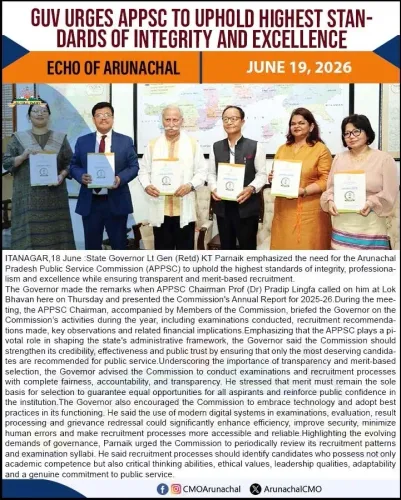
The APPSC was constituted in 1988, a year after Arunachal Pradesh attained full statehood in 1987, with the mandate to conduct fair and merit-based recruitment to state civil services. Over the decades, public service commissions across India have faced periodic scrutiny over alleged irregularities, prompting many states to adopt technology-driven reforms to restore institutional trust.
Arunachal Pradesh, a northeastern state bordering China with a relatively small population, has a high degree of dependence on government employment. Competition for state civil service posts is therefore intense, making the credibility of the examining body a matter of significant public concern.
Across the Northeast, state governments have increasingly invested in strengthening their public service commissions through process reforms, digital infrastructure, and stricter oversight — a trend that CM Khandu's remarks align with.
Stakeholders and Impact
The primary stakeholders are civil services aspirants from across Arunachal Pradesh who sit for APPSC examinations. For many, a state government position represents stable employment and social mobility in a region where private-sector opportunities remain limited.
The fact that unsuccessful candidates are reportedly expressing confidence in the process — rather than alleging malpractice or approaching courts — is itself a governance indicator. It suggests the APPSC's current leadership and administrative machinery have managed to build procedural legitimacy around the recruitment cycle.
Serving and aspiring state government employees, as well as coaching institutions that prepare candidates for these examinations, are also directly affected by the commission's functioning and reputation.
What's Next
Attention will now turn to subsequent APPSC examination cycles and whether the commission releases official data on candidate participation, result timelines, or grievance redressal outcomes. Any such disclosures would allow independent assessment of the standards CM Khandu has publicly endorsed.
If the commission sustains this credibility across future recruitment rounds, it could serve as a model for other smaller northeastern states seeking to strengthen their own public service bodies. The Chief Minister's public backing also raises the political stakes for the APPSC to maintain — and improve upon — its current standards.
Point of View
He is framing institutional credibility not through outcomes but through process acceptance, a harder benchmark to meet. This fits into a broader pattern of BJP-governed northeastern states using administrative transparency as a political differentiator, particularly in regions where state employment is scarce and exam irregularities have historically triggered public unrest. The endorsement also places the APPSC under implicit pressure: a Chief Minister's public praise sets a standard that future recruitment cycles must match. If subsequent cycles draw controversy, the political cost circles back to the office that vouched for the commission.
NationPress
21 Jul 2026
Frequently Asked Questions
What did CM Pema Khandu say about APPSC?
CM Pema Khandu praised the APPSC on 21 July 2026, stating that its commitment to transparent and fair recruitment exams is encouraging, and that even unsuccessful candidates are expressing confidence in the process.
What is the APPSC and what does it do?
The Arunachal Pradesh Public Service Commission (APPSC) is a constitutional body established in 1988 to conduct merit-based recruitment to state civil services and other government posts in Arunachal Pradesh.
Why is APPSC exam transparency important in Arunachal Pradesh?
Arunachal Pradesh has a small population and limited private-sector jobs, making government employment highly sought after. Transparent recruitment by the APPSC is therefore critical to public trust and social stability in the state.
Have APPSC exams faced controversies before?
Public service commissions across India have periodically faced allegations of irregularities. CM Khandu's commendation suggests the current APPSC cycle has managed to avoid such controversy and build procedural credibility.
What happens next after CM Khandu's endorsement of APPSC?
Attention will turn to future APPSC recruitment cycles and any official data on candidate participation or grievance outcomes, which will test whether the standards praised by the Chief Minister are sustained.