CM Pema Khandu Plants Rhododendrons to Boost Himalayan Biodiversity

Synopsis
Arunachal Pradesh Chief Minister Pema Khandu joined a rhododendron plantation drive on 22 June 2026, emphasising native-species restoration in the Eastern Himalayas. The effort aligns with India's National Mission for Sustaining the Himalayan Ecosystem and reflects a broader state push to protect biodiversity in one of the world's most ecologically sensitive mountain regions.
Key Takeaways
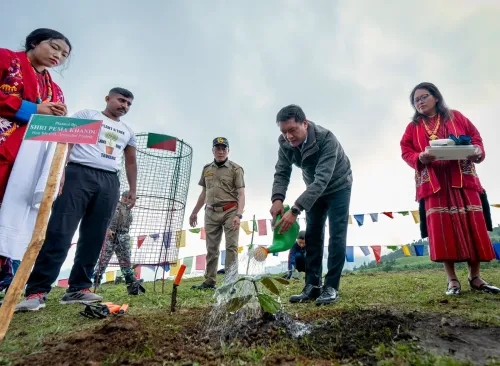
CM Pema Khandu participated in a rhododendron plantation drive in Arunachal Pradesh on 22 June 2026 .
Rhododendrons are native, ecologically significant flora of the Eastern Himalayas and indicators of mountain forest health.
The initiative aligns with the National Mission for Sustaining the Himalayan Ecosystem , launched in 2010 under India's National Action Plan on Climate Change.
Indigenous communities and the state forest department are the primary stakeholders in such plantation and conservation drives.
Arunachal Pradesh is a recognised biodiversity hotspot, and native-species afforestation here contributes to India's international biodiversity commitments.
Plantation survival rates and integration into state biodiversity action plans will determine the long-term impact of this effort.
Arunachal Pradesh Chief Minister Pema Khandu on Monday, 22 June 2026, participated in a rhododendron plantation drive in the state, framing the effort as an investment in the long-term ecological health of the Eastern Himalayas. Sharing the initiative on social media, he described it as nurturing the mountains for future generations and building a lasting natural legacy.
Context
Posting on X, CM Khandu wrote: 'Planting rhododendrons today, nurturing the Himalayas for tomorrow. Greener mountains, richer biodiversity, and a lasting natural legacy.' The message signals a deliberate focus on native species restoration — rhododendrons are emblematic flora of the Eastern Himalayas and serve as ecological indicators of mountain forest health. Arunachal Pradesh is among India's most biodiverse states, situated in a region recognised globally as a biodiversity hotspot.
Policy Backdrop
The plantation activity aligns with the National Mission for Sustaining the Himalayan Ecosystem (NMSHE), launched in 2010 under India's National Action Plan on Climate Change. The mission specifically targets ecological vulnerabilities across Himalayan states, including habitat loss, glacial retreat, and degradation of native flora. Indian Himalayan states have increasingly anchored state-level green programmes to this national framework, focusing on native species over monoculture plantations to maximise biodiversity value.
Arunachal Pradesh's state forest department has historically worked alongside indigenous communities to implement conservation and afforestation drives. Rhododendrons, beyond their ecological role, hold cultural significance for communities across the northeastern Himalayan belt, making their restoration a point of convergence between environmental policy and local heritage.
Stakeholders and Impact
The primary beneficiaries of sustained rhododendron plantation drives are indigenous communities whose livelihoods and cultural practices are tied to forest ecosystems in the Eastern Himalayas. Healthy rhododendron cover also supports pollinators, stabilises slopes against erosion, and contributes to watershed integrity — outcomes that affect downstream agricultural communities across the region. The state forest department is the key implementing agency for such drives, responsible for monitoring plantation survival rates over time.
At a broader level, consistent native-species afforestation in Arunachal Pradesh contributes to India's commitments under international biodiversity frameworks, including targets to restore degraded ecosystems and increase forest cover in ecologically sensitive zones.
What's Next
The durability of such initiatives will be measured through state forestry reports tracking plantation survival rates across seasons. Conservationists and policymakers will watch whether rhododendron conservation is formally integrated into updated state biodiversity action plans. If the current drive is part of a larger seasonal or annual programme, subsequent plantation targets and coverage data will offer a clearer picture of the state's commitment to native-species restoration in the Himalayas.
Point of View
Culturally resonant species — rather than generic plantation drives, the messaging is calibrated to appeal to both conservation advocates and indigenous communities. The move also reinforces Arunachal Pradesh's positioning as a responsible custodian of one of the planet's most biodiverse frontiers, a framing that carries diplomatic weight given the state's geopolitical sensitivity. Whether this translates into measurable policy outcomes will depend on the institutional follow-through from the state forest department.
NationPress
22 Jun 2026
Frequently Asked Questions
Why is Pema Khandu planting rhododendrons in Arunachal Pradesh?
Chief Minister Pema Khandu participated in a rhododendron plantation drive to promote native-species restoration and strengthen biodiversity in the Eastern Himalayas. Rhododendrons are ecologically significant to the region and their plantation supports slope stabilisation, pollinator habitats, and watershed health.
What is the significance of rhododendrons in the Eastern Himalayas?
Rhododendrons are native flora emblematic of the Eastern Himalayas and serve as ecological indicators of mountain forest health. They support biodiversity, stabilise slopes, and hold cultural importance for indigenous communities across the northeastern Himalayan belt.
What is the National Mission for Sustaining the Himalayan Ecosystem?
The National Mission for Sustaining the Himalayan Ecosystem (NMSHE) was launched in 2010 under India's National Action Plan on Climate Change. It aims to address ecological vulnerabilities in Himalayan states, including habitat loss and degradation of native flora, by supporting conservation and restoration programmes.
Is Arunachal Pradesh a biodiversity hotspot?
Yes, Arunachal Pradesh is situated in the Eastern Himalayas, a globally recognised biodiversity hotspot characterised by high levels of endemism in both flora and fauna. The state's forests are among the most ecologically rich in India.
What role do indigenous communities play in Arunachal Pradesh's forest conservation?
Indigenous communities in Arunachal Pradesh have historically been central to forest conservation, working alongside the state forest department in afforestation and biodiversity drives. Their traditional knowledge and cultural ties to native species like rhododendrons make them key stakeholders in such initiatives.