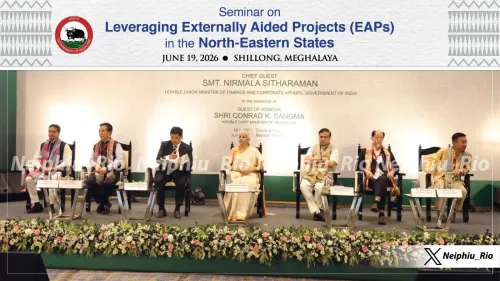
CM Rio flags infrastructure as key to Nagaland growth

Synopsis
Nagaland Chief Minister Neiphiu Rio on June 15 highlighted that infrastructure is central to the state's growth, pointing to geographical, historical and structural constraints that have long slowed development in one of India's oldest Northeastern states.
Key Takeaways
CM Neiphiu Rio stated on June 15, 2026 that infrastructure is central to accelerating growth and improving service delivery in Nagaland .
Nagaland , granted statehood in 1963 , is among the oldest states in the Northeast but faces persistent geographical and structural development constraints.
The Ministry of DoNER , established in 2001 , coordinates central assistance for infrastructure across the eight Northeastern states including Nagaland .
India's Act East Policy (2014) has elevated the Northeast's connectivity as a strategic priority, with programmes like Bharatmala directing funding to the region.
Nagaland 's border with Myanmar gives its infrastructure development added strategic significance for cross-border trade corridors.
Next Union Budget allocations under DoNER and progress on ongoing highway and rail projects will be key indicators of follow-through.
Nagaland Chief Minister Neiphiu Rio on Monday, June 15, 2026, underscored that infrastructure development remains the central driver for accelerating growth and improving service delivery in the state, acknowledging that Nagaland's development trajectory has long been constrained by geographical, historical and structural challenges.
Context
In his post, CM Rio noted that while Nagaland is among the oldest states in the Northeast, its progress has been held back by a unique combination of difficult terrain, historical complexities and structural bottlenecks. He stated plainly: 'Infrastructure remains central to accelerating growth and improving service delivery.' The observation comes as the state continues to navigate the twin pressures of geographic isolation and the need for deeper economic integration with the rest of India.
Policy Backdrop
Nagaland was granted statehood in 1963 under a sixteen-point agreement designed to address the ethnic aspirations and developmental needs of its predominantly tribal population, which also shares an international border with Myanmar. The Ministry of Development of North Eastern Region (DoNER), established in 2001, was created precisely to coordinate central assistance for infrastructure and growth across the eight Northeastern states. India's Act East Policy, announced in 2014, further elevated the Northeast's strategic importance by emphasising road, rail and digital connectivity as prerequisites for economic ties with Southeast Asia.
National programmes such as Bharatmala and the North East Special Infrastructure Development Scheme have directed increased central funding toward highways, airports and power projects across the region. Successive governments have identified the Northeast's infrastructure deficit as a legacy of geographical isolation, decades of insurgency and challenging terrain — conditions that Nagaland has experienced acutely.
Stakeholders and Impact
The residents of Nagaland, particularly those in remote hill districts, stand to gain most directly from improved road and rail links, which determine access to markets, healthcare and education. For the broader Northeast, CM Rio's articulation of the infrastructure imperative reinforces a shared regional demand for sustained central investment. Connectivity upgrades also carry strategic significance given Nagaland's proximity to the Myanmar border, where the Act East Policy's trade corridors are intended to open new economic routes.
Businesses and investors eyeing the Northeast as a gateway to Southeast Asia watch infrastructure progress closely, as road quality and logistics reliability directly affect the viability of cross-border commerce. Tribal communities whose livelihoods depend on agricultural produce reaching urban markets are among the most immediate beneficiaries of any improvement in rural connectivity.
What's Next
Attention will now turn to the next Union Budget allocations under DoNER and progress reports on ongoing Nagaland highway and rail-link projects. CM Rio's statement signals that the state government intends to keep infrastructure at the top of its agenda in engagements with the Centre. Whether this translates into fresh project announcements or accelerated timelines for existing schemes will be the measure of its impact.
Point of View
He draws on a well-established Northeast political vocabulary that has historically unlocked central sympathy and funding. The timing, ahead of budget cycles, suggests the statement is part of a broader lobbying posture by Northeastern chief ministers who compete for a share of DoNER and scheme allocations. If the Centre responds with enhanced project timelines or fresh outlays, Rio's positioning will have served its purpose; if not, the statement becomes part of a longer record of unmet regional demands.
NationPress
14 Sept 2026
Frequently Asked Questions
Why is infrastructure development important for Nagaland?
Infrastructure is critical for Nagaland because the state's mountainous terrain and historical isolation have limited road, rail and digital connectivity, making it difficult for residents to access markets, healthcare and education. CM Rio has identified it as the central driver for accelerating growth and improving service delivery.
What is the Act East Policy and how does it affect Nagaland?
The Act East Policy, launched in 2014, is India's strategic initiative to improve connectivity and economic ties between the Northeast and Southeast Asian nations. For Nagaland, which shares a border with Myanmar, the policy means highway and trade corridor projects that could open new economic routes.
What is the Ministry of DoNER?
The Ministry of Development of North Eastern Region, established in 2001, coordinates central government assistance for infrastructure and growth across the eight Northeastern states, including Nagaland, through targeted funding schemes.
When did Nagaland become a state?
Nagaland was granted statehood in 1963 under a sixteen-point agreement aimed at addressing the ethnic aspirations and developmental needs of its predominantly tribal population.
What is the Bharatmala scheme and does it cover Nagaland?
Bharatmala is a national highway development programme that has directed increased central funding toward road projects across India, including the Northeast. It is among the schemes intended to address the infrastructure deficit in states like Nagaland.