CM Sai Approves 125-Day Rural Jobs Scheme in Chhattisgarh
Synopsis
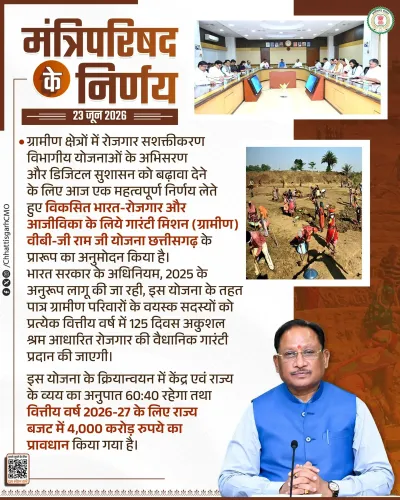
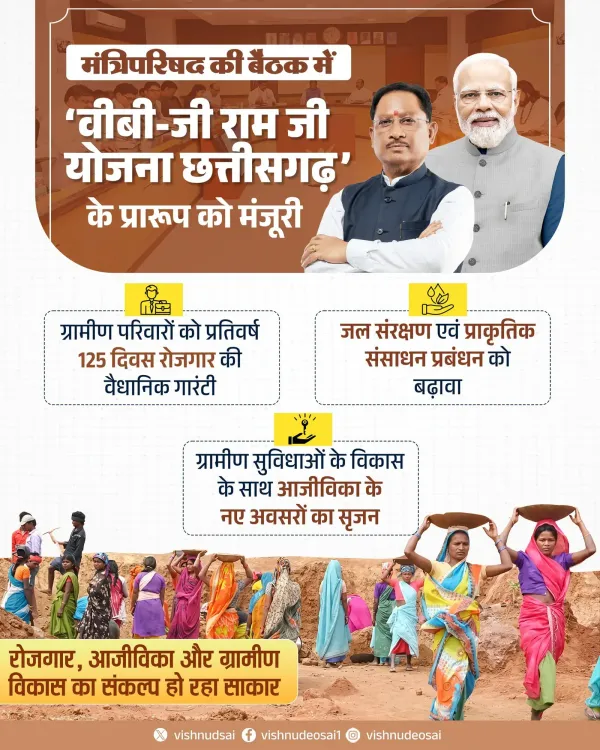
Chhattisgarh Chief Minister Vishnu Deo Sai announced on 23 June 2026 that the state cabinet approved the VB-G Ram Ji Yojana, a scheme guaranteeing eligible rural households 125 days of statutory employment annually — surpassing the 100-day central MGNREGA benchmark by 25 days.
Key Takeaways
The Chhattisgarh cabinet approved the draft framework of the VB-G Ram Ji Yojana on 23 June 2026 .
The scheme provides a statutory guarantee of 125 days of employment per year to eligible rural households — 25 days more than the central MGNREGA entitlement.
The scheme aims to generate sustainable rural employment , strengthen the rural economy, and support the 'Aatmanirbhar Chhattisgarh' vision.
Primary beneficiaries are rural families and village labourers in Chhattisgarh , a state with a large agrarian and tribal population.
Detailed eligibility norms, wage rates, and budgetary allocations are yet to be officially announced following the draft approval.
The move follows the BJP government's emphasis on rural income support since taking office in December 2023 .
Chhattisgarh Chief Minister Vishnu Deo Sai announced on Tuesday, 23 June 2026 that the state cabinet has approved the draft framework of the 'VB-G Ram Ji Yojana, Chhattisgarh' — a new state-level rural employment scheme that will guarantee eligible rural households a statutory entitlement of 125 days of work per year.
Context
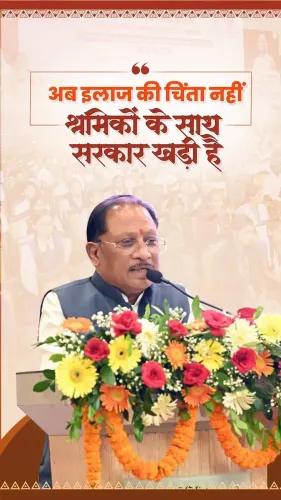
Posting in Hindi on X, CM Sai said the scheme was approved in today's cabinet meeting with the express aim of expanding employment opportunities for labourers in the state's villages. Translated, his post reads: 'Aaj mantriparishad ki baithak mein VB-G Ram Ji Yojana, Chhattisgarh ke praroop ko manjuri di gayi hai' ('Today, the cabinet meeting has approved the draft of the VB-G Ram Ji Yojana, Chhattisgarh'). He added that the scheme would generate sustainable rural employment and lend 'new strength to the rural economy.'
The announcement positions the scheme as a pillar of the BJP government's broader vision of an 'Aatmanirbhar Chhattisgarh' (self-reliant Chhattisgarh), with an emphasis on raising rural household incomes and fostering village-level prosperity.
Policy Backdrop
The new scheme builds directly on the foundation laid by the Mahatma Gandhi National Rural Employment Guarantee Act (MGNREGA), enacted by Parliament in 2005, which provides a statutory guarantee of up to 100 days of unskilled wage employment annually to rural households across India. The VB-G Ram Ji Yojana would extend that floor by 25 additional days, taking the guaranteed employment ceiling to 125 days per year for eligible families in Chhattisgarh.
Several Indian states have previously supplemented MGNREGA with state-funded top-up schemes to address seasonal unemployment gaps, particularly in agrarian and forest-dependent economies. Chhattisgarh, with its large rural and tribal population, has historically relied on agriculture and forest-based livelihoods, making employment guarantees especially significant during lean agricultural seasons.
Since coming to power in December 2023, the BJP government under CM Sai has emphasised rural income support and self-reliance as central planks of its governance agenda, with Gram Panchayat-level asset creation as a stated convergence goal.
Stakeholders and Impact
The primary beneficiaries of the scheme are eligible rural families and village-level wage labourers across Chhattisgarh, a state where a significant share of the workforce depends on seasonal agricultural income. The statutory guarantee of 125 days of employment is designed to provide income security during off-season periods and reduce distress migration from villages to urban centres.
Beyond individual households, the scheme is expected to channel labour toward the creation of durable community assets at the village level — roads, water conservation structures, and other rural infrastructure — thereby strengthening Gram Panchayat economies. The convergence of state funds with existing central MGNREGA mechanisms will be a key implementation variable to watch.
What's Next
The cabinet approval covers the draft framework of the VB-G Ram Ji Yojana; detailed operational guidelines, eligibility norms, budgetary allocations, and convergence mechanisms with MGNREGA are expected to be formalised in subsequent cabinet or assembly sessions. The rollout timeline and per-day wage rates under the scheme have not yet been officially announced.
If operationalised at scale, the scheme could set a precedent for other BJP-governed states with large rural constituencies to introduce similar top-up employment guarantees ahead of the next cycle of state elections, underscoring the political salience of rural welfare commitments in central India.
Point of View
' the government elevates the scheme from a discretionary welfare measure to a justiciable right, raising the political cost of non-delivery. The timing — mid-2026, well ahead of any immediate electoral deadline — suggests the administration is focused on implementation credibility rather than short-term optics. This fits a broader pattern among BJP-governed states of layering state-funded rural schemes atop central programmes to demonstrate governance distinctiveness.
NationPress
23 Jun 2026
Frequently Asked Questions
What is the VB-G Ram Ji Yojana in Chhattisgarh?
The VB-G Ram Ji Yojana is a new state-level rural employment scheme approved by the Chhattisgarh cabinet on 23 June 2026. It provides eligible rural households a statutory guarantee of 125 days of employment per year, extending beyond the 100-day entitlement under the central MGNREGA.
How is VB-G Ram Ji Yojana different from MGNREGA?
While MGNREGA guarantees up to 100 days of wage employment per year to rural households across India, the VB-G Ram Ji Yojana adds 25 more days, taking the total statutory employment guarantee to 125 days per year for eligible families in Chhattisgarh.
Who will benefit from VB-G Ram Ji Yojana?
The scheme targets eligible rural households and village-level labourers in Chhattisgarh. Detailed eligibility criteria are yet to be officially notified following the cabinet's approval of the draft framework.
When will VB-G Ram Ji Yojana be implemented?
The cabinet approved the draft framework on 23 June 2026. Operational guidelines, eligibility norms, wage rates, and budgetary allocations are expected to be finalised in subsequent cabinet or assembly sessions; a specific launch date has not been announced.
What did CM Vishnu Deo Sai say about the new rural jobs scheme?
CM Sai announced on X that the scheme was approved to expand employment opportunities for rural labourers, guarantee 125 days of work annually, create sustainable village-level jobs, and strengthen the rural economy as part of the 'Aatmanirbhar Chhattisgarh' vision.