CM Sai Pushes Mother-Tongue Education Under NEP 2020
Synopsis
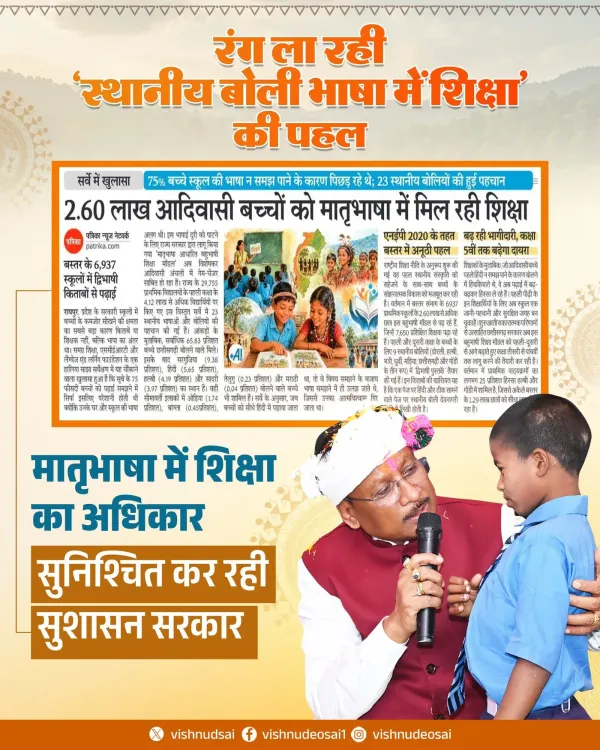
Chhattisgarh Chief Minister Vishnu Deo Sai has declared mother-tongue education a child's right, stating that lakhs of children in Bastar and Sarguja divisions are already learning in local dialects under the National Education Policy 2020, aiming to improve learning outcomes and preserve indigenous linguistic heritage.
Key Takeaways
CM Vishnu Deo Sai framed mother-tongue education as a fundamental right for every child in Chhattisgarh .
The initiative is being implemented through the National Education Policy 2020 , which mandates local-language instruction up to at least Grade 5 .
Bastar and Sarguja divisions — home to large tribal communities speaking Gondi , Halbi , and other dialects — are specifically highlighted as active rollout zones.
The government says the approach makes learning 'simpler and more natural' for children while preserving indigenous languages and cultural identity.
Teacher training and recruitment for local dialects remain a key challenge for expanding the programme beyond current divisions.
Chhattisgarh's model is emerging as a reference point for other tribal-majority states implementing NEP's multilingual education provisions.
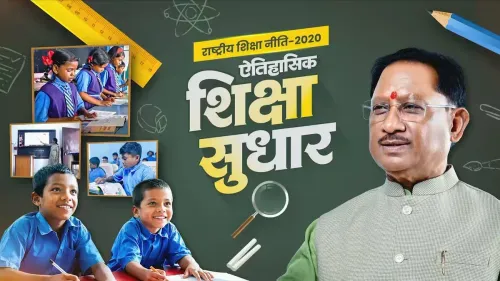
Chhattisgarh Chief Minister Vishnu Deo Sai on Wednesday, 8 July 2026, reaffirmed his government's commitment to delivering education in mother tongues and local dialects across the state, citing the National Education Policy (NEP) 2020 as the policy vehicle driving the initiative.
Context
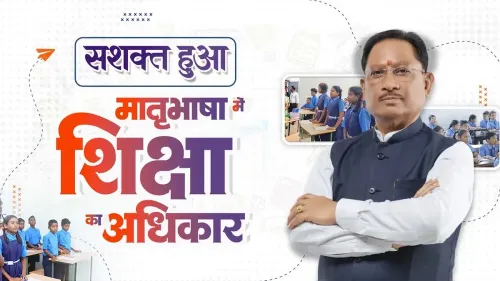
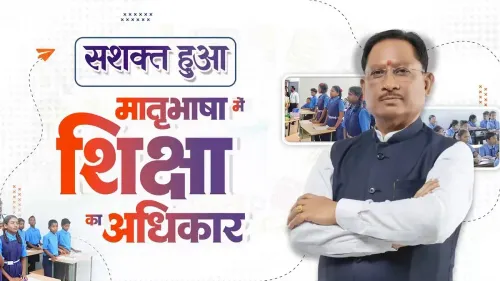
In his post, CM Sai declared: 'मातृभाषा में शिक्षा, हर बच्चे का अधिकार' ('Education in the mother tongue — every child's right'), framing access to local-language schooling as a fundamental entitlement rather than a government favour. He stated that through effective implementation of the NEP, the state is ensuring that every child in Chhattisgarh receives education in their mother tongue and local dialects. He specifically named Bastar and Sarguja divisions as regions where lakhs of children are already learning in local languages.
Policy Backdrop
The National Education Policy 2020, approved by the Union Cabinet in July 2020, recommends the mother tongue or local language as the medium of instruction up to at least Grade 5. The policy marks a significant departure from the historically English- or Hindi-dominant classroom, aiming to improve foundational learning by anchoring early education in a child's first language.
Chhattisgarh is home to a substantial tribal population, and its two largest tribal belts — Bastar division in the south and Sarguja division in the north — are home to communities that speak languages such as Gondi and Halbi alongside regional dialects. For these communities, the gap between home language and classroom language has historically been a key driver of early school dropout and poor foundational literacy.
Stakeholders and Impact
Tribal children and indigenous language communities stand as the primary beneficiaries of this initiative. CM Sai noted that the effort is making the learning process 'simpler and more natural' for children while simultaneously carrying the state's 'rich linguistic heritage, culture and identity' to the next generation.
Beyond the classroom, the policy carries cultural preservation stakes: many of Chhattisgarh's local dialects lack robust written traditions, and integrating them into formal schooling creates both documentation pressure and institutional support for their survival. Teacher recruitment and training in these local dialects remain a logistical challenge that will shape how far the initiative can reach across the state's remaining divisions.
What's Next
The government's stated emphasis on 'effective implementation' signals that the focus is shifting from policy adoption to measurable delivery. Progress reports on NEP rollout in divisions beyond Bastar and Sarguja, alongside any state-level announcements on teacher training pipelines for local-dialect instruction, will be the next indicators of how deeply the initiative is taking root. Chhattisgarh's experience is being watched as a template for other tribal-majority states navigating the same multilingual education challenge under the NEP framework.
Point of View
Two of the state's most politically and socially sensitive tribal regions, the government is signalling that NEP implementation is reaching its most challenging constituencies. The framing of mother-tongue education as a 'right' rather than a scheme benefit is notable: it elevates the issue from administrative delivery to constitutional entitlement, a rhetorical shift that raises the political cost of non-delivery. Nationally, this fits a broader BJP pattern of using NEP as a cultural and electoral touchstone in tribal-majority states.
NationPress
7 Oct 2026
Frequently Asked Questions
What is the National Education Policy 2020 and how does it relate to mother-tongue education?
The National Education Policy 2020, approved by India's Union Cabinet in July 2020, recommends that children be taught in their mother tongue or local language as the medium of instruction up to at least Grade 5, aiming to improve foundational learning outcomes.
Which regions of Chhattisgarh are receiving education in local dialects?
CM Vishnu Deo Sai specifically named Bastar division in southern Chhattisgarh and Sarguja division in the north as regions where lakhs of children are currently receiving education in local languages and dialects such as Gondi and Halbi.
Why is mother-tongue education important for tribal children in Chhattisgarh?
Many tribal children in Chhattisgarh grow up speaking indigenous languages at home, and teaching them in a different language early on has historically contributed to poor foundational literacy and school dropout. Mother-tongue instruction bridges this gap and makes learning more accessible.
Who is Vishnu Deo Sai and when did he become Chief Minister of Chhattisgarh?
Vishnu Deo Sai is a BJP leader who became Chief Minister of Chhattisgarh in December 2023 following the party's victory in the state assembly elections.
What challenges remain in implementing local-language education across Chhattisgarh?
The primary challenge is recruiting and training enough teachers who are proficient in the state's diverse local dialects, as well as extending the programme beyond the currently highlighted Bastar and Sarguja divisions to other parts of Chhattisgarh.