CM Sai Champions PM Surya Ghar Free Electricity Scheme in Chhattisgarh
Synopsis
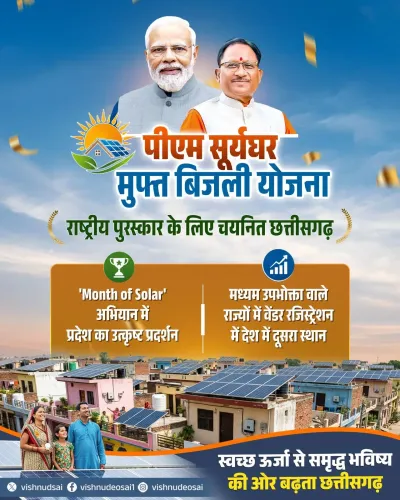
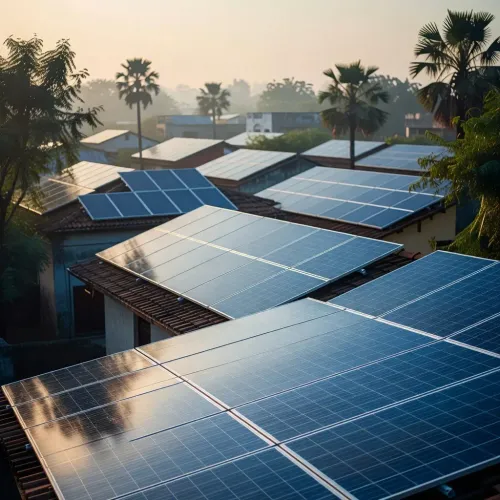
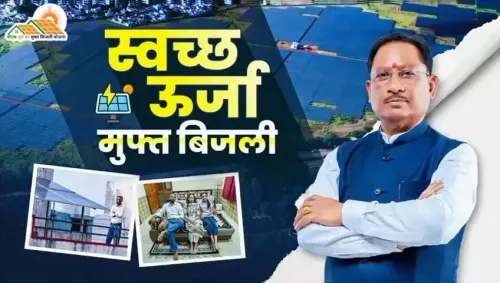
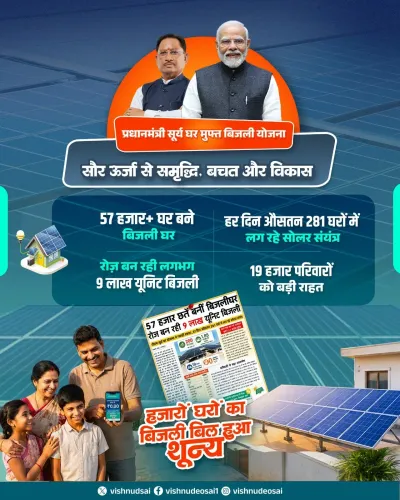
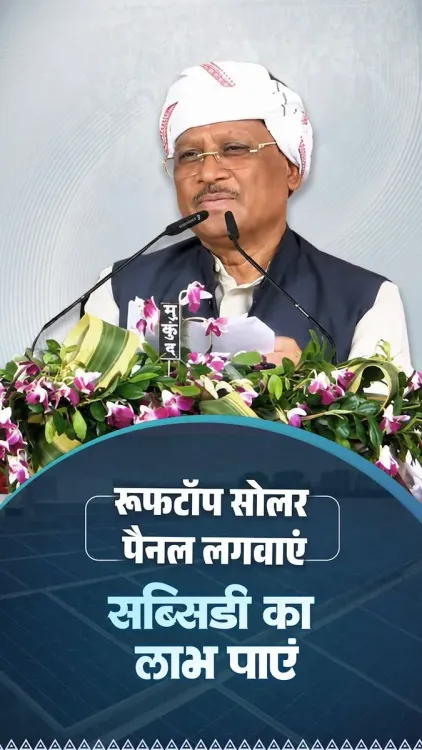
Chhattisgarh Chief Minister Vishnu Deo Sai on 22 June 2026 championed PM Modi's PM Surya Ghar: Muft Bijli Yojana, saying joint central-state efforts are turning rooftops across the state into clean energy sources and making citizens energy producers.
Key Takeaways
CM Vishnu Deo Sai publicly endorsed the PM Surya Ghar: Muft Bijli Yojana on 22 June 2026 via a post on X.
The scheme provides up to 300 units of free electricity per month to households installing rooftop solar panels.
Chhattisgarh is implementing the programme through a joint central-state government framework.
Citizens can sell surplus solar power back to the grid, making them energy producers and not just consumers.
The scheme targets 1 crore households nationally and has particular relevance for Chhattisgarh's rural and tribal population.
The initiative aligns with India's broader push for renewable energy expansion and energy self-reliance.
Chhattisgarh Chief Minister Vishnu Deo Sai on Monday, 22 June 2026, praised the PM Surya Ghar: Muft Bijli Yojana as a landmark initiative toward energy self-reliance, highlighting its expanding reach across the state through coordinated efforts of the central and state governments.
Context
In his post, CM Sai described the scheme — launched by Prime Minister Narendra Modi — as a visionary campaign aimed at building an energy self-reliant India. Translating his remarks: 'Ab nagarik apni chhaaton ko swachh urja ke srot mein badalte hue kewal bijli upbhokta hi nahin, balki urja utpadak bhi ban rahe hain' — ('Citizens are now transforming their rooftops into sources of clean energy, becoming not just electricity consumers but energy producers as well.')
The Chief Minister tagged Prime Minister Modi directly in the post, signalling state-level political ownership of the centrally sponsored rooftop solar programme.
Policy Backdrop
The PM Surya Ghar: Muft Bijli Yojana was launched by the Union Government to provide free electricity of up to 300 units per month to households by installing rooftop solar panels. The scheme offers substantial central subsidies to reduce the financial burden on beneficiaries and is designed to cover 1 crore households across India.
Under the scheme, households with a rooftop solar installation can sell surplus electricity back to the grid, effectively converting domestic rooftops into decentralised power generation units. Chhattisgarh, a state with significant rural and tribal populations, has been identified as a key geography for the programme's rollout given the high proportion of households with independent rooftops.
The joint implementation model — combining central government subsidies with state government facilitation — has been the operational framework for the scheme's on-ground delivery, including awareness campaigns, beneficiary registration, and coordination with power distribution companies.
Stakeholders and Impact
For households in Chhattisgarh, the scheme offers a dual benefit: elimination or significant reduction of monthly electricity bills and the potential for income generation through surplus power sale. Rural and semi-urban families, who often face irregular power supply and high per-unit costs, stand to gain the most.
The state's power distribution infrastructure and local bodies are key implementation partners, responsible for connecting rooftop installations to the grid and processing net-metering arrangements. The scheme also supports the broader national target of expanding renewable energy capacity and reducing dependence on coal-based power — a significant consideration given Chhattisgarh's historical role as a major coal-producing state.
For the BJP governments at both the centre and the state, the programme carries political salience as a visible welfare delivery mechanism ahead of future electoral cycles.
What's Next
With CM Sai publicly reaffirming the state's commitment, the Chhattisgarh government is expected to continue accelerating beneficiary enrolment and installation targets under the scheme. The emphasis on citizens becoming 'energy producers' suggests the state may further push net-metering adoption and awareness in districts where rooftop solar penetration remains low.
As India works toward its renewable energy commitments, state-level political momentum of this kind is likely to translate into intensified administrative push — with Chhattisgarh positioning itself as an active contributor to the national clean energy transition.
Point of View
A more durable and aspirational pitch.
NationPress
22 Jun 2026
Frequently Asked Questions
What is PM Surya Ghar Muft Bijli Yojana?
PM Surya Ghar: Muft Bijli Yojana is a central government scheme that provides up to 300 units of free electricity per month to households by subsidising the installation of rooftop solar panels, allowing surplus power to be sold back to the grid.
How is Chhattisgarh implementing the PM Surya Ghar scheme?
Chhattisgarh is implementing the scheme through a joint effort of the central and state governments, coordinating beneficiary registration, subsidies, and grid connectivity via state power distribution companies.
What did Chhattisgarh CM Vishnu Deo Sai say about the solar scheme?
CM Vishnu Deo Sai said on 22 June 2026 that PM Surya Ghar is a visionary initiative toward energy self-reliance, and that citizens in Chhattisgarh are now becoming energy producers by converting their rooftops into clean energy sources.
Who is eligible for PM Surya Ghar free electricity scheme?
Residential households across India with suitable rooftops are eligible for the PM Surya Ghar scheme, which covers the cost of solar panel installation through central subsidies and enables net-metering for surplus electricity sale.
How many households does PM Surya Ghar scheme target?
The PM Surya Ghar: Muft Bijli Yojana targets 1 crore households across India for rooftop solar installation.