Goyal: India leads global ship recycling with 35.4% share
Synopsis
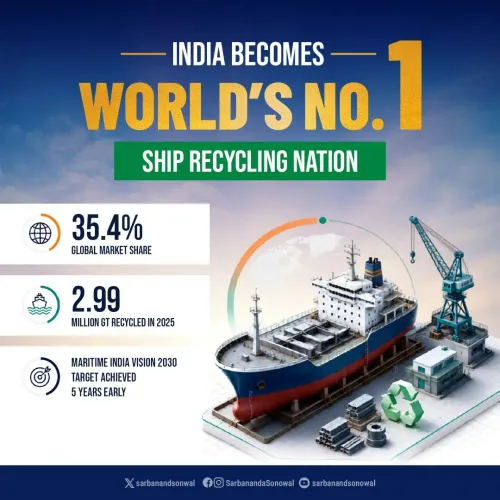
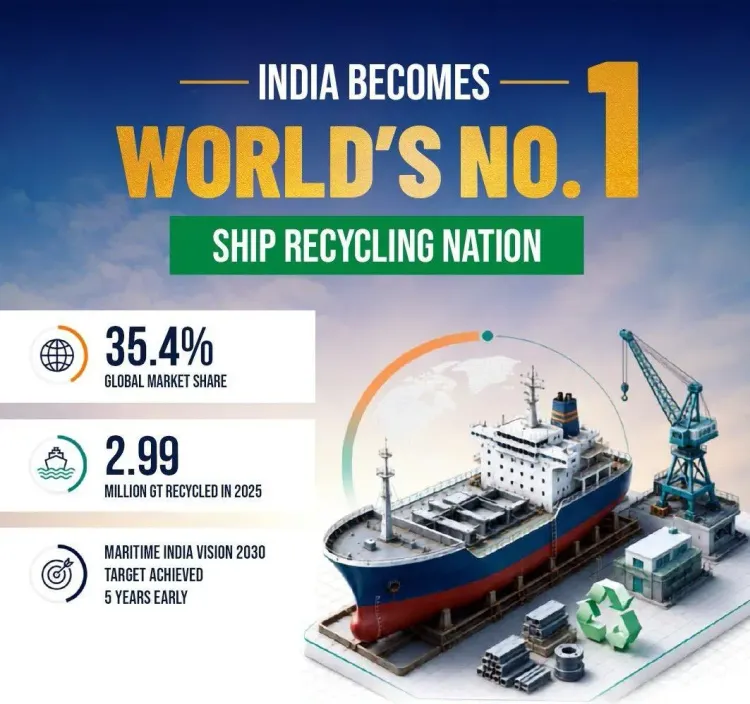
India has become the world's top ship recycling nation with 2.99 million GT recycled in 2025 and a 35.4% global market share, Commerce Minister Piyush Goyal announced on 22 June 2026, declaring the Maritime India Vision 2030 target met five years ahead of schedule.
Key Takeaways
India recycled 2.99 million gross tons of ships in 2025 , the highest of any country.
India's global ship recycling market share stands at 35.4 per cent , making it the world's leading recycling nation.
The achievement is officially stated to fulfil the Maritime India Vision 2030 target five years ahead of schedule .
The milestone builds on the Sagarmala Project (2015) and the Maritime India Vision launched in 2021 .
Policy emphasis on ease of doing business and alignment with international standards such as the Hong Kong International Convention has driven the sector's growth.
The announcement was attributed to PM Narendra Modi's maritime policy reforms and leadership.
Union Commerce and Industry Minister Piyush Goyal on Monday, 22 June 2026 announced that India has become the world's leading ship recycling nation, with recycling volumes rising to 2.99 million gross tons (GT) in 2025, capturing 35.4 per cent of the global market. The minister said the achievement fulfils the Maritime India Vision (MIV) 2030 target five years ahead of schedule, crediting the milestone to policy reforms and ease of doing business initiatives under Prime Minister Narendra Modi.
Context
Goyal's post, shared on X (formerly Twitter), described the development as 'a milestone for India's shipping sector,' citing the country's dominant position in global ship recycling. Quoting official figures, he said India now accounts for more than a third of all ship recycling activity worldwide, reinforcing its status as 'a global hub for responsible and sustainable ship recycling.'
The announcement was accompanied by a link to a Press Information Bureau release, indicating the figures carry official government backing. The minister specifically attributed the achievement to PM Modi's 'exemplary leadership, maritime policy reforms and ease of doing business initiatives.'
Policy Backdrop
The Maritime India Vision 2030 was unveiled in 2021 during the Maritime India Summit as a comprehensive roadmap for the country's maritime sector, setting explicit targets for ship recycling capacity, sustainability standards, and sector modernisation. The government had aimed to reach these benchmarks by 2030; the claim that the target has been met by 2025 would represent a five-year advance on that timeline.
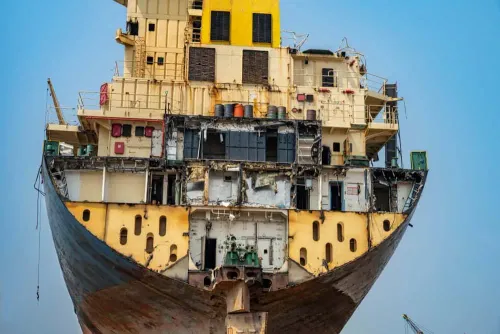
India's ship recycling industry is concentrated at coastal yards, most prominently in Alang, Gujarat, which has historically been among the largest ship-breaking locations in the world. Policy focus in recent years has centred on aligning Indian yards with international environmental and labour standards, including conventions such as the Hong Kong International Convention for the safe and environmentally sound recycling of ships.
The broader Sagarmala Project, launched in 2015, set the foundation for port-led maritime development, with ship recycling forming one pillar of India's expanded maritime ambitions. Successive ease of doing business measures have sought to formalise operations and attract greater tonnage away from competing South Asian recycling hubs.
Stakeholders and Impact
The ship recycling sector supports a large workforce of workers at coastal yards, as well as downstream industries that process recovered steel, machinery, and other materials. A larger share of global recycling volume strengthens demand for this workforce and for ancillary industries including steel re-rolling mills and scrap dealers.
For the broader maritime industry — including shipowners, classification societies, and insurers — India's dominance as a recycling destination means competitive pricing and, if sustainability standards are maintained, an increasingly viable option for environmentally compliant end-of-life vessel disposal. International shipowners have in recent years faced pressure from regulators and investors to ensure vessels are recycled at certified, responsible facilities.
What's Next
With the MIV 2030 ship recycling target now claimed as met, attention will turn to whether the government sets a revised, more ambitious benchmark and how it plans to sustain India's leading position against competition from Bangladesh, Pakistan, and Turkey. Regulatory updates to yard certification, worker safety standards, and environmental compliance will be closely watched by both domestic operators and international bodies.
Further implementation updates on remaining Maritime India Vision 2030 targets — covering port capacity, shipbuilding, and inland waterways — are expected as the government approaches the original deadline year of 2030, with Monday's announcement likely to serve as a template for showcasing early delivery on other sectoral goals.
Point of View
With Minister Goyal explicitly tying a technical shipping metric to the Prime Minister's personal leadership. Claiming an MIV 2030 target met five years early gives the government a concrete deliverable in a sector that has historically attracted international scrutiny over environmental and labour conditions — reframing India's ship recycling dominance as responsible rather than merely cheap. The timing also signals an intent to use maritime achievements as leverage in ongoing trade and bilateral negotiations, where India's role as a sustainable recycling hub could become a diplomatic asset. Whether the claim withstands independent verification of the 2.99 million GT and 35.4% figures will determine how durable this narrative proves to be.
NationPress
23 Jun 2026
Frequently Asked Questions
Is India now the world's largest ship recycling country?
According to an official government announcement made on 22 June 2026 , India is the world's leading ship recycling nation, having recycled 2.99 million gross tons in 2025 and holding a 35.4 per cent share of the global market.
What is Maritime India Vision 2030?
Maritime India Vision 2030 is a government roadmap unveiled in 2021 at the Maritime India Summit, setting targets for ship recycling capacity, port modernisation, shipbuilding, and sustainability across India's maritime sector.
Where does ship recycling happen in India?
India's ship recycling industry is concentrated primarily at Alang in Gujarat , one of the largest ship-breaking locations in the world, supported by ancillary industries including steel re-rolling mills and scrap processing units.
What is the Hong Kong Convention and does India follow it?
The Hong Kong International Convention is an international treaty setting environmental and safety standards for ship recycling. India has been aligning its yards and regulations with these standards as part of its push to position itself as a responsible recycling destination.
What is the Sagarmala Project?
The Sagarmala Project was launched in 2015 to promote port-led development and maritime infrastructure growth in India, forming the policy foundation on which subsequent initiatives like Maritime India Vision 2030 were built.