CM Sai Govt Adds Solar Subsidy Under PM Surya Ghar Scheme
Synopsis
The Chief Minister's Office of Chhattisgarh on 19 July 2026 announced that the Vishnu Deo Sai government is offering an additional state subsidy for rooftop solar installation on top of the Centre's PM Surya Ghar Muft Bijli Yojana, urging residents to adopt clean energy and reduce household electricity costs.
Key Takeaways
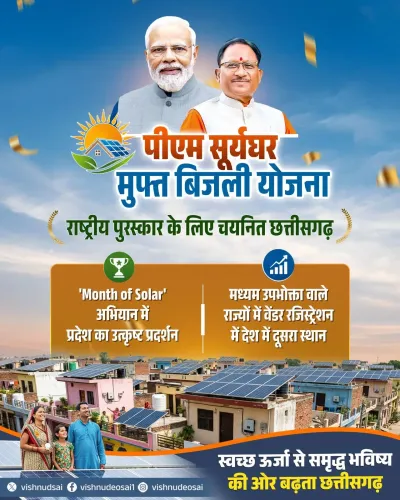
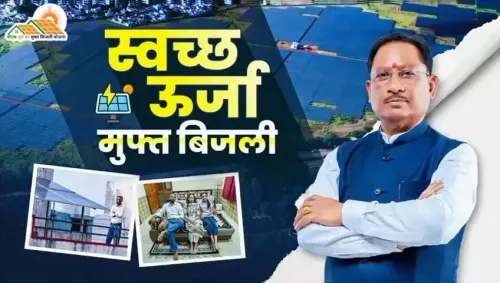
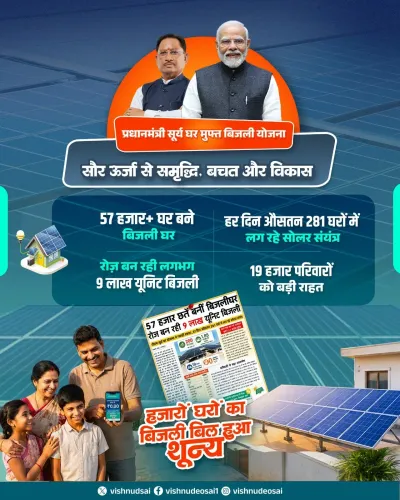
The Chief Minister's Office of Chhattisgarh on 19 July 2026 promoted rooftop solar adoption under the PM Surya Ghar Muft Bijli Yojana .
The Vishnu Deo Sai government is providing an additional state-level subsidy on top of the central scheme's incentive.
The PM Surya Ghar Muft Bijli Yojana , launched in February 2024 , offers subsidies enabling up to 300 units of free electricity per month for residential beneficiaries.
Chhattisgarh 's move mirrors similar dual-subsidy approaches adopted by states such as Gujarat and Maharashtra .
The initiative is framed under the #ViksitChhattisgarh and Aatmanirbhar Chhattisgarh development goals.
Exact quantum and eligibility criteria of the state's additional subsidy are yet to be officially detailed.
The Chief Minister's Office of Chhattisgarh on Sunday, 19 July 2026, urged residents to install rooftop solar panels under the PM Surya Ghar Muft Bijli Yojana, highlighting that the Vishnu Deo Sai government is offering an additional state-level subsidy on top of the central government's existing incentive.
Context
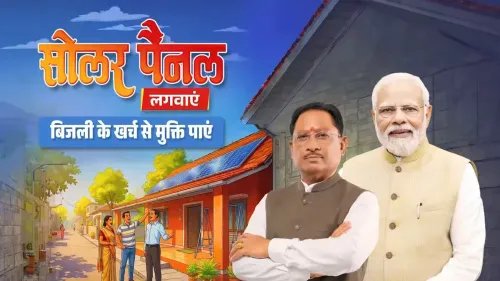
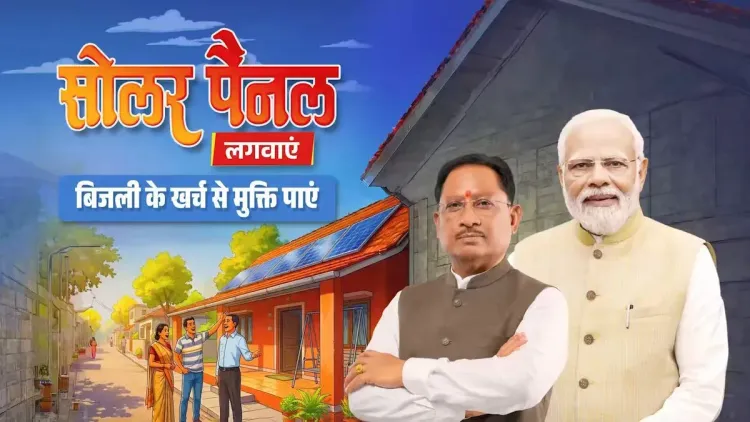
The post, shared from the official handle of the Chief Minister's Office of Chhattisgarh, calls on citizens to adopt solar energy and reduce household electricity expenses. In the original Hindi, the message reads: 'सोलर पैनल लगवाएं, बिजली के खर्च से मुक्ति पाएं' — 'Install solar panels, free yourself from electricity bills.' It explicitly names the PM Surya Ghar Muft Bijli Yojana as the central scheme under which subsidies are available for rooftop solar installation, and states that the Vishnu Deo Sai administration is providing an additional subsidy on top of that support.
Policy Backdrop
The PM Surya Ghar Muft Bijli Yojana was announced in the Union Budget 2024-25 and formally launched in February 2024 by the government of Prime Minister Narendra Modi. The scheme offers subsidies for residential rooftop solar installations and is designed to deliver up to 300 units of free electricity per month to beneficiary households. Chhattisgarh, a central Indian state with a historically large coal-based power generation base, is now layering state incentives onto the national programme as part of a broader push toward renewable energy. Several other states, including Gujarat and Maharashtra, have similarly introduced additional subsidies or simplified approvals to accelerate rooftop solar adoption.
India's renewable energy ambition — targeting 500 GW of non-fossil fuel capacity by 2030 — has driven this pattern of central-state co-financing. State electricity distribution companies also stand to benefit, as wider rooftop solar adoption can reduce the subsidy burden on power utilities by cutting peak residential demand.
Stakeholders and Impact
The primary beneficiaries of the combined subsidy are residential electricity consumers across Chhattisgarh. By pairing the central scheme with a state top-up, the Vishnu Deo Sai government aims to lower the upfront cost barrier that has historically slowed rooftop solar uptake among middle- and lower-income households. The CMO's post frames the initiative as part of building an 'Aatmanirbhar Chhattisgarh' — a self-reliant Chhattisgarh — echoing the broader national self-reliance narrative.
The post also carries the hashtag #ViksitChhattisgarh, linking the solar push to the state's development agenda. Households that install qualifying systems could see a significant reduction in monthly electricity bills, with the potential to export surplus power back to the grid under net-metering arrangements.
What's Next
The quantum and precise eligibility criteria of the Chhattisgarh government's additional subsidy have not yet been officially detailed in public documents available for independent verification. Observers will watch monthly installation figures and the pace of subsidy disbursement over the next two quarters to assess whether the dual-incentive structure translates into measurable uptake. The state's 2026-27 budget allocation for this additional incentive will be a key indicator of the government's long-term fiscal commitment to the programme.
If installation momentum builds, Chhattisgarh could emerge as a model for other coal-heavy states seeking to diversify their energy mix while meeting renewable purchase obligations — a transition that carries both environmental and economic significance for the region.
Point of View
The move also signals an attempt to align with India's 500 GW renewable target ahead of potential scrutiny on state-level renewable purchase obligations. The dual-subsidy structure could meaningfully accelerate residential solar uptake if implementation is smooth, but the absence of publicly disclosed figures for the state top-up leaves the actual fiscal and household impact unclear. How quickly the state disburses combined benefits will determine whether this remains a communication exercise or becomes a substantive energy transition milestone.
NationPress
19 Jul 2026
Frequently Asked Questions
What is the PM Surya Ghar Muft Bijli Yojana?
The PM Surya Ghar Muft Bijli Yojana is a central government scheme launched in February 2024 that provides subsidies for residential rooftop solar panel installation, enabling eligible households to receive up to 300 units of free electricity per month.
Is Chhattisgarh giving extra subsidy for solar panels in 2026?
Yes. The Vishnu Deo Sai government in Chhattisgarh is offering an additional state-level subsidy on top of the central PM Surya Ghar Muft Bijli Yojana subsidy, as announced by the Chief Minister's Office on 19 July 2026. The exact amount and eligibility criteria have not yet been officially detailed.
How do I apply for rooftop solar subsidy in Chhattisgarh?
Residents can apply through the national PM Surya Ghar portal to access the central subsidy. For the additional Chhattisgarh state subsidy, applicants should contact their local electricity distribution company or the state energy department for updated guidelines.
How much free electricity can I get under PM Surya Ghar Yojana?
Under the PM Surya Ghar Muft Bijli Yojana, eligible residential beneficiaries can receive up to 300 units of free electricity per month through the combination of solar generation and subsidy support.
Which states offer additional solar rooftop subsidies in India?
Several states, including Gujarat, Maharashtra, and now Chhattisgarh, have announced additional subsidies or simplified approvals on top of the central PM Surya Ghar Muft Bijli Yojana to accelerate rooftop solar adoption among residential consumers.