CM Sai Pushes PM Surya Ghar Solar Scheme in Chhattisgarh
Synopsis
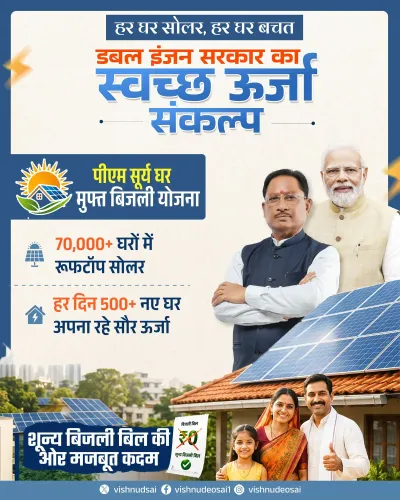
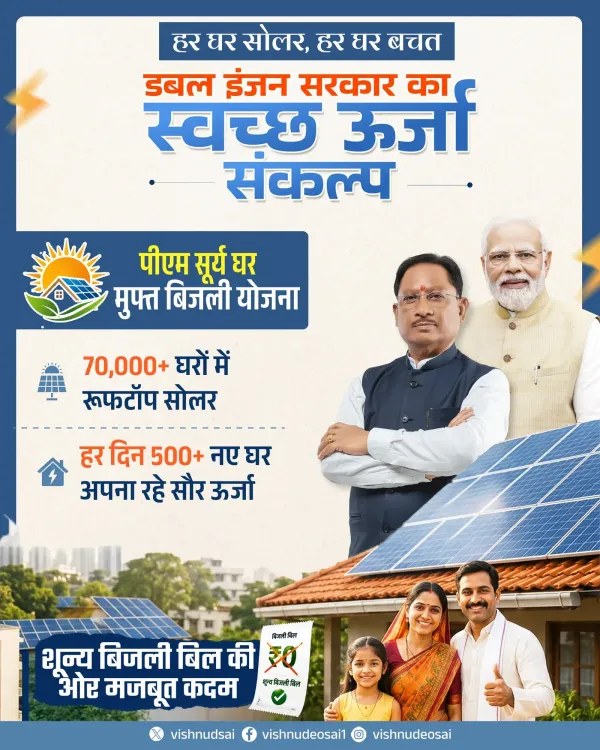
Chhattisgarh Chief Minister Vishnu Deo Sai has reaffirmed the state's push under PM Surya Ghar-Muft Bijli Yojana, saying thousands of families are already on rooftop solar and pledging to drive electricity bills to zero for as many households as possible.
Key Takeaways
CM Vishnu Deo Sai posted on 22 July 2026 reaffirming Chhattisgarh's drive to connect every household to clean, affordable energy.
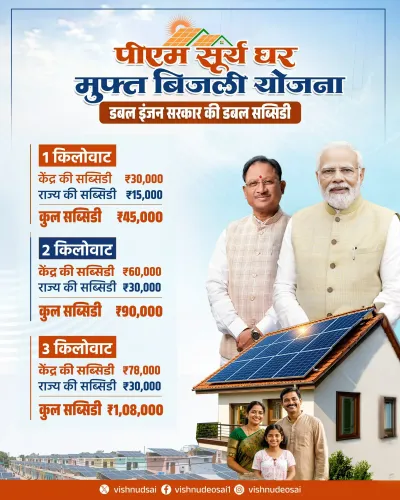
The PM Surya Ghar-Muft Bijli Yojana , launched in February 2024 , offers up to 300 units of free electricity per month via rooftop solar subsidies.
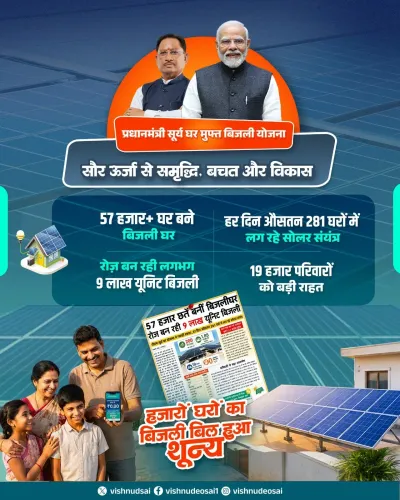
Thousands of families in Chhattisgarh have already been enrolled in rooftop solar installations under the scheme.
The state government's stated goal is to bring electricity bills to zero for the maximum number of households.
The push is framed under the BJP's 'double engine sarkar' model, citing alignment between the state and central governments.
Progress will be tracked through household registration data and subsidy disbursements, with state budget targets a key indicator going forward.
Chhattisgarh Chief Minister Vishnu Deo Sai on Wednesday, 22 July 2026, reaffirmed the state government's commitment to connecting every household in Chhattisgarh to clean and affordable energy through the PM Surya Ghar-Muft Bijli Yojana, stating that thousands of families have already been linked to rooftop solar installations under the scheme.
Context
In his post on X, CM Sai wrote — translated from Hindi — that 'the campaign to connect every household in Chhattisgarh to clean and affordable energy is continuously moving forward through the efforts of the double engine government.' He added that 'thousands of families have already been connected to rooftop solar through the PM Surya Ghar-Muft Bijli Yojana,' and declared the government's resolve that 'the electricity bill of as many homes as possible becomes zero and every family benefits from clean energy along with economic savings.'
The phrase 'double engine sarkar' (double engine government) refers to the BJP's political formulation of having the same party in power at both the state and central levels, enabling faster implementation of central schemes through aligned state machinery.
Policy Backdrop
The PM Surya Ghar-Muft Bijli Yojana was launched in February 2024 following its announcement in the Union Budget 2024. The scheme provides eligible households with subsidies and financing support to install rooftop solar panels, with the stated benefit of up to 300 units of free electricity per month for participating families.
The initiative sits within the broader framework of India's National Solar Mission, which has pursued distributed solar expansion since 2010, with household-level installations receiving sharply renewed emphasis after 2019. Chhattisgarh, a central Indian state with a substantial tribal population, has been among the states prioritising the convergence of such central welfare and energy programmes with state-level delivery infrastructure.
Stakeholders and Impact
The primary beneficiaries of the scheme are residential households, particularly rural and semi-urban families for whom electricity bills represent a significant recurring expense. By reducing or eliminating monthly power costs, the scheme aims to generate direct economic savings for low- and middle-income families.
BJP-governed states have broadly highlighted the 'double engine' model as a mechanism for accelerating central scheme uptake, and Chhattisgarh's push under CM Sai — who took office in December 2023 — follows a pattern seen across similarly governed states where rooftop solar registrations have been presented as a governance benchmark.
What's Next
The state government's stated goal of maximising zero-electricity-bill households will be tracked through household registration numbers and subsidy disbursement data under the scheme. Observers will watch for any revised state-level targets in the next Chhattisgarh state budget, which could signal how aggressively the administration plans to scale installations.
As the scheme matures nationally, Chhattisgarh's progress in converting registrations into active rooftop solar connections will serve as an indicator of how effectively the 'double engine' convergence model translates political messaging into on-ground energy access.
Point of View
Reinforcing the BJP's 'double engine' narrative ahead of any potential review of scheme performance. By foregrounding economic savings — zero electricity bills — rather than environmental goals, the messaging is calibrated for household-level resonance in a state with significant rural and tribal populations. The post fits a broader pattern across BJP-governed states of using social media to claim ownership of central scheme delivery as a state-level governance achievement. Whether the optics translate into verifiable enrolment numbers will determine the political durability of this messaging.
NationPress
22 Jul 2026
Frequently Asked Questions
What is PM Surya Ghar-Muft Bijli Yojana?
PM Surya Ghar-Muft Bijli Yojana is a central government scheme launched in February 2024 that provides subsidies and financing to help households install rooftop solar panels, offering up to 300 units of free electricity per month to eligible families.
How many families have benefited from the solar scheme in Chhattisgarh?
CM Vishnu Deo Sai stated that thousands of families in Chhattisgarh have already been connected to rooftop solar under the PM Surya Ghar-Muft Bijli Yojana, though exact verified figures for the state have not been officially published.
What is the 'double engine government' that CM Sai refers to?
'Double engine government' is a BJP political term describing states where the same party governs both at the state and central levels, which the party argues enables faster and more coordinated implementation of central welfare and infrastructure schemes.
Who is Vishnu Deo Sai?
Vishnu Deo Sai is the BJP Chief Minister of Chhattisgarh, in office since December 2023. He is a senior BJP leader from the state with a background in tribal community representation.
What is the goal of Chhattisgarh's rooftop solar campaign?
The Chhattisgarh government's stated goal is to ensure that as many households as possible achieve a zero electricity bill by connecting them to rooftop solar installations under the PM Surya Ghar-Muft Bijli Yojana, combining clean energy access with direct economic savings for families.