CM Sai Pushes 'Solar for All' to Make Every Roof an Energy Source
Synopsis
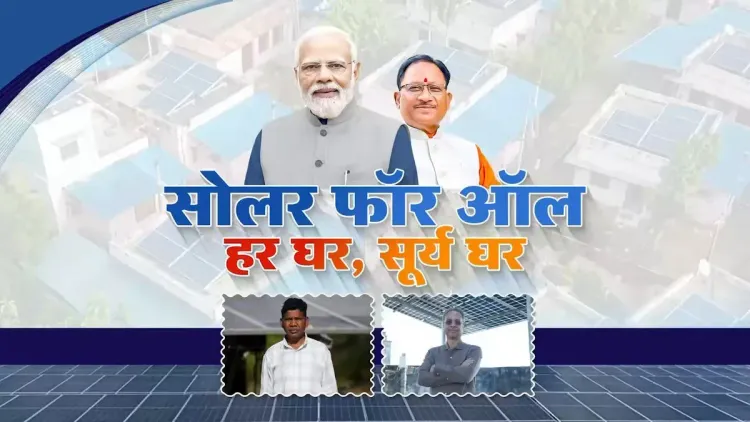
Chhattisgarh Chief Minister Vishnu Deo Sai launched the 'Solar for All' campaign on 24 July 2026, vowing to bring rooftop solar to every eligible family — urban, rural, forest-dwelling, and high-rise residents alike — as part of a drive toward energy self-reliance in the state.
Key Takeaways
CM Vishnu Deo Sai announced the 'Solar for All' campaign on 24 July 2026 , targeting rooftop solar for every eligible household in Chhattisgarh .
The campaign covers four distinct housing categories: urban, rural, forest-area ( vananachal ), and multi-storey residential buildings.
The stated goal is for each consumer to generate their own electricity, making Chhattisgarh energy self-reliant ( aatmanirbhar ).
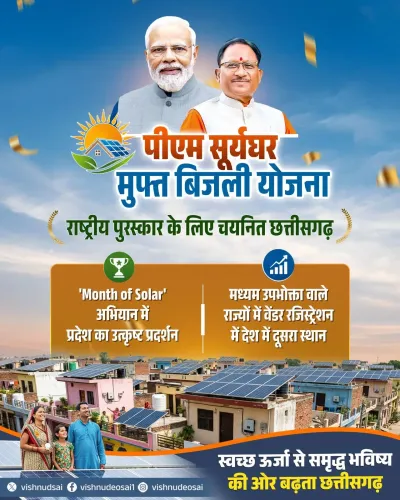
The initiative aligns with India's national target of 500 GW of non-fossil fuel capacity by 2030 and follows similar campaigns in Rajasthan , Gujarat , and Maharashtra .
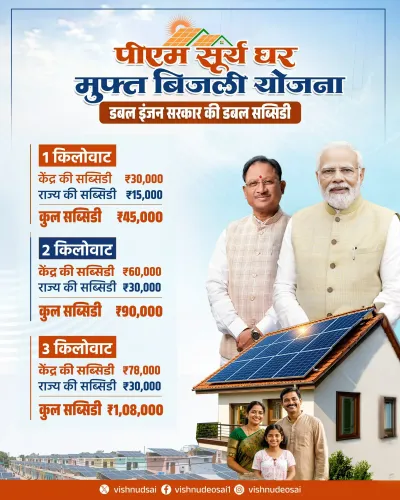
Subsidy amounts, eligibility criteria, and implementation timelines are yet to be officially notified.
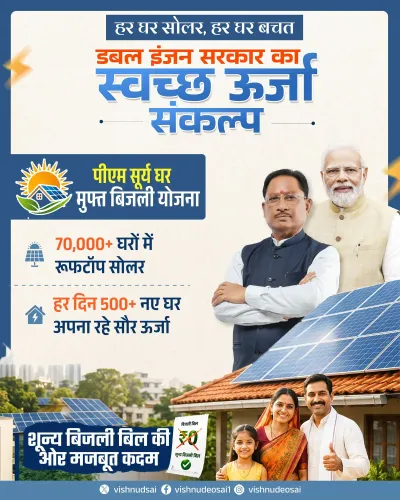
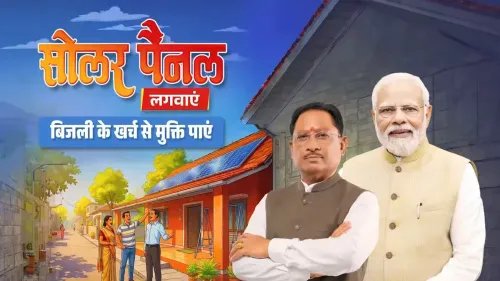
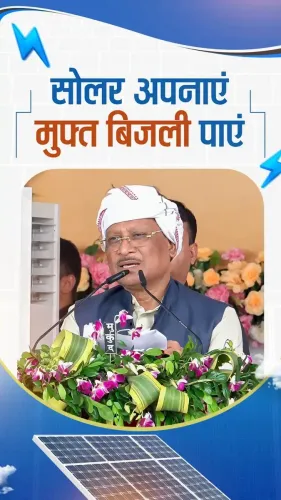
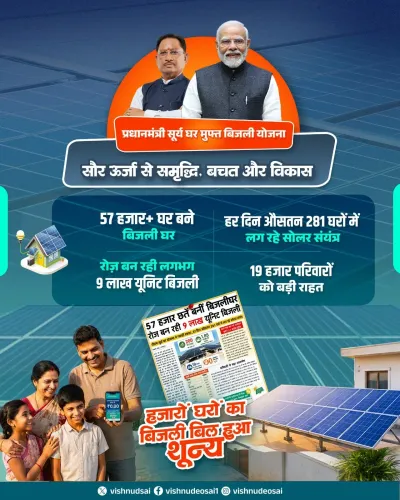
Chhattisgarh Chief Minister Vishnu Deo Sai on Friday, 24 July 2026, declared that the state's 'Solar for All' (Solar for All) campaign will extend rooftop solar benefits to every eligible household — across cities, villages, forest regions, and multi-storey housing complexes — with the goal of making Chhattisgarh self-reliant in energy.
Context
Posting on X, CM Sai outlined the campaign's core pledge in Hindi: 'हर छत बनेगी ऊर्जा का स्रोत, हर परिवार बनेगा आत्मनिर्भर' — 'Every roof will become a source of energy, every family will become self-reliant.' He stated that the resolve is to ensure solar energy's benefits reach every eligible family, whether in urban centres, villages, forest tracts, or high-rise buildings.
The Chief Minister added that the target is for every consumer to generate their own electricity and become a partner in building an energy-self-reliant Chhattisgarh. The post was accompanied by a video, indicating a formal campaign communication rather than an off-the-cuff remark.
Policy Backdrop
Chhattisgarh has maintained a solar policy framework since 2012, with subsequent amendments setting state-level capacity targets including rooftop segments. The 'Solar for All' campaign is the latest expression of that lineage, now framed around household-level energy autonomy rather than utility-scale addition alone.
At the national level, India's Jawaharlal Nehru National Solar Mission, launched in 2010, established the foundational push for grid-connected and off-grid solar applications. The central government's current ambition of 500 GW of non-fossil fuel capacity by 2030 has prompted states to translate that target into localised rooftop programmes. Rajasthan, Gujarat, and Maharashtra have run comparable campaigns over the past decade, turning households into prosumers — simultaneous producers and consumers of electricity.
Decentralised rooftop generation is also seen as a tool to reduce transmission and distribution losses, a persistent challenge for state electricity distribution companies across India.
Stakeholders and Impact
The campaign, as described by CM Sai, is deliberately inclusive in geography: urban households, rural families, communities in Chhattisgarh's forested interior (vananachal), and residents of multi-storey apartment blocks are all named as target beneficiaries. This breadth signals an intent to move beyond the typical urban-rooftop solar model that has dominated earlier state programmes.
For households currently dependent on the state grid — particularly in remote forest areas where supply can be erratic — rooftop solar with net metering or battery storage could meaningfully reduce electricity bills and improve supply reliability. The campaign's framing around aatmanirbharta (self-reliance) also carries political resonance, echoing the central government's broader 'Aatmanirbhar Bharat' narrative.
What's Next
The specifics of the 'Solar for All' campaign — including subsidy quantum, eligibility criteria, empanelled vendors, and annual installation targets — are yet to be formally notified through official state channels. Observers will watch for a detailed policy order that translates the Chief Minister's stated resolve into an operational programme with measurable timelines and budgetary backing.
If the campaign achieves broad uptake, Chhattisgarh could position itself alongside Gujarat and Rajasthan as a benchmark for state-led rooftop solar adoption in India — a signal with implications for how other mineral-rich, energy-producing states approach the clean energy transition.
Point of View
The campaign attempts to bridge the rural-urban divide that has historically complicated solar rollouts in the state. The initiative fits a clear national pattern: state governments are increasingly using rooftop solar as both a clean-energy tool and a direct-benefit programme that is visible to voters at the household level. The campaign's credibility, however, will hinge on the operational details — subsidy structure, vendor empanelment, and grid-integration capacity — none of which have been publicly specified yet.
NationPress
24 Jul 2026
Frequently Asked Questions
What is the 'Solar for All' campaign in Chhattisgarh?
'Solar for All' is a state campaign announced by Chhattisgarh Chief Minister Vishnu Deo Sai on 24 July 2026 , aimed at providing rooftop solar installations to every eligible household across urban, rural, forest, and multi-storey housing areas in the state.
Who will benefit from the Chhattisgarh Solar for All scheme?
All eligible families in Chhattisgarh — including those in cities, villages, forest-interior ( vananachal ) communities, and high-rise apartment buildings — are stated beneficiaries of the campaign.
How does the Chhattisgarh solar campaign relate to the national solar mission?
The campaign aligns with India's goal of achieving 500 GW of non-fossil fuel capacity by 2030 , building on the foundational framework of the Jawaharlal Nehru National Solar Mission launched in 2010 and Chhattisgarh's own solar policy dating to 2012 .
What subsidies or financial support are available under Solar for All in Chhattisgarh?
The subsidy quantum, eligibility criteria, and empanelled vendors for the 'Solar for All' campaign have not yet been officially notified. A formal policy order detailing financial support is awaited from the state government.
Which other Indian states have run similar rooftop solar campaigns?
Rajasthan , Gujarat , and Maharashtra have all implemented comparable state-level rooftop solar programmes over the past decade, turning households into prosumers who both consume and feed electricity into the grid.