CM Sai Urges Chhattisgarh Residents to Guard Against Cyber Fraud
Synopsis
Chhattisgarh Chief Minister Vishnu Deo Sai issued a Hindi-language cyber crime advisory on 27 June 2026, urging citizens to stay vigilant against digital fraud and spread awareness. The appeal connects to India's national cyber crime framework anchored by the I4C and the National Cyber Crime Reporting Portal.
Key Takeaways
CM Vishnu Deo Sai posted a cyber crime awareness advisory on 27 June 2026 on his official X account.
He urged citizens to beware of cyber fraud and called personal vigilance the 'greatest protection.' Citizens were asked to educate not just themselves but also those around them about cyber crimes.
The advisory aligns with the national framework: the Indian Cyber Crime Coordination Centre (I4C) set up in 2018 and the National Cyber Crime Reporting Portal launched in 2019 .
Digital banking and UPI users in Chhattisgarh are among the most vulnerable groups targeted by online fraudsters.
State governments across India increasingly use social media to amplify cyber safety messaging at no additional public cost.
Chhattisgarh Chief Minister Vishnu Deo Sai on Saturday, 27 June 2026 issued a public advisory on cyber crime, urging citizens to stay alert and spread awareness about digital fraud. The post, shared on his official X account, called personal vigilance the strongest defence against cyber criminals.
Context
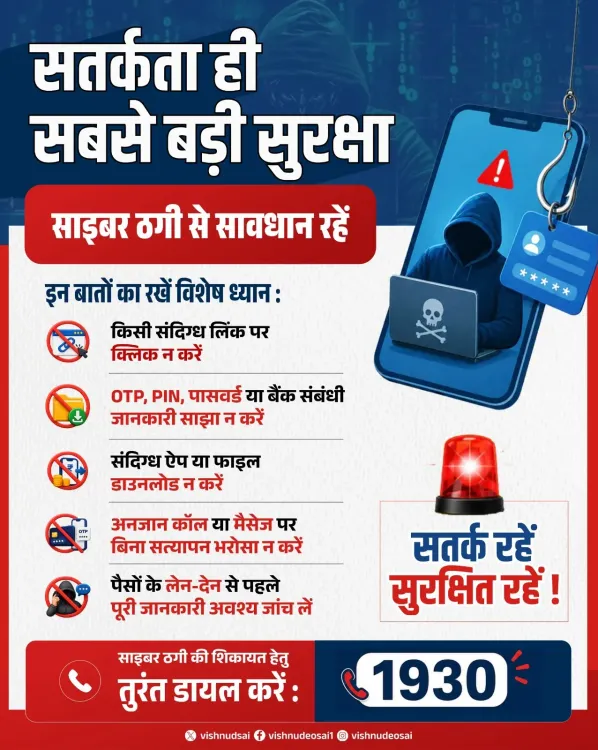
Writing in Hindi, CM Sai warned: 'Cyber thagi se savdhaan rahein' ('Beware of cyber fraud'). He added that awareness is the greatest protection, and called on citizens to educate themselves as well as others around them about cyber crimes. The message was accompanied by an image, reinforcing the advisory nature of the post.
The appeal comes at a time when digital payment adoption across Chhattisgarh and the rest of India has expanded rapidly, widening the potential pool of targets for online fraudsters. State governments have increasingly turned to social media to reach citizens directly with safety messaging.
Policy Backdrop
The advisory aligns with a broader national architecture built to combat cyber crime. The Ministry of Home Affairs launched the National Cyber Crime Reporting Portal in 2019, enabling citizens to report cyber offences online. The Indian Cyber Crime Coordination Centre (I4C), set up in 2018, coordinates the national response and works with state-level agencies.
Chhattisgarh, like other states, participates in awareness campaigns under this framework, complementing dedicated police cyber cells at the district level. Social media advisories from senior officials are a recognised tool within this ecosystem to amplify reach without additional expenditure.
Stakeholders and Impact
The advisory is directed at the general public, with particular relevance for digital banking users, UPI transaction users, and first-time smartphone users in semi-urban and rural areas of Chhattisgarh. These groups have seen the fastest growth in digital adoption and are disproportionately targeted by fraudsters using phishing, vishing, and fake investment schemes.
By framing citizen vigilance — rather than only institutional response — as the primary line of defence, the message places responsibility on individuals to verify calls, links, and payment requests before acting on them.
What's Next
Observers will watch whether this advisory is followed by state-level coordination with I4C or an expansion of district cyber police units to improve complaint redressal speed. A sustained campaign across regional languages and community platforms would be required to translate a single social media post into measurable awareness at the grassroots level. The Sai government has an opportunity to anchor such an effort within its broader digital governance agenda for the state.
Point of View
High-visibility tool that fits a well-established pattern of state governments using executive social media presence to supplement formal law-enforcement outreach. The timing is not incidental: UPI transaction volumes and smartphone penetration in Tier-2 and Tier-3 Chhattisgarh towns have grown sharply, expanding the fraud surface. A single post, however, does not substitute for structured district-level cyber cell capacity or vernacular media campaigns. The real test of the Sai government's commitment to digital security will be whether this advisory is the opening move of a coordinated campaign or a standalone gesture.
NationPress
27 Jun 2026
Frequently Asked Questions
What did Chhattisgarh CM Vishnu Deo Sai say about cyber crime?
CM Vishnu Deo Sai urged citizens to beware of cyber fraud, calling personal vigilance the greatest protection, and asked people to spread awareness about cyber crimes among those around them.
How can I report cyber crime in Chhattisgarh or India?
Citizens can report cyber crimes through the National Cyber Crime Reporting Portal launched by the Ministry of Home Affairs in 2019, or by contacting the local police cyber cell.
What is the Indian Cyber Crime Coordination Centre (I4C)?
The Indian Cyber Crime Coordination Centre (I4C) was established by the Government of India in 2018 under the Ministry of Home Affairs to coordinate the national response to cyber crime and work with state agencies.
Why are cyber fraud cases rising in India?
Cyber fraud cases have increased steadily with the rapid growth of UPI transactions and smartphone penetration since the mid-2010s, which has expanded the number of potential targets for online criminals.
What should I do to protect myself from cyber fraud in India?
Stay alert to unsolicited calls, links, or payment requests; verify the identity of anyone asking for personal or financial information; and report suspicious activity to the National Cyber Crime Reporting Portal or your local cyber police cell.