CM Samrat Choudhary Hails AustralianSuper's $500M India Bet

Synopsis
Bihar Chief Minister Samrat Choudhary on 9 July 2026 welcomed AustralianSuper's reported 500 million Australian dollar investment in India, crediting PM Modi's stable policies and economic leadership for making India a top global investment destination.
Key Takeaways
Bihar CM Samrat Choudhary publicly welcomed AustralianSuper's reported commitment of 500 million Australian dollars to India on 9 July 2026 .
He attributed the investment to PM Narendra Modi's leadership, citing India's 'strong economy, stable policies and rapid growth.' AustralianSuper is one of Australia's largest superannuation funds, making this a significant long-term institutional capital commitment.
The India-Australia Economic Cooperation and Trade Agreement (2022) laid the bilateral framework that facilitates such investment flows.
India's Make in India initiative and successive FDI liberalisation rounds since 2014 underpin the policy environment being cited.
Upcoming Union Budget 2026-27 and RBI FDI data will be key markers for whether similar pension-fund investments follow.
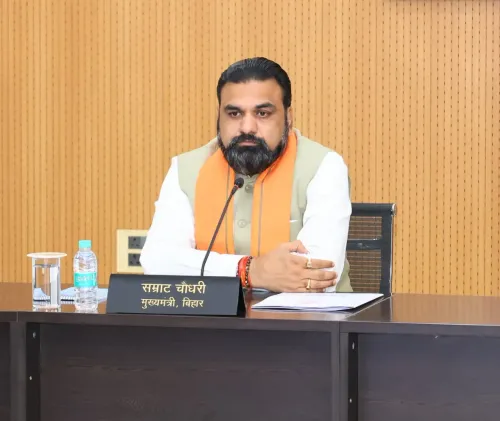
Bihar Chief Minister Samrat Choudhary on Thursday, 9 July 2026, credited Prime Minister Narendra Modi's economic leadership for drawing one of Australia's largest pension funds to commit a landmark investment in India, calling the move a testament to global confidence in the country's growth story.
Writing on X in Hindi, CM Choudhary stated: 'ऑस्ट्रेलियनसुपर द्वारा 500 मिलियन ऑस्ट्रेलियाई डॉलर के निवेश की घोषणा' ('the announcement of an investment of 500 million Australian dollars by AustralianSuper') is 'proof of global trust in India's strong economy, stable policies and rapid growth.' He attributed the development squarely to PM Modi's leadership, describing India as having emerged as 'the most trusted and attractive investment destination for global investors.'
Context
AustralianSuper is one of Australia's largest superannuation funds, managing retirement savings with a mandate to seek returns in high-growth international markets. A commitment of 500 million Australian dollars to India would represent a significant allocation by a pension-style institution into an emerging economy, signalling long-term confidence rather than speculative capital flows.
The announcement drew an immediate political response from senior BJP leaders across states, with CM Choudhary among the first to frame it as validation of the Modi government's economic stewardship at the national level.
Policy Backdrop
India has pursued sustained foreign direct investment liberalisation since the early 2010s, with the Make in India initiative launched in 2014 serving as a flagship framework to attract global manufacturers and institutional investors alike. Successive rounds of sectoral reforms — spanning infrastructure, manufacturing, and services — have contributed to rising FDI inflows over the past decade.
The bilateral investment environment received a structural boost in 2022 when India and Australia concluded an Economic Cooperation and Trade Agreement (ECTA), creating a more predictable framework for cross-border capital flows. That agreement reflected shared interests in democratic governance and rules-based trade, and is widely seen as the foundation on which institutional investors like AustralianSuper can build long-term exposure to India.
India is currently the fifth-largest economy globally, and policymakers have positioned it as an alternative manufacturing and services hub as global supply chains diversify away from single-country dependence.
Stakeholders and Impact
For global pension and superannuation funds, India's combination of demographic growth, infrastructure expansion, and improving ease of doing business makes it an increasingly compelling allocation. AustralianSuper's reported commitment, if confirmed through official channels, could encourage peer funds to evaluate similar exposures.
Domestically, the announcement reinforces a political narrative the BJP has consistently advanced: that stable governance and investor-friendly policies under PM Modi have structurally elevated India's standing in global capital markets. For Bihar, a state that has been working to attract its own share of industrial investment, statements like CM Choudhary's also serve to align state-level ambitions with the national investment story.
What's Next
The Union Budget 2026-27 and subsequent Reserve Bank of India FDI data releases will be closely watched to determine whether AustralianSuper's commitment translates into confirmed inflows and whether comparable pension-fund announcements follow. Any follow-up discussions at Australia-India Joint Economic Commission meetings will also be a key indicator of whether this marks a one-off allocation or the start of a broader institutional trend.
If large superannuation funds from other developed economies take cues from this move, India could see a qualitative shift in its FDI composition — from project-specific flows to long-duration institutional capital, which would have meaningful implications for infrastructure financing and sovereign credit perception.
Point of View
Rather than a conventional corporate investor, is politically significant: pension capital signals long-horizon confidence, which is harder to dismiss as transactional. It also reflects a broader pattern in which the India-Australia relationship, cemented by the 2022 ECTA, is being actively leveraged to demonstrate that democratic alignment translates into tangible economic dividends. Whether the investment materialises at the scale cited will determine how durable this narrative proves to be.
NationPress
9 Jul 2026
Frequently Asked Questions
What is AustralianSuper's investment in India?
AustralianSuper , one of Australia's largest superannuation funds, has announced an investment of 500 million Australian dollars in India, according to a post by Bihar CM Samrat Choudhary on 9 July 2026 . The investment is being cited as a sign of global institutional confidence in India's economy.
Why did Bihar CM Samrat Choudhary comment on AustralianSuper?
CM Samrat Choudhary commented on the AustralianSuper announcement to credit PM Narendra Modi's economic policies — including stable governance and investor-friendly reforms — for making India an attractive global investment destination.
What is the India-Australia Economic Cooperation and Trade Agreement?
The India-Australia Economic Cooperation and Trade Agreement (ECTA) , concluded in 2022 , is a bilateral trade and investment framework that reduces tariffs and creates a more predictable environment for cross-border capital flows between the two countries.
What is Make in India and how does it relate to FDI?
Make in India is a flagship initiative launched by the Modi government in 2014 to attract foreign investment into Indian manufacturing and services. It has been accompanied by successive rounds of FDI liberalisation across sectors, contributing to rising inflows over the past decade.
What will indicate whether more pension funds invest in India after AustralianSuper?
The Union Budget 2026-27 and Reserve Bank of India FDI data releases will be key indicators. Follow-up announcements at Australia-India Joint Economic Commission meetings will also signal whether AustralianSuper's commitment triggers a broader trend among global pension funds.