CM Samrat Choudhary Hails CBSE Maithili Recognition
Synopsis
Bihar Chief Minister Samrat Choudhary has hailed CBSE's decision to recognise Maithili as a mother-tongue subject from Class 1 to the secondary level, calling it historic and crediting PM Modi's leadership in promoting Indian languages under the NEP 2020 framework.
Key Takeaways
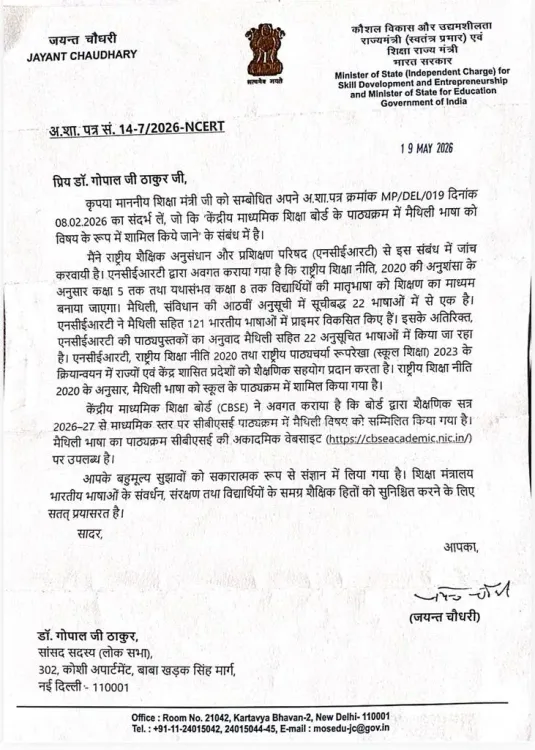
CBSE has included Maithili as a mother-tongue subject from Class 1 to the secondary level in its curriculum.
Bihar Chief Minister Samrat Choudhary described the decision as 'historic and most welcome' on 25 May 2026 .
Maithili is listed in the Eighth Schedule of the Indian Constitution and is spoken by millions primarily in northern Bihar .
The decision aligns with the National Education Policy 2020 , which recommended mother-tongue instruction at least up to Grade 5.
A phased rollout of Maithili textbooks and teacher training by CBSE is expected to follow.
The move continues a broader pattern of CBSE expanding language offerings, following earlier inclusions of Sanskrit, Urdu, and Tamil .
Bihar Chief Minister Samrat Choudhary on Monday, 25 May 2026, welcomed the Central Board of Secondary Education's decision to include Maithili as a mother-tongue subject from Class 1 to the secondary level in its curriculum, calling it a historic and deeply welcome step for the cultural identity of the Mithila region.
Context
Posting in Hindi on X, CM Choudhary described the decision as 'ऐतिहासिक एवं अत्यंत स्वागतयोग्य' ('historic and most welcome'), saying it would give Maithili 'a new identity and respect.' He credited Prime Minister Narendra Modi's leadership for continuously strengthening the preservation and promotion of Indian languages, cultures, and traditions.
Maithili is spoken by tens of millions of people primarily in northern Bihar and parts of the Terai region. It holds the distinction of being listed in the Eighth Schedule of the Indian Constitution, making this CBSE recognition a formal alignment of national curriculum policy with constitutional status.
Policy Backdrop
The move draws directly from the National Education Policy (NEP) 2020, which recommended mother tongue or regional language as a medium of instruction and as a subject at least until Grade 5, with the broader aim of strengthening foundational learning and cultural rootedness. The CBSE inclusion extends that principle to the secondary level for Maithili.
This step continues a pattern of CBSE expanding its language offerings to reflect India's linguistic diversity — earlier inclusions of Sanskrit, Urdu, and Tamil as board-level subjects followed similar state-level and community-level demands. The decision signals an effort to align the national curriculum framework with the country's multilingual reality without fragmenting a common academic structure.
Stakeholders and Impact
The most immediate beneficiaries are Maithili-speaking students enrolled in CBSE-affiliated schools across Bihar and beyond, who will now have the option to study their mother tongue as a formal subject from the earliest grades. Educationists have long argued that learning in or through the mother tongue improves comprehension, cognitive development, and school retention rates among young children.
For the broader Mithila cultural ecosystem — including writers, scholars, and community organisations — the recognition is seen as institutional validation of a language that has a literary tradition stretching back centuries. The decision also has implications for CBSE-affiliated schools in Nepal's Terai, where Maithili is widely spoken, though curriculum adoption there would depend on bilateral arrangements.
What's Next
CBSE will need to oversee the phased development of Maithili-medium textbooks and the training of qualified language teachers to make the inclusion operational. The pace of this rollout will determine how quickly students can actually access the subject. Observers will also watch whether similar notifications follow for other regional languages with constitutional recognition, as the Maithili decision could serve as a template for future inclusions under the NEP framework.
For Bihar's political landscape, the announcement ahead of the state's ongoing development narrative gives the ruling alliance an opportunity to consolidate support among Maithili-speaking communities. The broader implication is that language policy is increasingly becoming a site where national education reform and regional cultural assertion converge.
Point of View
Publicly crediting PM Modi's leadership on the issue is also a deliberate act of political alignment, tying a culturally resonant win to the BJP's broader narrative of civilisational pride and linguistic preservation. The move carries electoral undertones in Bihar, where Maithili-speaking communities are a significant demographic bloc. More broadly, it raises the question of whether this marks the beginning of a systematic expansion of CBSE's language catalogue under NEP, or remains an isolated recognition.
NationPress
10 Oct 2026
Frequently Asked Questions
What is the CBSE Maithili inclusion decision?
CBSE has recognised Maithili as a mother-tongue subject from Class 1 to the secondary level in its curriculum, giving Maithili-speaking students the option to formally study their language in CBSE-affiliated schools.
Why did Bihar CM Samrat Choudhary welcome the CBSE Maithili decision?
CM Samrat Choudhary called the decision historic because it gives institutional recognition to the language and culture of the Mithila region, which he said would connect future generations to their roots.
Is Maithili an official Indian language?
Yes, Maithili is listed in the Eighth Schedule of the Indian Constitution, making it one of India's 22 scheduled languages. The CBSE inclusion now formally aligns national curriculum policy with that constitutional status.
How does NEP 2020 relate to the Maithili CBSE inclusion?
The National Education Policy 2020 recommended mother tongue or regional language as a subject and medium of instruction at least until Grade 5. The CBSE Maithili inclusion extends this principle to the secondary level.
What happens next after CBSE includes Maithili in its curriculum?
CBSE will need to develop Maithili-medium textbooks and conduct teacher training as part of a phased rollout before students can access the subject in affiliated schools.