CM Sawant Hails India's 7% Growth as Fastest Major Economy
Synopsis
Goa Chief Minister Pramod Sawant highlighted India's projected 7% GDP growth on October 13, 2026, calling it the world's fastest-growing major economy and crediting PM Modi's reform agenda — including Aatmanirbhar Bharat and GST — for the country's resilience amid global headwinds, El Niño pressures, and geopolitical turbulence.
Key Takeaways
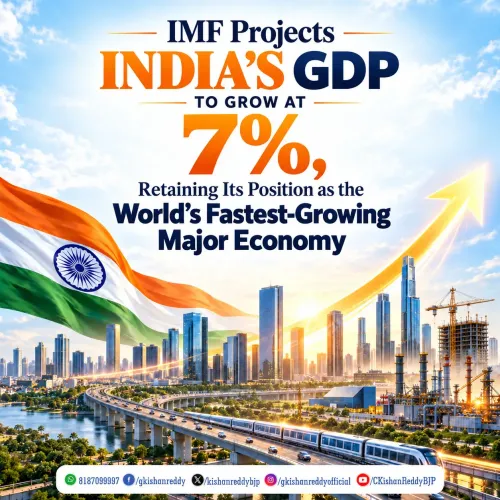
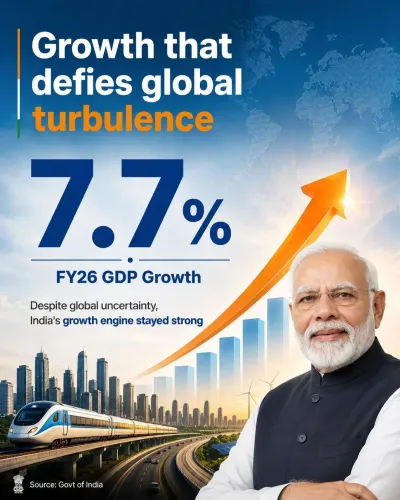
India's GDP is projected to grow at 7% , retaining its position as the world's fastest-growing major economy, according to Goa CM Pramod Sawant's post.
Growth is attributed to strong economic fundamentals , sustained structural reforms and rising national confidence under PM Narendra Modi .
The Aatmanirbhar Bharat Abhiyan , launched in May 2020 with a Rs 20 lakh crore package, remains a cornerstone of the government's self-reliance strategy.
GST , implemented in July 2017 , unified India's indirect tax system and is cited as a foundational reform enabling sustained economic growth.
Global headwinds cited include El Niño disruptions , geopolitical turmoil , and broader economic uncertainty facing major world economies.
The next Economic Survey and Union Budget will offer updated official benchmarks to assess the 7% projection .
Even as global markets wrestle with geopolitical shocks and erratic weather patterns, India is holding its line — and then some. Goa Chief Minister Pramod Sawant on Tuesday, October 13, 2026, cited a 7% GDP growth projection for India, underscoring the country's standing as the world's fastest-growing major economy amid a turbulent global environment.
A 7% Projection in a World Full of Headwinds
Sawant's post names three concurrent pressures bearing down on global growth: El Niño-linked climate disruptions, sustained geopolitical turmoil, and broader global economic headwinds. Against that backdrop, a 7% growth rate is not a routine statistic — it is a statement of structural staying power. India has repeatedly been cited in official and multilateral assessments as the fastest-growing among the world's major economies, a distinction the government has anchored to a decade of sustained reform.
The Chief Minister attributed this resilience squarely to 'strong fundamentals, sustained reforms and the nation's growing confidence' under Prime Minister Narendra Modi — framing economic performance as both a policy outcome and a national confidence story.
The Reform Architecture Behind the Numbers
The policy lineage Sawant invokes is real and traceable. The Goods and Services Tax, rolled out in July 2017, unified India's fragmented indirect tax structure into a single national market — a reform economists had debated for two decades. The Aatmanirbhar Bharat Abhiyan, announced in May 2020 with a Rs 20 lakh crore stimulus framework during the COVID-19 crisis, pivoted national economic strategy toward domestic manufacturing, supply-chain localisation, and reduced import dependence.
Production-linked incentive schemes under the same umbrella have since pulled investment into sectors from semiconductors to smartphones, pharmaceuticals to defence equipment — all designed to build the kind of industrial base that insulates growth from external shocks.
Why a Goa CM's Post Reads as a National Signal
Sawant's commentary is routine for BJP chief ministers, who frequently amplify the Centre's economic narrative on social media. But the three-phrase close — 'Resilient Bharat. Rising Bharat. Aatmanirbhar Bharat.' — is deliberate brand language, deployed across the party ecosystem to tie state-level governance to the larger Modi-era economic story. It signals that the BJP's 2026 political pitch still runs through the economy, and that the growth-versus-global-chaos contrast remains the preferred frame.
With the next Economic Survey and Union Budget on the horizon, and multilateral bodies expected to update their India forecasts, this 7% projection will soon face official scrutiny. If the numbers hold, expect the narrative to amplify considerably.
Point of View
Party-wide brand around growth and self-reliance. The invocation of Aatmanirbhar Bharat and PM Modi in a single breath is not incidental — it ties local governance credibility to national economic performance ahead of what could be a significant budget cycle. With multilateral bodies yet to officially confirm the 7% figure, the political framing is running ahead of the official data — a gap the next Economic Survey will either close or complicate. If the projection holds, it hands the BJP a powerful re-election talking point across multiple state cycles.
NationPress
13 Oct 2026
Frequently Asked Questions
What is India's projected GDP growth rate in 2026?
Goa Chief Minister Pramod Sawant cited a 7% GDP growth projection for India in a post dated October 13, 2026 , describing it as the fastest growth rate among the world's major economies.
What is Aatmanirbhar Bharat and why is it being mentioned?
Aatmanirbhar Bharat Abhiyan is a self-reliance initiative launched by the central government in May 2020 with a Rs 20 lakh crore economic package. It promotes domestic manufacturing and reduces India's import dependence, and is frequently cited as a pillar of India's economic resilience.
Why is India called the world's fastest-growing major economy?
India has consistently been described in official and multilateral assessments as the fastest-growing major economy due to sustained structural reforms — including GST implementation in 2017 and production-linked incentive schemes — and strong domestic demand that has buffered the country from global slowdowns.
What global risks does India's economy currently face?
CM Sawant flagged three key risks: El Niño-linked climate disruptions , ongoing geopolitical turmoil , and broader global economic headwinds. Despite these pressures, India's growth trajectory is being maintained, according to the projection he cited.
What will confirm India's official growth rate for 2026?
The upcoming Economic Survey and Union Budget are expected to provide official growth estimates. Statements from multilateral institutions such as the IMF on India's GDP projections will also serve as key benchmarks.