CM Siddaramaiah Chairs Katalyst Connect GCC Meet in Karnataka
Synopsis
Karnataka Chief Minister DK Shivakumar addressed Global Capability Centre leaders at the Katalyst Connect interaction on 8 July 2026, invoking 'Team Karnataka' to signal a unified, partnership-first approach to the state's dominant technology-services sector.
Key Takeaways
Chief Minister DK Shivakumar addressed GCC leaders at the Katalyst Connect interaction on 8 July 2026 .
He framed the engagement around the collective identity of 'Team Karnataka' , positioning the state as a partner to multinational firms.
Bengaluru hosts India's largest concentration of Global Capability Centres, making Karnataka the leading GCC destination nationally.
Karnataka competes with Maharashtra , Tamil Nadu and Telangana for new GCC campus investments.
The state's IT policy frameworks date to the 1990s , underpinning decades of technology-sector investment attraction.
Follow-up announcements on policy incentives, land allocations and working groups will indicate the meeting's concrete outcomes.
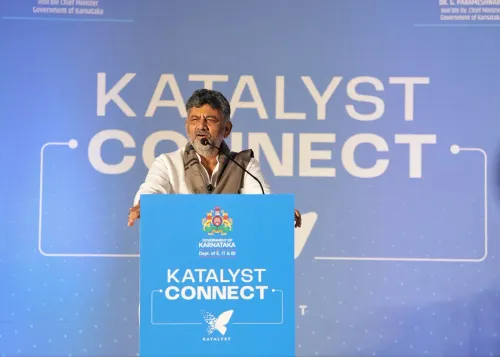
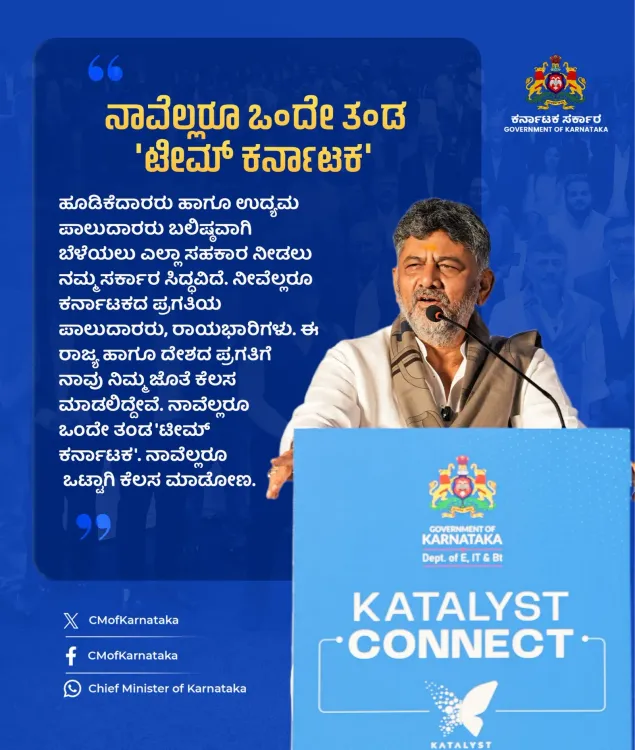
The Chief Minister's Office of Karnataka announced on Wednesday, 8 July 2026 that Chief Minister Shri DK Shivakumar addressed the Katalyst Connect interaction, a closed-door engagement with leaders of Global Capability Centres (GCCs), rallying participants under the collective banner of 'ಟೀಮ್ ಕರ್ನಾಟಕ' ('Team Karnataka').
Context
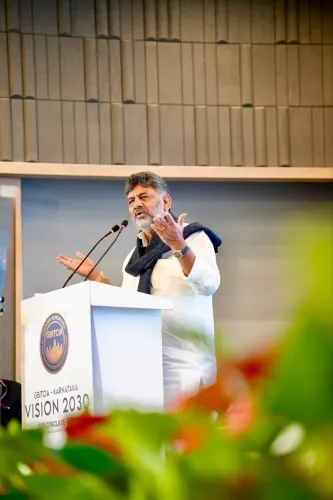
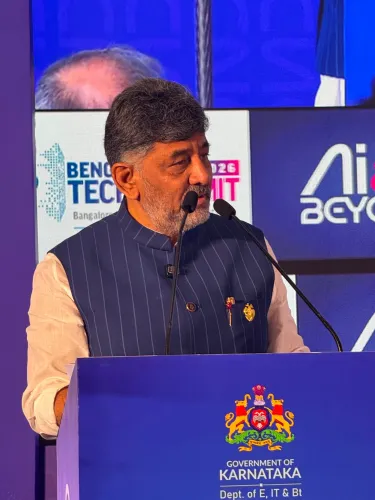
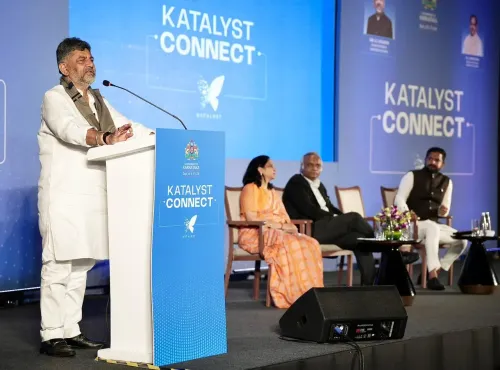
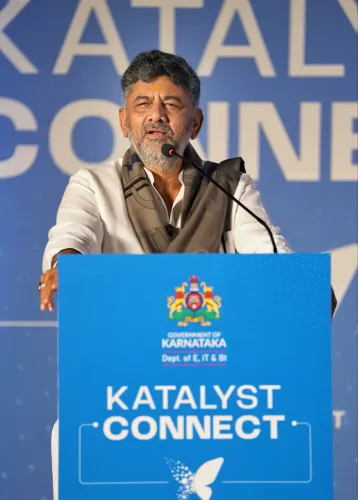
Speaking at the Katalyst Connect session, Chief Minister Shivakumar struck a collaborative tone, declaring: 'We are all Team Karnataka.' The phrase signals the state government's intent to position itself as a unified partner — rather than a regulator — to the multinational firms that operate GCCs out of Bengaluru and other Karnataka cities. The Chief Minister's Office shared highlights of the address on X (formerly Twitter) alongside three images from the event.
GCCs are offshore delivery hubs established by global corporations for functions ranging from information technology and engineering to finance and research and development. Bengaluru hosts the largest concentration of such centres in India, making Karnataka the default first stop for multinationals scouting their next captive unit.
Policy Backdrop
Karnataka's engagement with the technology services sector stretches back to the 1990s, when successive state IT policy frameworks introduced single-window clearances and dedicated infrastructure to attract multinational investment. Those early moves seeded Bengaluru's identity as India's technology capital and laid the foundation for the GCC ecosystem that now employs hundreds of thousands of skilled workers across the state.
The Katalyst Connect format — convening GCC heads directly with senior political leadership — reflects a broader shift in state-level industrial outreach. Rather than relying solely on large investor summits, state governments have begun scheduling targeted, sector-specific interactions to address granular concerns around talent pipelines, real-estate costs and regulatory facilitation in near-real time.
Stakeholders and Impact
The primary beneficiaries of a reinvigorated Karnataka GCC push are the multinational corporations that use these centres to deliver services globally, and the skilled tech workforce — engineers, finance professionals and data scientists — who fill those roles. Karnataka's GCC density also generates downstream demand for commercial real estate, ancillary services and mid-tier supplier firms across the state.
Karnataka competes directly with Maharashtra, Tamil Nadu and Telangana for each new GCC campus decision. The 'Team Karnataka' branding is a deliberate counter-narrative to inter-state competition, emphasising ecosystem depth and government responsiveness as differentiators. GCCs now account for a rising share of India's services exports, making their location decisions consequential for national economic metrics as well.
What's Next
Observers will watch for concrete follow-through from the Katalyst Connect interaction — specifically any policy incentives, land allocations for new GCC campuses, or joint working groups announced in the weeks ahead. The state government's ability to convert the goodwill of a 'Team Karnataka' framing into binding commitments from GCC leaders will be the real test of the meeting's impact.
If Karnataka can institutionalise the Katalyst Connect format as a regular feedback loop between GCC leadership and the Chief Minister's Office, it could set a template for how Indian states manage their most globally integrated industries going forward.
Point of View
Not a bureaucratic gatekeeper. This mirrors a nationwide pattern of state governments personalising investor outreach at the chief ministerial level to compress deal timelines. For DK Shivakumar, the optics of convening global tech leaders reinforces a governance narrative centred on economic stewardship — valuable political currency in a state where the urban tech workforce is an influential constituency. The real measure of success, however, will be whether Katalyst Connect produces binding policy commitments or remains a high-visibility interaction without structural follow-through.
NationPress
7 Oct 2026
Frequently Asked Questions
What is the Katalyst Connect meeting in Karnataka?
Katalyst Connect is a closed-door interaction organised by the Karnataka government to bring Chief Minister DK Shivakumar and senior officials face-to-face with leaders of Global Capability Centres operating in the state, with the aim of addressing their policy and infrastructure concerns directly.
What are Global Capability Centres and why are they important to Karnataka?
Global Capability Centres are offshore hubs set up by multinational corporations for IT, engineering, finance and R&D work. Karnataka, particularly Bengaluru, hosts India's largest concentration of GCCs, making them a major source of skilled employment and services exports for the state.
What did CM DK Shivakumar say at the Katalyst Connect event?
Chief Minister DK Shivakumar declared 'We are all Team Karnataka,' framing the state government and GCC leaders as unified partners rather than separate stakeholders, according to highlights shared by the Chief Minister's Office of Karnataka on 8 July 2026.
How does Karnataka compare with other states in attracting GCCs?
Karnataka competes primarily with Maharashtra, Tamil Nadu and Telangana for new GCC investments. Bengaluru's established talent pool and decades of IT-friendly policy give Karnataka a structural advantage, though rival states have been aggressively offering competing incentives.
What policy outcomes are expected after the Katalyst Connect GCC meeting?
Observers are watching for follow-up announcements including new policy incentives, land allocations for GCC campuses, or the formation of joint working groups between the state government and GCC leaders to resolve operational challenges.