CM Yogi calls Ayodhya Deepotsav a global 'cultural Ram Setu'
Synopsis
Uttar Pradesh CM Yogi Adityanath called Ayodhya's Deepotsav a 'cultural Ram Setu' connecting India and the world, noting artists from Sri Lanka, Indonesia, Thailand and South Africa. He contrasted the festival's global scale with the pre-2017 government's Saifai Mahotsav and credited PM Modi's guidance.
Key Takeaways
CM Yogi Adityanath described Ayodhya's Deepotsav as a 'cultural Ram Setu' bridging India with the world on 4 November 2026 .
Artists from Sri Lanka, South Africa, Indonesia, and Thailand performed Ramkatha in their own languages and traditions at the festival.
Yogi credited PM Narendra Modi and the 'double-engine government' for elevating Ayodhya's cultural identity since 2017 .
He drew a sharp contrast with the Saifai Mahotsav , associated with the pre-2017 Samajwadi Party government, calling it limited to 'family glory.' Modern technology — including digital staging — is being used to connect younger generations to India's Sanatan heritage through the festival.
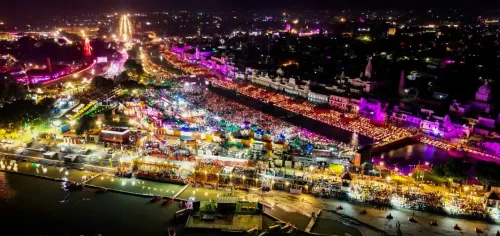
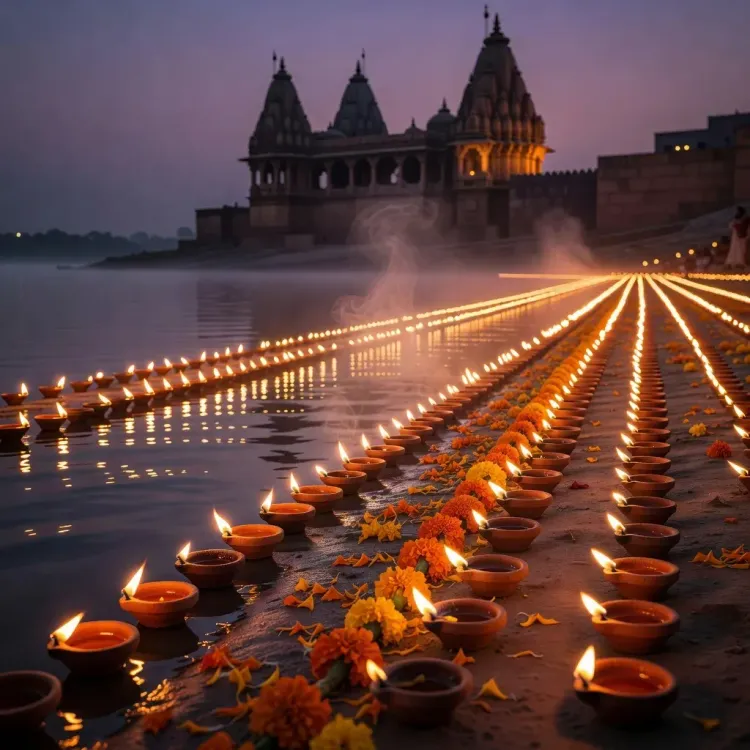
A festival of lamps is quietly becoming a festival of nations. On Wednesday, 4 November 2026, Uttar Pradesh Chief Minister Yogi Adityanath declared that Ayodhya's Deepotsav has evolved into an extraordinary 'sांस्कृतिक रामसेतु' — a 'cultural Ram Setu' — bridging India with the world through the living tradition of Ramkatha.
In his post, CM Yogi described artists from Sri Lanka, South Africa, Indonesia, Thailand and several other nations bringing the story of Ram to life in their own languages and traditions. His metaphor was precise: 'जैसे अनेक नदियां एक ही सागर में मिलती हैं' — 'just as many rivers meet the same ocean, the streams of different cultures converge in Ayodhya into a single essence of Ramness.'
From local lamp to global stage: what Deepotsav has become
Since the BJP government took office in Uttar Pradesh in 2017, the state has systematically repositioned Ayodhya — regarded as the birthplace of Lord Ram — as the centrepiece of a large-scale cultural project. Each edition of Deepotsav has layered traditional Ramkatha performances with modern technology, drawing international artists and generating mass participation from across the country. The scale and the multinational character of the festival are what distinguish it sharply from earlier state-backed events.
CM Yogi specifically credited Prime Minister Narendra Modi's 'yashashvi margdarshan' — 'illustrious guidance' — and what he called the 'double-engine government' for giving Ayodhya's cultural identity new glory. The reference to double-engine is the BJP's standard formulation for aligned state and central governments working in concert.
The dig at Saifai — and the politics of cultural memory
Yogi did not let the celebratory moment pass without a pointed contrast. He wrote that those in power before 2017 confined their cultural imagination to the Saifai Mahotsav — a festival held in Etawah district historically associated with the Samajwadi Party — which he characterised as a showcase for 'family glory.' His formulation was blunt: 'उनके लिए परिवार ही प्रदेश था, हमारे लिए पूरा प्रदेश ही परिवार है' — 'For them, family was the state; for us, the entire state is family.'
The line is a compressed political argument: that the previous administration's cultural priorities were narrow and dynastic, while the present government's are expansive and civilisational. It frames the Deepotsav not merely as a religious celebration but as a rebuttal written in a hundred thousand diyas.
Technology, heritage, and the next generation
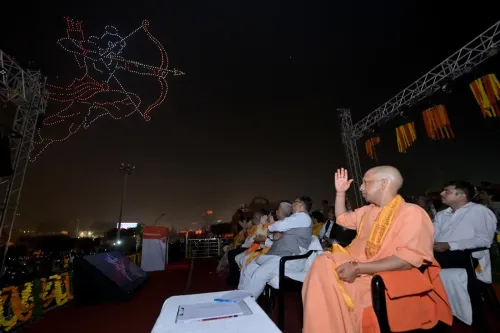
Yogi's post also flagged the role of modern technology — light projections, digital staging — in making the 'sांस्कृतिक sangam' more spectacular and in connecting younger generations to what he called India's 'gauravshali virasat', its glorious heritage. The convergence of ancient narrative and contemporary production values is a deliberate part of the Ayodhya cultural strategy, aimed at making the city's heritage legible and magnetic to audiences well beyond the devout.
He closed with the declaration that today's Deepotsav is not merely a festival of lamps but a confluence of the faith of crores of Ram devotees, modern technology, and India's Sanatan heritage — 'whose radiance is reaching the entire world.' Jai Jai Shri Ram.
When a city built around a 7,000-year-old epic starts drawing artists from four continents, something larger than a local festival is clearly under construction — and Lucknow is making sure the whole world notices.
Point of View
But its deployment at the peak of a globally attended festival maximises its reach and contrast. For the BJP, Ayodhya's transformation into an international cultural hub is a core proof-point of governance — the argument being that cultural nationalism, when backed by infrastructure and technology, produces tangible outcomes rather than just rhetoric. The strategic elevation of Ayodhya as a soft-power export — with Ramkatha carried by South African and Indonesian artists — also signals an attempt to build civilisational bridges that parallel India's growing diplomatic footprint in the Global South.
NationPress
4 Nov 2026
Frequently Asked Questions
What is Deepotsav in Ayodhya?
Deepotsav is an annual festival of lights held in Ayodhya, Uttar Pradesh, featuring mass lamp lighting, Ramkatha performances, and cultural programmes from India and abroad. The Uttar Pradesh government has significantly expanded the event since 2017.
Which countries participated in Ayodhya Deepotsav 2026?
CM Yogi Adityanath's post named Sri Lanka, South Africa, Indonesia, and Thailand among the countries whose artists performed Ramkatha at Deepotsav 2026 in Ayodhya.
What is the Saifai Mahotsav that CM Yogi criticised?
Saifai Mahotsav is a cultural event held in Etawah district of Uttar Pradesh, historically associated with the Samajwadi Party leadership. CM Yogi contrasted its perceived family-centric character with the broader, state-wide vision of Deepotsav.
What did CM Yogi mean by 'cultural Ram Setu'?
By 'cultural Ram Setu', CM Yogi Adityanath meant that Ayodhya's Deepotsav has become a cultural bridge connecting India with the world, much as the mythological Ram Setu connected India and Sri Lanka in the Ramayana.
How has Ayodhya changed since 2017 under CM Yogi?
Since the BJP government formed in Uttar Pradesh in 2017, Ayodhya has seen major infrastructure upgrades, the construction of the Ram Mandir, and the expansion of Deepotsav into an internationally attended cultural festival combining traditional performance with modern technology.