CM Yogi frames UP governance on three pillars: culture, security, self-reliance
Synopsis
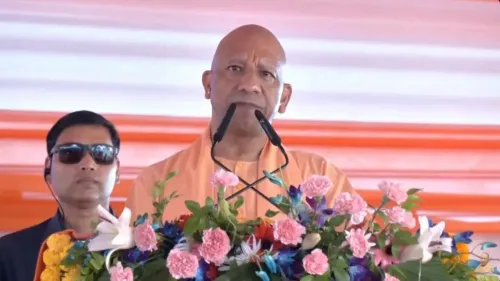
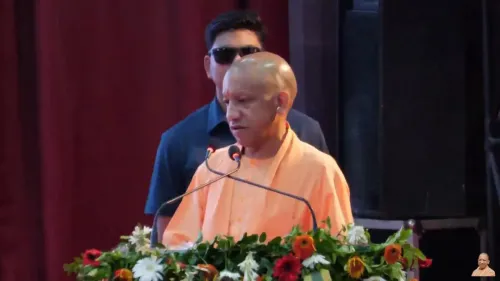
UP Chief Minister Yogi Adityanath reaffirmed his government's three-pillar governance doctrine — culture, security and self-reliance — in a video post on X, encapsulating a policy approach his administration has pursued since taking office in 2017.
Key Takeaways
CM Yogi Adityanath posted on X on 30 September 2026 declaring his government simultaneously pursues culture, security and self-reliance.
The three-pillar framework — sanskriti, suraksha, swavalamban — has defined UP governance since 2017 .
Cultural initiatives include the Kashi Vishwanath Corridor , Ayodhya redevelopment, and the rebranding of Allahabad as Prayagraj .
The One District One Product (ODOP) programme and two UP Global Investors Summits anchor the self-reliance agenda.
The state has publicly targeted becoming a $1 trillion economy , framing development as inseparable from cultural and security priorities.
The video-format post signals the messaging is directed at UP's 240 million residents , not just policy audiences.
Three words — sanskriti, suraksha, swavalamban (culture, security, self-reliance) — have become the governing grammar of Uttar Pradesh under Uttar Pradesh Chief Minister Yogi Adityanath, and on Wednesday, 30 September 2026, he made that explicit in a video post on X that distilled nearly a decade of state policy into a single sentence.
The Chief Minister's post, in Hindi, reads: 'Hamari sarkar sanskriti, suraksha aur swavalamban ek saath lekar chal rahi hai' — 'Our government is moving forward with culture, security and self-reliance together.' Compact as the line is, it maps directly onto three distinct and measurable arcs of UP governance since 2017.
The 'Sanskriti' thread: heritage as state policy
Under Adityanath, Uttar Pradesh has repositioned itself as India's foremost custodian of Hindu and composite cultural heritage. From the redevelopment of the Kashi Vishwanath Corridor in Varanasi and the Ram Mandir complex in Ayodhya to the rebranding of Allahabad as Prayagraj, cultural identity has been a deliberate policy lever — not just electoral signalling. The state has also pushed investment into folk arts, religious tourism circuits, and the promotion of the Kumbh Mela as a global event, drawing record pilgrim footfall.
The 'Suraksha' thread: how law-and-order became a political brand
When Adityanath took office in March 2017, Uttar Pradesh carried a reputation for routine lawlessness. His administration responded with high-profile anti-crime drives, the expansion of the Anti-Terror Squad, and a notably aggressive stance on organised crime. The government has repeatedly cited declining crime statistics — particularly against women — as evidence of a transformed law-and-order environment. Critics have questioned methods; supporters point to investor confidence returning to a state once avoided for its security climate.
The 'Swavalamban' thread: UP's economic pivot
Self-reliance, the third pillar, translates on the ground into a push for industrial investment, MSME growth, and farmer income. The state has hosted two editions of the UP Global Investors Summit, drawing investment pledges in the hundreds of thousands of crores. Agricultural schemes, the One District One Product (ODOP) programme — which maps every district to a signature local industry or craft — and infrastructure buildout from expressways to data centres all feed this narrative. UP's ambition, stated explicitly by the government, is to become a $1 trillion economy.
Why this framing matters now
Condensing governance into a slogan is a political act as much as an administrative one. With assembly elections still years away but the political cycle always turning, Adityanath's three-pillar frame signals both an accountability claim ('here is what we promised and delivered') and a forward mandate ('here is what the next phase looks like'). The video format — not a press release, not a policy document — underlines that this is a message aimed at voters as much as officials. The question UP's 240 million residents will eventually answer at the ballot box: do the three pillars hold?
Point of View
Memorable identity — making governance auditable by the voter's own gut check. The framing is not new; it has been the spine of BJP's Uttar Pradesh narrative since 2017, but its repetition in 2026 signals the party intends to contest any future election on incumbency, not just aspiration. What makes it politically durable is that each pillar speaks to a distinct constituency — cultural conservatives, middle-class families anxious about safety, and aspirational youth seeking economic opportunity — without visibly trading one off against another. The risk, as always with grand frames, is that the gap between slogan and measurable outcome becomes the opposition's sharpest weapon.
NationPress
1 Oct 2026
Frequently Asked Questions
What does Yogi Adityanath mean by sanskriti, suraksha and swavalamban?
The three Hindi words translate to culture, security and self-reliance respectively, and represent the three stated pillars of Yogi Adityanath's governance model for Uttar Pradesh since 2017.
What is the One District One Product scheme in Uttar Pradesh?
The One District One Product (ODOP) programme maps each of UP's 75 districts to a signature local industry or handicraft, channelling government support to strengthen that product's production, branding and market access.
What is Uttar Pradesh's $1 trillion economy target?
The Uttar Pradesh government has set an official ambition of making the state a $1 trillion economy, positioning it as a major growth engine for India through industrial investment, MSME development and infrastructure expansion.
When did Yogi Adityanath become Chief Minister of Uttar Pradesh?
Yogi Adityanath first became Chief Minister of Uttar Pradesh in March 2017 after the BJP's landslide victory in state assembly elections.
What cultural projects has the Yogi Adityanath government undertaken?
Major cultural projects include the Kashi Vishwanath Corridor redevelopment in Varanasi, the Ram Mandir precinct development in Ayodhya, the renaming of Allahabad to Prayagraj, and large-scale infrastructure for the Kumbh Mela.