CM Yogi Hails Bahraich Farmers for Leading UP's Natural Farming Push
Synopsis
Chief Minister Yogi Adityanath has lauded Bahraich as one of Uttar Pradesh's top districts for natural farming adoption, congratulating its farmers for advancing chemical-free agriculture in line with state and central sustainability goals.
Key Takeaways
The Chief Minister's Office of Uttar Pradesh cited Bahraich as one of the foremost districts in the state for natural farming adoption as of 21 July 2026 .
CM Yogi Adityanath personally congratulated Bahraich's farmers for their 'commendable work' in chemical-free cultivation.
Natural farming eliminates synthetic fertilisers and pesticides, lowering input costs and improving long-term soil health.
The initiative is supported nationally by the Bharatiya Prakritik Krishi Padhati (BPKP) , a sub-scheme under Paramparagat Krishi Vikas Yojana , launched in 2020 .
Uttar Pradesh has embedded natural farming targets into its state agricultural strategy, using district-level recognition to drive wider adoption.
Bahraich's success may serve as a model for expanding natural farming clusters across other districts in the state.
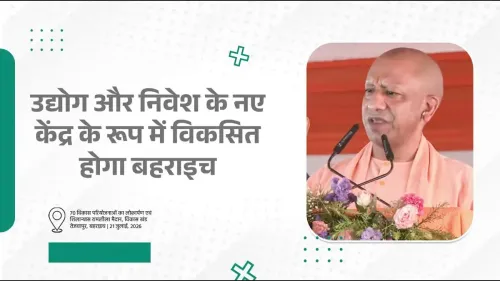
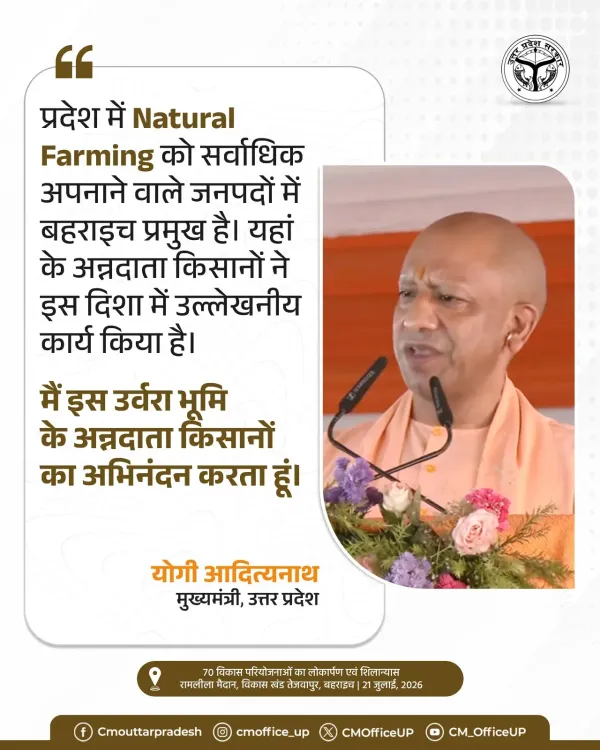
The Chief Minister's Office of Uttar Pradesh, citing Chief Minister Yogi Adityanath, on Tuesday, 21 July 2026, recognised Bahraich as one of the leading districts in the state for adoption of natural farming, commending its farmers for their 'remarkable work' in sustainable agriculture.
Posting on behalf of the Chief Minister, the office quoted him as saying: 'प्रदेश में Natural Farming को सर्वाधिक अपनाने वाले जनपदों में बहराइच प्रमुख है' — 'Among the districts that have adopted Natural Farming the most in the state, Bahraich is foremost.' The Chief Minister added that the annadata (provider-of-grain) farmers of this urwara bhoomi (fertile land) have done 'commendable work' in this direction, and extended his congratulations to them.
Context
Bahraich is a district in eastern Uttar Pradesh bordering Nepal, situated in the fertile Indo-Gangetic plains. The district has a predominantly agrarian economy with a large population of smallholder farmers. The Chief Minister's acknowledgement singles out Bahraich from among Uttar Pradesh's 75 districts, positioning it as a model for chemical-free cultivation. Natural farming eliminates synthetic fertilisers and pesticides, relying instead on locally available biological inputs. The approach is designed to lower input costs for farmers, restore soil microbial health, and reduce the ecological burden of intensive chemical agriculture — concerns that are particularly acute in the densely cultivated Indo-Gangetic belt.Policy Backdrop
The recognition aligns with a multi-layered policy architecture. At the national level, the Bharatiya Prakritik Krishi Padhati (BPKP), introduced in 2020 as a sub-scheme under Paramparagat Krishi Vikas Yojana, provides a framework and funding mechanism for scaling natural farming across Indian states. Uttar Pradesh has integrated natural farming targets into its broader agricultural strategy, with an emphasis on district-level adoption and farmer training programmes. The state's approach involves identifying districts where uptake is highest and using them as demonstration clusters to encourage neighbouring areas. District-level recognition of the kind extended to Bahraich is a deliberate tool in this strategy, creating peer-level incentives among farming communities across the state.Stakeholders and Impact
The primary beneficiaries are small and marginal farmers in Bahraich, who stand to gain from reduced dependence on purchased chemical inputs — a significant cost burden for low-income cultivators. Improved soil health over successive seasons can also translate into more stable yields, reducing vulnerability to input price shocks. Beyond individual farmers, the broader ecosystem — including soil, groundwater, and local biodiversity — benefits from reduced chemical runoff. For the state government, district-level success stories such as Bahraich provide evidence to support expanded programme funding and help build farmer confidence in transitioning away from conventional practices.What's Next
The spotlight on Bahraich signals that the Uttar Pradesh government may look to replicate its natural farming model in additional districts, potentially forming expanded clusters linked to central funding under BPKP. As the state continues to push sustainable agriculture as both an ecological and economic imperative, district-level recognition is likely to become a recurring feature of its outreach — with Bahraich's experience serving as a template for the broader Indo-Gangetic farming belt.Point of View
The government creates a reputational incentive for other districts to compete in natural farming uptake. This fits a broader national arc in which state governments are expected to demonstrate measurable progress on sustainable agriculture to unlock central funds under schemes like BPKP. The move also allows the Yogi administration to align its agrarian messaging with ecological priorities ahead of what are likely to be increasingly climate-stressed agricultural seasons in the Indo-Gangetic plains.
NationPress
21 Jul 2026
Frequently Asked Questions
What is natural farming and why is UP promoting it?
Natural farming is a chemical-free agricultural method that uses locally available biological inputs instead of synthetic fertilisers and pesticides. Uttar Pradesh is promoting it to reduce input costs for farmers, restore soil health, and support climate-resilient agriculture across the state.
Why has Bahraich been recognised for natural farming in UP?
Bahraich has been identified by Chief Minister Yogi Adityanath as one of the districts with the highest natural farming adoption in Uttar Pradesh. The district's farmers have reportedly made notable progress in transitioning to chemical-free cultivation, earning a public commendation from the Chief Minister.
What is the Bharatiya Prakritik Krishi Padhati (BPKP)?
BPKP is a central government sub-scheme under Paramparagat Krishi Vikas Yojana, introduced in 2020, to promote and fund the scaling of natural farming practices across India.
How does Bahraich's natural farming recognition affect other UP districts?
By publicly singling out Bahraich, the state government creates a peer-level incentive for other districts to accelerate natural farming adoption, as district administrations and farmer groups may seek similar recognition and associated programme support.
What are the benefits of natural farming for small farmers in UP?
Small and marginal farmers benefit primarily from lower input costs since they no longer need to purchase expensive chemical fertilisers and pesticides. Over time, improved soil health can also lead to more stable yields and reduced vulnerability to input price fluctuations.