CM Yogi: UP's 19 Lakh Officials Must Show Training in Better Services

Synopsis
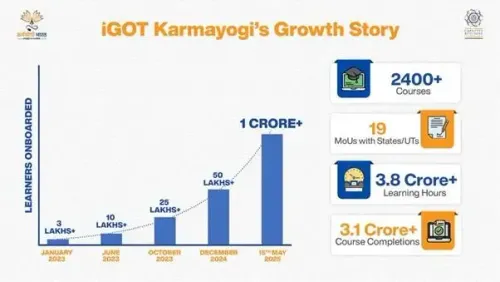
Uttar Pradesh's CMO revealed over 19 lakh government employees have completed nearly 4 crore iGOT Karmayogi training courses, with 334-plus institutes on the Unnati portal. CM Yogi Adityanath called for success to be measured in better citizen services and decisions, not certificates.
Key Takeaways
Over 19 lakh 26 thousand Uttar Pradesh government employees are registered on the iGOT Karmayogi portal .
Collectively, they have completed nearly 4 crore training courses on the platform.
More than 334 training institutions in UP are linked to the state's Unnati portal .
CM Yogi Adityanath explicitly stated that success must be measured in better citizen services and simpler processes, not certificate counts.
Mission Karmayogi was launched by the Government of India in 2021 to shift civil-service training from rule-based to competency-based learning.
Uttar Pradesh's dual-track model — national iGOT platform plus state Unnati network — positions it as one of the largest state adopters of the central reform framework.
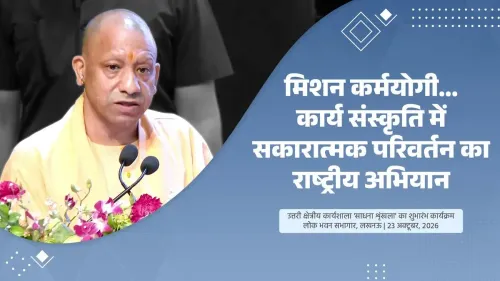
Certificates are not the finish line — that is the pointed message Chief Minister Yogi Adityanath delivered on Friday, October 23, 2026, as the Chief Minister's Office of Uttar Pradesh shared a striking governance milestone: over 19 lakh 26 thousand state government employees are now registered on the iGOT Karmayogi portal, and together they have completed nearly 4 crore training courses.
The announcement arrived with a sharp caveat. Quoting Chief Minister Adityanath directly, the CMO post stated: 'Prashikshan ki vastavik safalta pramaaN patr ki sankhya se nahin, balki behtar nirnayo, saral prakriyaon aur nagrikon ko mili behtar sevaon mein dikhai deni chahiye' — 'The real success of training should show not in the number of certificates, but in better decisions, simpler processes, and improved services to citizens.'
A state-level surge on a national platform
Mission Karmayogi, launched by the Government of India in 2021, was designed to move civil-service training away from seniority-based rule compliance toward competency-based, role-specific learning — delivered digitally. Uttar Pradesh's enrolment figures represent one of the largest state-level adoption stories on the central iGOT Karmayogi portal, which serves as the national online hub for this shift.
Running parallel is the state's own infrastructure layer: the Unnati portal, which now links more than 334 training institutions across Uttar Pradesh. That network gives the state a two-track approach — national platform for content and certification, state network for institutional coordination.
Why CM Yogi's qualifier matters
The scale of the numbers is striking. Nearly 4 crore course completions across a workforce of roughly 19 lakh means each registered employee has, on average, completed more than twenty courses. Yet the Chief Minister chose to front-load a warning, not a celebration — and that framing is deliberate.
Governance reform programmes across India have long struggled with a 'compliance trap': employees log courses to tick boxes, but on-ground service delivery remains slow, opaque, or inaccessible. By publicly redirecting the benchmark from enrolment to outcomes — faster decisions, simpler workflows, better citizen interfaces — Adityanath is signalling that the next phase of scrutiny will be qualitative, not quantitative.
The output test now looms for UP bureaucracy
What does 'better service' actually look like in measurement terms? That question now sits at the centre of Uttar Pradesh's civil-service reform roadmap. Analysts watching state-level implementation of Mission Karmayogi say the credibility of the programme depends entirely on whether departments can demonstrate links between training modules and improvements in grievance resolution times, scheme-disbursement speeds, or digital service uptake.
Uttar Pradesh, India's most populous state with a government workforce that touches virtually every district, is a bellwether. If training can be shown to move the needle on citizen-facing outcomes here, it becomes a replicable model. If not, the certificate count — however impressive — remains a number on a dashboard.
The journey, as the Chief Minister put it, does not end here. The next chapter will be written not in course completions, but in the daily experience of ordinary citizens walking up to a government counter.
Point of View
Placing the state among the most active implementers of the Centre's Mission Karmayogi framework. However, CM Yogi's deliberate pivot from scale to outcomes signals an awareness that training-programme credibility in India has consistently stalled at the certification stage. By publicly setting a qualitative benchmark, the Chief Minister is managing expectations ahead of any outcome audit — while also insulating the programme against the criticism that digital training is cosmetic compliance. The real political test will come when citizen-satisfaction metrics and grievance-resolution data are placed alongside these enrolment figures.
NationPress
23 Oct 2026
Frequently Asked Questions
What is the iGOT Karmayogi portal?
iGOT Karmayogi is the national online training platform launched under the central government's Mission Karmayogi programme in 2021, designed to provide competency-based, role-specific digital learning to government employees across India.
How many UP government employees are on iGOT Karmayogi?
Over 19 lakh 26 thousand Uttar Pradesh government employees are registered on the iGOT Karmayogi portal, and they have collectively completed nearly 4 crore training courses.
What is the Unnati portal in Uttar Pradesh?
Unnati is a Uttar Pradesh state-level portal that links government training institutions to coordinate personnel development; more than 334 institutes across the state are currently connected to it.
What is Mission Karmayogi?
Mission Karmayogi is a Government of India programme launched in 2021 to reform the civil services by shifting training from rule-based compliance to role-based, competency-driven digital learning for government employees.
What did CM Yogi say about government training programmes?
CM Yogi Adityanath said the real success of training should not be measured by the number of certificates but by better decisions, simpler processes, and improved services delivered to citizens.