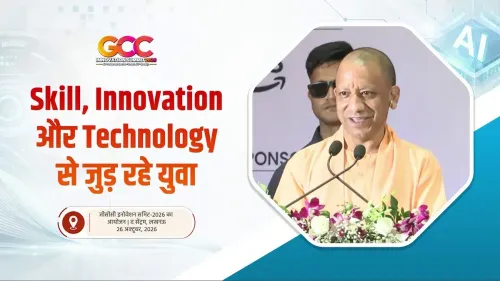
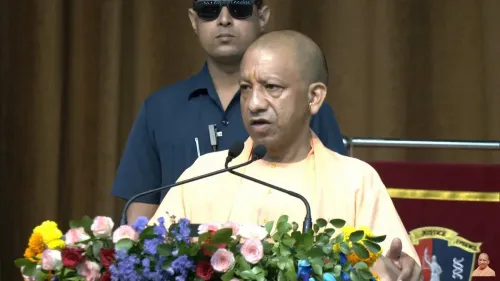
CM Yogi: UP produces 2 lakh+ STEM graduates yearly

Synopsis
Uttar Pradesh is producing over two lakh STEM graduates annually and training students in quantum forensics and scientific policing, with Tata, Samsung, HCL and Hinduja co-building an industry-ready workforce, CM Yogi Adityanath announced on 15 November 2026.
Key Takeaways
Uttar Pradesh produces more than 2 lakh STEM graduates per year, according to Chief Minister Yogi Adityanath's office.
The UP State Institute of Forensic Sciences now offers emerging subjects including Scientific Policing and Quantum Forensics .
Global and Indian firms — Tata, Samsung, Hinduja and HCL — are partnering with the state to build a future-ready, industry-ready workforce.
The initiative aligns with post-2017 UP higher education expansion and the National Education Policy 2020 push for multidisciplinary STEM skilling.
The strategy directly addresses youth out-migration by creating local talent pipelines tied to companies with UP operations.
More than two lakh STEM graduates roll out of Uttar Pradesh every year — and the state is now betting that quantum forensics and scientific policing can be as career-defining as a software engineering degree. Chief Minister Yogi Adityanath's office made the case on Sunday, 15 November 2026, spotlighting a workforce push that pairs classroom expansion with direct industry muscle.
Forensics, quantum science, and a new kind of campus
At the heart of the announcement is the Uttar Pradesh State Institute of Forensic Sciences, where students are now pursuing disciplines such as Scientific Policing and Quantum Forensics — subjects that sit at the intersection of criminal justice and cutting-edge science. Chief Minister Yogi Adityanath framed it plainly: 'STEM yani Science, Technology, Engineering aur Mathematics' (STEM meaning Science, Technology, Engineering and Mathematics), signalling that the state is broadening what 'technical education' means beyond traditional engineering colleges. The forensics institute represents a deliberate effort to create specialised talent pipelines for law enforcement and public safety — sectors that have historically lagged behind in structured professional training.
This sits within a wider arc. After 2017, the Uttar Pradesh government aggressively expanded its network of technical and professional institutions, partly in response to the National Education Policy 2020, which pushed states to integrate multidisciplinary STEM learning with real-world skill development.
Tata, Samsung, HCL, Hinduja: the corporate classroom
The numbers mean little without a destination for graduates, and that is where the corporate partnerships land. Tata, Samsung, Hinduja and HCL — a mix of Indian conglomerates and global electronics giants — are now working alongside the state to shape what the CM's office calls a 'Future-Ready and Industry-Ready Workforce.' These are not token memoranda of understanding: Samsung has an established manufacturing and training footprint in Uttar Pradesh, while HCL has pursued industry-academia tie-ups across North India. Tata, with its sprawling technology and manufacturing arms, adds breadth to what industries graduates can actually walk into.
The logic is straightforward — and consequential. Uttar Pradesh is India's most populous state, and youth out-migration to metros like Delhi, Bengaluru and Mumbai has long drained local talent. By co-designing curricula with companies that have local or near-local operations, the state is trying to make the talent chain shorter: study here, get hired here.
What the UP STEM push signals for India's skills race
India's broader competition for tech investment — with states like Karnataka, Tamil Nadu and Telangana historically dominant — is partly a talent competition. A state that can credibly supply two lakh-plus technically trained graduates annually, backed by global brand names willing to co-invest in that pipeline, changes its pitch to investors considerably. Uttar Pradesh's industrial corridor projects and data centre investments in recent years have already begun shifting perception. The workforce narrative is the demand-side complement to that supply-side story.
Watch for placement data from the forensic sciences institute and the depth of curriculum co-design agreements with the named firms — those will reveal whether this partnership model produces genuinely job-ready graduates or remains aspirational.
Point of View
The Yogi government is building a composite narrative — educational capacity plus employer endorsement — that speaks directly to investors evaluating talent availability. The forensics angle is notably distinct: it ties workforce development to state governance priorities around law enforcement modernisation, reinforcing a broader 'law and order plus growth' brand the administration has cultivated since 2017. Whether placement rates and curriculum depth match the ambition will ultimately determine if this becomes a replicable model for India's larger northern states.
NationPress
15 Nov 2026
Frequently Asked Questions
How many STEM graduates does Uttar Pradesh produce each year?
According to Chief Minister Yogi Adityanath's office, Uttar Pradesh produces more than two lakh (200,000) STEM graduates annually.
What is the UP State Institute of Forensic Sciences?
It is a state-run institute in Uttar Pradesh that trains students in advanced forensic disciplines, including Scientific Policing and Quantum Forensics.
Which companies are partnering with Uttar Pradesh for workforce development?
Tata, Samsung, Hinduja and HCL are among the global and Indian firms collaborating with the UP government to create a future-ready, industry-ready workforce.
What is Quantum Forensics and why is UP teaching it?
Quantum Forensics applies emerging quantum science principles to criminal investigation and evidence analysis. UP is introducing it to position graduates at the frontier of law enforcement technology.
How does UP's STEM push relate to National Education Policy 2020?
NEP 2020 emphasised multidisciplinary STEM education and skill integration; Uttar Pradesh's post-2017 expansion of technical institutions and industry partnerships is aligned with those national priorities.