Dr. Jitendra Singh Hails Lavender's Rise from Bhaderwah to Pan-India
Synopsis
Union Minister Dr. Jitendra Singh on July 7, 2026 hailed lavender's transformation from a Bhaderwah, Doda pilot into a pan-India success across four states, crediting the NDA government and the CSIR Aroma Mission for linking science with hill farmers.
Key Takeaways
Jitendra Singh credited the BJP-led NDA government under PM Modi with scaling lavender cultivation from Bhaderwah, Doda to a pan-India crop.
Lavender is now being cultivated in Uttarakhand, Himachal Pradesh, Nagaland , and Arunachal Pradesh , replicating the Jammu and Kashmir model.
The CSIR Aroma Mission , launched in 2016 , is the central policy vehicle linking scientific institutions with hill farmers for aromatic crop scale-up.
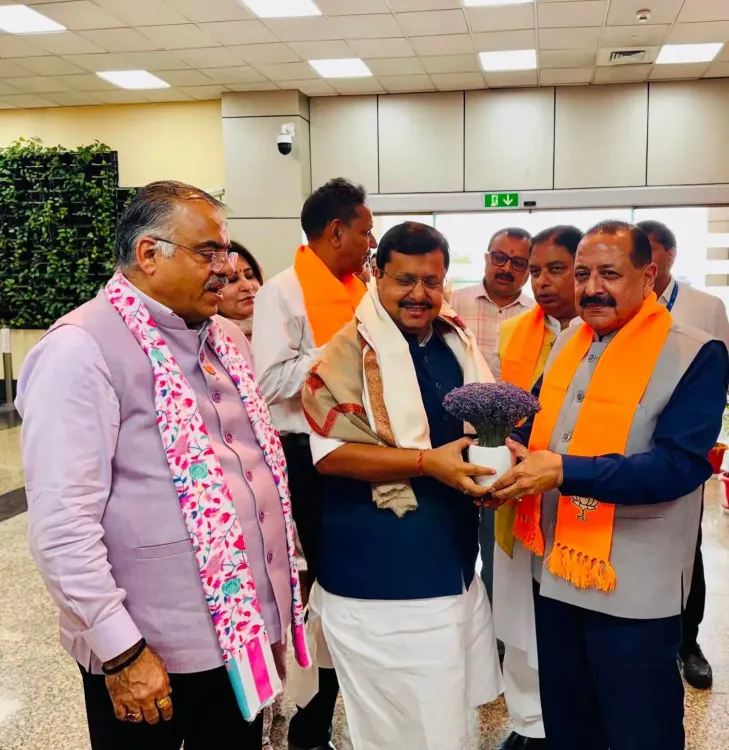
Singh presented a lavender souvenir to BJP National President Nitin Nabin , underscoring the political significance attached to the initiative.
Domestic lavender essential oil production supports India's self-reliance goals in phytopharmaceuticals and fragrance ingredients .
Future progress depends on distillation infrastructure and procurement support in newly adopting states, particularly in the northeast.
Union Science and Technology Minister Dr. Jitendra Singh on Tuesday, July 7, 2026, credited the BJP-led NDA government under Prime Minister Narendra Modi with transforming lavender cultivation from a modest pilot in Bhaderwah, Doda district of Jammu and Kashmir into a pan-India agricultural success story, now replicated across Uttarakhand, Himachal Pradesh, Nagaland, and Arunachal Pradesh.
Context
Dr. Singh made the remarks while presenting a lavender souvenir to BJP National President Shri Nitin Nabin, calling it 'a unique occasion' to mark the crop's journey. In his post on X, the minister wrote that the government 'made India realise the enormous real value of Lavender, which began its modest journey from a small town of Bhaderwah in district Doda.' The gesture underscored the political symbolism now attached to lavender as an emblem of grassroots agricultural transformation under the current dispensation.
Bhaderwah, a hill town in the Chenab Valley, has over the past decade become synonymous with India's lavender economy. The town's agro-climatic conditions — high altitude, cool temperatures, and well-drained slopes — closely mirror the lavender-growing regions of Provence in France, making it a natural fit for commercial cultivation.
Policy Backdrop
The commercial scale-up of lavender in India is closely linked to the CSIR Aroma Mission, launched by the Council of Scientific and Industrial Research in 2016. The mission was designed to promote cultivation and value-addition of aromatic plants, including lavender, to boost farmer incomes in ecologically sensitive hill regions where conventional crops are less viable.
The mission linked CSIR laboratories — particularly the Indian Institute of Integrative Medicine (IIIM) in Jammu — with state horticulture departments to provide planting material, technical training, and market linkages. Lavender essential oil, used in pharmaceuticals, cosmetics, and aromatherapy, commands significant value in both domestic and export markets, making it an attractive alternative livelihood for hill farmers.
Dr. Jitendra Singh, who represents the Udhampur constituency in Jammu and Kashmir, has been a consistent advocate of the Aroma Mission, frequently citing Bhaderwah's transformation as proof of science-led agricultural diversification. The replication of the model in Uttarakhand, Himachal Pradesh, Nagaland, and Arunachal Pradesh reflects a deliberate strategy to extend the Himalayan aromatic crops belt across multiple hill states.
Stakeholders and Impact
Lavender cultivation has directly benefited small and marginal farmers in high-altitude zones who previously relied on subsistence crops with limited market access. The crop's relatively low water requirement, resistance to wildlife grazing, and high per-kilogram realisation for distilled essential oil have made it an economically compelling option in fragile Himalayan ecosystems.
The broader push also serves India's self-reliance goals in phytopharmaceuticals and fragrance ingredients, sectors that have historically depended on imports from Europe and West Asia. Domestic lavender oil production reduces that dependence while creating a new export-capable supply chain rooted in tribal and hill communities across the northeast and the western Himalayas.
The occasion of presenting a lavender souvenir to BJP National President Nitin Nabin also signals the party's intent to politically own the Aroma Mission's successes, positioning it as a tangible deliverable of the NDA government's rural science outreach ahead of future electoral cycles.
What's Next
Observers will watch for further state-level adoption announcements and any enhanced budget allocations for the CSIR Aroma Mission in the next parliamentary session. With Nagaland and Arunachal Pradesh now cited as replication states, the northeast's integration into the national aromatic crops value chain is a key policy frontier. Sustained institutional support — including distillation infrastructure and guaranteed procurement mechanisms — will determine whether the Bhaderwah model scales durably or remains a showcase pilot.
Point of View
Blurring the line between institutional credit (CSIR) and political credit (BJP). The pan-India replication narrative, spanning the northeast and the western Himalayas, also signals an effort to broaden the NDA's rural development footprint beyond its traditional strongholds. The Bhaderwah-to-nation arc fits a recurring BJP communications template: local pilot, national scale, ministerial amplification.
NationPress
7 Jul 2026
Frequently Asked Questions
What is the lavender mission in India and where did it start?
India's commercial lavender cultivation began as a pilot in Bhaderwah , a hill town in Doda district of Jammu and Kashmir, supported by the CSIR Aroma Mission launched in 2016. It has since expanded to Uttarakhand, Himachal Pradesh, Nagaland, and Arunachal Pradesh.
What is the CSIR Aroma Mission?
The CSIR Aroma Mission is a national programme launched by the Council of Scientific and Industrial Research in 2016 to promote cultivation and value-addition of aromatic plants, including lavender, to boost incomes for farmers in hill regions.
Why is Bhaderwah famous for lavender?
Bhaderwah in Jammu and Kashmir has high-altitude, cool, well-drained terrain that closely resembles lavender-growing regions in Europe, making it ideal for commercial cultivation. It became the launchpad for India's lavender economy under the CSIR Aroma Mission.
What did Dr. Jitendra Singh say about lavender on July 7 2026?
Dr. Jitendra Singh stated that the BJP-led NDA government under PM Modi 'made India realise the enormous real value of Lavender,' which grew from a modest start in Bhaderwah into a pan-India success story replicated across four states.
How does lavender farming help Indian hill farmers?
Lavender requires low water, is resistant to wildlife grazing, and produces high-value essential oil used in pharmaceuticals and cosmetics. It offers small and marginal hill farmers a commercially viable alternative to subsistence crops with limited market access.