Dr. Jitendra Singh hails Shahpur Kandi project completion
Synopsis
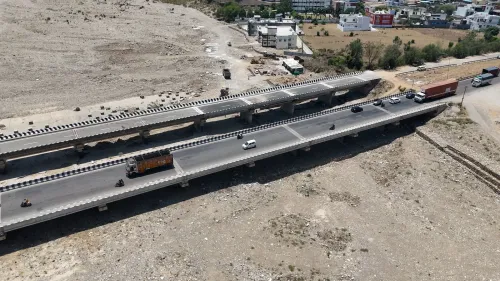
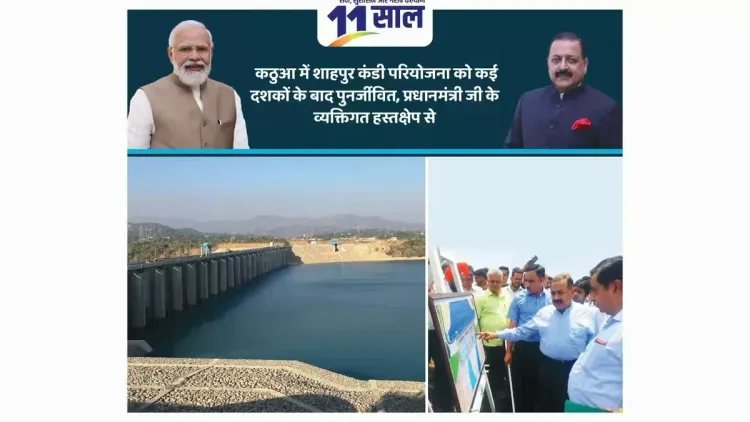
The Shahpur Kandi National Project on the Ravi river, whose foundation stone was laid by PM Indira Gandhi in 1984 but stalled for decades, has been completed under PM Modi's tenure, Union Minister Dr. Jitendra Singh announced on 1 July 2026, bringing irrigation to the historically water-scarce Kandi belt of Kathua and Samba districts.
Key Takeaways
The Shahpur Kandi National Project on the Ravi river is now complete, as announced by Union Minister Dr.
Jitendra Singh on 1 July 2026 .
The project's foundation stone was laid by former Prime Minister Smt.
Indira Gandhi in 1984 , making it a four-decade journey from conception to completion.
The project had remained stalled for decades before receiving a renewed central push after 2014 under Prime Minister Narendra Modi .
Districts Kathua and Samba in the Jammu region are the primary beneficiaries, ending their status as irrigation-starved areas.
The Kandi belt — traditionally defined by its semi-arid, unirrigated terrain — is expected to be so transformed that future generations may not recognise the term's original meaning.
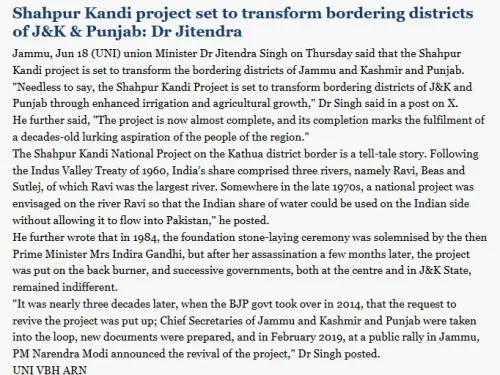
Union Science and Technology Minister Dr. Jitendra Singh on Wednesday, 1 July 2026 highlighted the completion of the Shahpur Kandi National Project on the Ravi river, calling it a transformative moment for the long irrigation-starved Kandi belt of the Jammu region. The minister noted that the project, whose foundation stone was laid in 1984, has now begun delivering abundant irrigation water to districts that had historically lacked it.
Context
In his post on X, Dr. Jitendra Singh observed that the Shahpur Kandi project 'took off only after PM Narendra Modi took over' following decades of stagnation. He added that in years to come, the next generation of Kathua and Samba districts 'may ask their elders what is the meaning of Kandi and why this region was called Kandi' — a remark underscoring how thoroughly the project is expected to change the agricultural character of the area. The word 'Kandi' traditionally refers to the semi-arid, unirrigated upland tracts of the Jammu foothills.
Policy Backdrop
The Shahpur Kandi National Project was first conceived as a multipurpose irrigation and hydropower scheme on the Ravi river. Former Prime Minister Smt. Indira Gandhi laid its foundation stone in 1984, but the project remained largely stalled through successive governments over four decades. After 2014, the central government classified it among priority national projects and extended sustained financial and administrative support to push it toward completion. The project's trajectory mirrors a broader pattern of the post-2014 policy push to revive long-pending water infrastructure in Jammu and Kashmir and reduce regional disparities in irrigation access.
Stakeholders and Impact
The primary beneficiaries are farming communities in Kathua and Samba — two districts in the Jammu division that have historically depended on rain-fed agriculture due to the absence of reliable canal irrigation. The Kandi belt's semi-arid terrain made cultivation precarious and yields unpredictable, keeping rural incomes suppressed. Completion of the project is expected to expand the net irrigated area in these districts, potentially enabling crop diversification and improving agricultural productivity for thousands of farm households.
What's Next
Attention will now turn to the pace at which the newly completed infrastructure is operationalised and the actual area brought under canal irrigation in Kathua and Samba. Any hydropower output from the project's power component will also be closely watched as a measure of the scheme's full economic contribution to the Jammu region. Similar long-pending river and irrigation projects in the broader Jammu belt are likely to face renewed scrutiny and public pressure for expedited completion in the wake of this milestone.
Point of View
Visible infrastructure win in the Jammu region — one that is especially potent because it can be contrasted against four decades of inaction by earlier governments. By invoking the 1984 foundation stone and the post-2014 revival in the same breath, Dr. Jitendra Singh is framing the project as emblematic of a broader governance narrative: that long-promised but undelivered public works are now being executed. The rhetorical flourish about future generations not knowing what 'Kandi' means is a deliberate attempt to anchor the project's impact in generational memory, elevating it beyond routine infrastructure news. For Kathua and Samba — both electorally significant in the Jammu division — the timing of this announcement carries clear political weight ahead of any future electoral cycle.
NationPress
1 Jul 2026
Frequently Asked Questions
What is the Shahpur Kandi National Project?
The Shahpur Kandi National Project is a multipurpose irrigation and hydropower scheme on the Ravi river in the Jammu region, designed to supply canal water to the semi-arid Kandi belt covering districts such as Kathua and Samba. Its foundation stone was laid by Prime Minister Indira Gandhi in 1984.
Why did the Shahpur Kandi project take so long to complete?
The project remained stalled for several decades after its foundation stone was laid in 1984, largely due to prolonged administrative and financial delays under successive governments. It received renewed central priority and sustained support after 2014, eventually reaching completion.
Which districts will benefit from the Shahpur Kandi project?
Kathua and Samba districts in the Jammu division are the primary beneficiaries. Both districts fall within the Kandi belt, a historically semi-arid and irrigation-scarce upland tract that has depended on rain-fed agriculture.
What does 'Kandi' mean in the context of Jammu?
'Kandi' refers to the semi-arid, unirrigated upland foothills of the Jammu region. The term historically described areas with poor water access and difficult agricultural conditions — conditions that the completed Shahpur Kandi project is expected to fundamentally change.
What did Union Minister Dr. Jitendra Singh say about the Shahpur Kandi project?
On 1 July 2026, Dr. Jitendra Singh posted on X that the project, stalled since its 1984 foundation stone, took off only after PM Narendra Modi assumed office and is now complete, providing 'abundant irrigation' to previously water-starved land in Kathua and Samba.