Mandaviya: e-Shram Portal Crosses 31.67 Cr Unorganised Worker Registrations
Synopsis
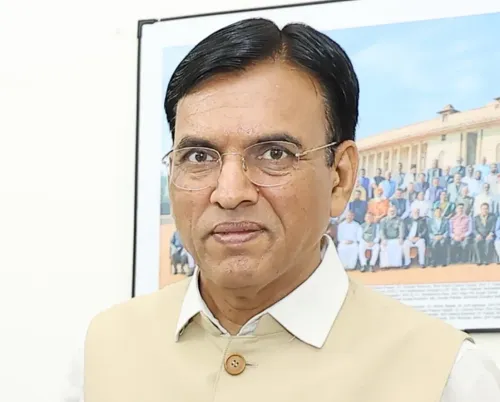
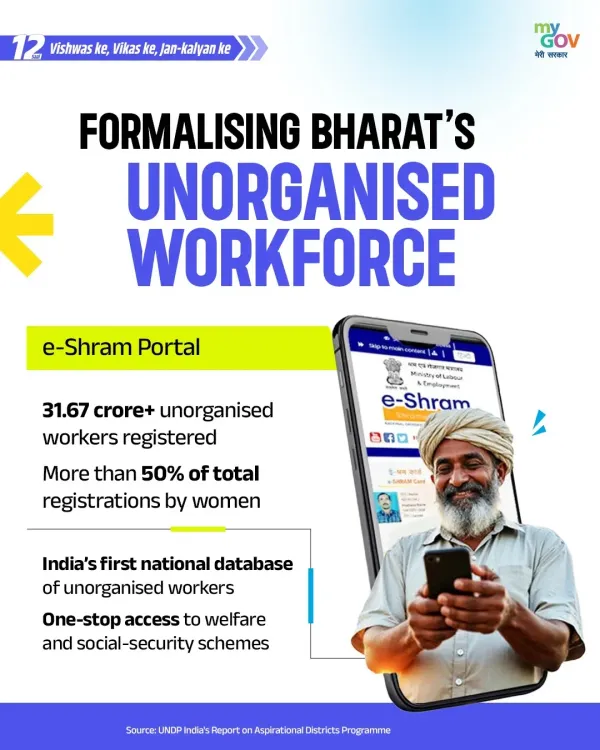
Union Labour Minister Mansukh Mandaviya announced on June 8, 2026, that the e-Shram portal has registered over 31.67 crore unorganised workers, positioning it as a central platform for social security access under the government's ongoing welfare agenda.
Key Takeaways
Union Labour and Sports Minister Mansukh Mandaviya announced over 31.67 crore unorganised worker registrations on the e-Shram portal .
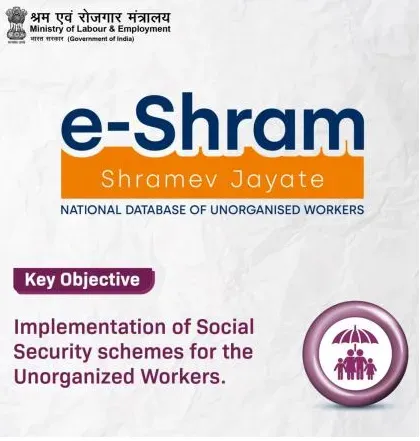
The e-Shram portal was launched in August 2021 to create a national database of India's informal workforce.
The Code on Social Security, 2020 provided the legislative foundation for extending social security to gig and unorganised sector workers.
Registered workers gain access to benefits including accidental insurance and potential linkage to schemes like Ayushman Bharat and PM Jan Dhan Yojana .
The announcement was made under the hashtag #12YearsOfGaribKalyan , reflecting the government's welfare communication strategy.
Next steps involve integrating e-Shram data with central and state-level welfare schemes for portable, last-mile benefit delivery.
Union Labour and Sports Minister Mansukh Mandaviya on Monday, June 8, 2026, highlighted that the e-Shram portal has registered over 31.67 crore unorganised workers, describing it as a one-stop platform for social security access. The announcement came under the hashtag #12YearsOfGaribKalyan, marking over a decade of the ruling party's welfare outreach agenda.
Context
In his post, Mandaviya stated: 'With over 31.67 crore unorganised workers registered, the e-Shram portal is serving as a one-stop platform to ensure access to social security schemes.' The figure underscores the scale of India's informal workforce and the government's push to map it digitally. The minister framed the milestone as part of 'empowering Bharat's workforce.'
The e-Shram portal was launched in August 2021 by the Ministry of Labour and Employment to create a centralised national database of unorganised workers — a category that includes construction labourers, domestic workers, street vendors, migrant workers and gig workers. Prior to its launch, no single national registry of this workforce existed.
Policy Backdrop
The portal's creation was enabled in part by the Code on Social Security, 2020, which for the first time extended formal social security provisions to gig and unorganised sector workers. The code consolidated multiple earlier labour laws and created a legislative basis for welfare portability across state boundaries.
The e-Shram initiative sits within the broader Digital India framework, which aims to improve last-mile delivery of government schemes through technology. Post-pandemic, the government accelerated efforts to map migrant and informal workers after the COVID-19 crisis exposed gaps in welfare delivery to this segment. The portal links registered workers to schemes including insurance cover and, potentially, other central welfare programmes.
Stakeholders and Impact
The primary beneficiaries are India's vast unorganised workforce — estimated to constitute over 90 per cent of the country's total employed population. Registration on e-Shram enables workers to access scheme benefits, including accidental insurance under Pradhan Mantri Suraksha Bima Yojana, and positions them for integration with programmes such as Ayushman Bharat and PM Jan Dhan Yojana.
Labour welfare advocates and state-level welfare boards have long sought a unified database to reduce duplication and exclusion errors in benefit delivery. The 31.67 crore registration figure, if sustained, represents a significant administrative achievement in a sector historically resistant to formalisation. Gig workers — employed through app-based platforms — are among the newer categories the portal is designed to cover.
What's Next
The Ministry of Labour and Employment is expected to focus on deeper integration of e-Shram data with existing central schemes to enable seamless, portable benefit delivery regardless of a worker's state of residence. Analysts tracking labour policy will watch for budgetary allocations and legislative updates that could expand the scope of portability.
The #12YearsOfGaribKalyan framing signals that the government intends to use such milestones as part of a broader political communication effort on welfare delivery ahead of future electoral cycles. Further announcements from the Ministry of Labour and Employment on scheme convergence are likely as the registration base continues to grow.
Point of View
Allowing it to demonstrate tangible administrative reach into India's vast informal economy. Anchoring the announcement to #12YearsOfGaribKalyan is a deliberate act of political branding, connecting a technocratic achievement to a longer welfare narrative. However, registration numbers alone do not capture benefit uptake or coverage quality — the harder policy question is whether registered workers are actually receiving scheme benefits. The push toward scheme convergence will be the real test of whether e-Shram translates into meaningful social security for India's unorganised workforce.
NationPress
22 Oct 2026
Frequently Asked Questions
What is the e-Shram portal and who can register on it?
The e-Shram portal is a national database launched by the Ministry of Labour and Employment in August 2021 to register unorganised workers, including construction labourers, domestic workers, street vendors, migrant workers and gig workers, and link them to social security schemes.
How many workers have registered on e-Shram?
According to Union Labour Minister Mansukh Mandaviya's post on June 8, 2026, over 31.67 crore unorganised workers have registered on the e-Shram portal.
What benefits do workers get after registering on e-Shram?
Registered workers can access benefits including accidental insurance cover under Pradhan Mantri Suraksha Bima Yojana and are positioned for integration with schemes such as Ayushman Bharat and PM Jan Dhan Yojana.
What is the Code on Social Security 2020?
The Code on Social Security, 2020 is a central law that consolidated multiple earlier labour statutes and, for the first time, extended formal social security provisions to gig and unorganised sector workers in India.
What is #12YearsOfGaribKalyan?
#12YearsOfGaribKalyan is a hashtag used by the ruling party to mark over a decade of its welfare outreach programmes; Minister Mandaviya used it to frame the e-Shram milestone within this broader welfare narrative.