e-Shram portal turns five with 31.89 crore registrations, 11.5 lakh gig workers enrolled

Synopsis
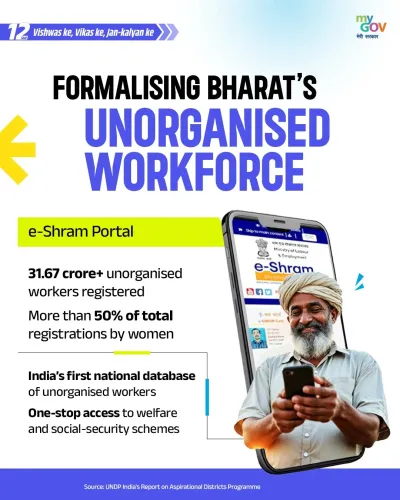
Five years after launch, India's e-Shram portal has registered 31.89 crore unorganised workers — and now counts 11.5 lakh gig and platform workers among them. With women outnumbering men on the registry and 15 welfare schemes consolidated in one place, the portal has quietly become one of India's most consequential labour-data infrastructure projects.
Key Takeaways
e-Shram portal completes five years on 26 August 2026 with 31.89 crore total registrations.
Approximately 11.5 lakh platform workers have enrolled on the system.
Women account for 54.28% of registered workers; 55.21% of registrants are aged 18–40 .
Top states by registration: Uttar Pradesh , Bihar , West Bengal , Madhya Pradesh , and Maharashtra .
The portal consolidates 15 social security schemes and links workers to PMSBY (₹2 lakh accidental cover) and PMJJBY .
Majority of enrolments completed via Common Service Centres (CSCs) .
India's e-Shram portal has crossed 31.89 crore registrations and onboarded approximately 11.5 lakh platform workers as it completes five years on 26 August 2026, according to an official factsheet released on Tuesday. The milestone cements the portal's position as the country's largest digital registry for unorganised labour.
What the Portal Has Built
Launched in 2021 as an Aadhaar-seeded National Database of Unorganised Workers, the e-Shram portal issues every registrant a unique Universal Account Number (UAN). Over five years, it has evolved from a simple registry into a one-stop digital platform integrating welfare, employment, skilling, apprenticeship, and pension services. The platform now consolidates 15 social security and welfare schemes under a single interface, allowing registered workers to access eligible benefits and track what they have already received.
Who Has Registered
Women account for 54.28 per cent of registered workers, outnumbering male registrants at 45.72 per cent. On age distribution, 55.21 per cent of registrants fall in the 18–40 age bracket, 24.18 per cent are aged 40–50, and 20.53 per cent are above 50. Top occupational categories include agriculture, domestic and household work, construction, and apparel.
Uttar Pradesh, Bihar, West Bengal, Madhya Pradesh, and Maharashtra have recorded the highest registrations. The bulk of enrolments have been completed through Common Service Centres (CSCs), with self-registration the second most common route.
Insurance and Social Security Access
Registered workers can enrol in the Pradhan Mantri Suraksha Bima Yojana (PMSBY) and the Pradhan Mantri Jeevan Jyoti Bima Yojana (PMJJBY) directly through the portal. Under PMSBY, eligible workers receive accidental insurance of ₹2 lakh for accidental death or permanent disability and ₹1 lakh for partial disability.
Government's Assessment
'e-Shram has improved benefit delivery, portability and evidence-based policymaking. It advances the government's vision of an inclusive, technology-driven social security ecosystem,' the official statement said. The factsheet further noted that the portal has enabled more targeted and transparent delivery of government support by creating a nationwide digital identity for unorganised workers.
What Comes Next
The database is expected to support the formulation and implementation of social security and welfare measures specifically for platform and gig workers — a segment that has grown rapidly but remains largely outside formal labour protections. With 11.5 lakh platform workers now enrolled, policymakers have a richer data foundation to design targeted interventions as India's gig economy expands.
Point of View
But the harder question is coverage quality — how many of those registered have actually received a welfare benefit, and how many UANs are dormant? The addition of 11.5 lakh platform workers signals intent to bring gig labour into the social security fold, yet India's gig economy is estimated to employ several crore workers, making the current enrolment a fraction of the addressable base. The portal's real test is not registration volume but benefit uptake rates, which the government has not yet made public. Until portability of benefits is verifiably demonstrated at scale, the registry risks remaining a database rather than a delivery mechanism.
NationPress
9 Oct 2026
Frequently Asked Questions
What is the e-Shram portal and what does it do?
The e-Shram portal is an Aadhaar-seeded National Database of Unorganised Workers launched in 2021 by the Indian government. It issues a Universal Account Number to each registrant and consolidates 15 social security and welfare schemes — covering insurance, pensions, skilling, and employment — on a single platform.
How many workers have registered on e-Shram as of 2026?
As of its fifth anniversary on 26 August 2026, the e-Shram portal has recorded 31.89 crore registrations. Of these, approximately 11.5 lakh are platform or gig workers.
Which states have the highest e-Shram registrations?
Uttar Pradesh, Bihar, West Bengal, Madhya Pradesh, and Maharashtra lead in registrations. Most enrolments have been completed through Common Service Centres, with self-registration the second most common method.
What insurance benefits do e-Shram registrants get?
Registered workers can enrol in PMSBY, which provides accidental insurance of ₹2 lakh for accidental death or permanent disability and ₹1 lakh for partial disability. They can also access PMJJBY life insurance through the portal.
Why does e-Shram matter for platform and gig workers?
Platform workers — those employed by app-based services — largely fall outside formal labour protections. Their enrolment on e-Shram gives the government a data foundation to design targeted social security measures for this fast-growing segment of India's workforce.