Have the First Sacred Stones from India Arrived for France's First Traditional Hindu Mandir?
Synopsis
A historic milestone in Franco-Indian collaboration has been achieved with the arrival of sacred stones from India to France for the first traditional Hindu Mandir. This project symbolizes a beautiful blend of cultures, craftsmanship, and spiritual values, marking the beginning of an iconic structure dedicated to worship, education, and community.
Key Takeaways
Historic milestone : Arrival of sacred stones from India for the Mandir in France.
Cultural collaboration : Fusion of Indian craftsmanship and French engineering.
Community engagement : The Mandir will serve as a hub for worship and cultural exchange.
Symbol of friendship : Represents the bond between India and France.
Artisan collaboration : Joint effort between Indian and French artisans enhances cultural ties.
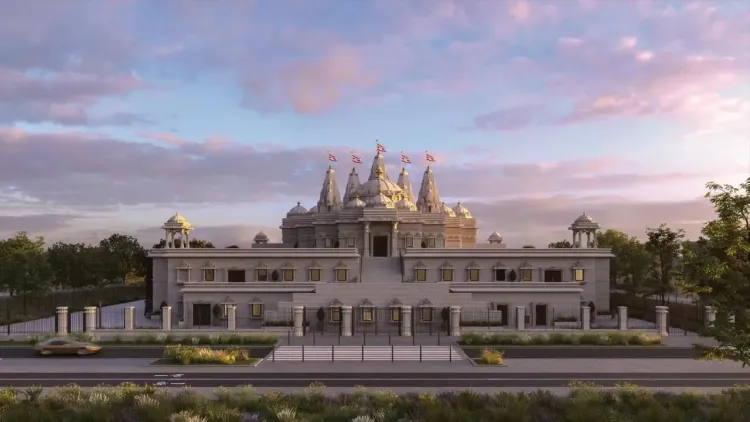
Paris, Jan 27 (NationPress) In a remarkable display of Franco-Indian cultural synergy, the inaugural stones from India have made their way to Paris for the upcoming Hindu Mandir in Bussy-Saint-Georges.
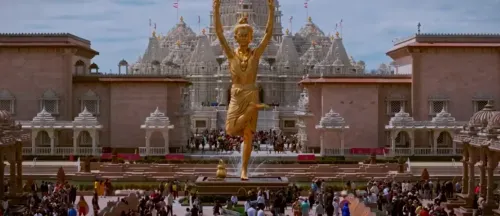
The ceremonial reception of these stones signifies the commencement of the construction of the first traditional Hindu temple of its kind in France, crafted with age-old techniques and a wealth of shared knowledge.
The stones, meticulously sourced from India and prepared through time-honored methods, embody centuries of architectural legacy. Specialized elements have been expertly hand-carved by skilled artisans in India, ensuring the preservation of ancient techniques that have been handed down through generations, before they embarked on their journey to France.
In France, Indian craftsmen will collaborate with French stonemasons, some of whom were part of the restoration team for Notre-Dame Cathedral, merging Indian carving traditions with the esteemed stonemasonry skills of France.
This ceremony represented more than just the arrival of traditionally carved stones; it epitomized a convergence of cultures, values, and knowledge.
The Mandir is being developed with a broader vision of creating a space dedicated to worship, culture, education, and community involvement. Once completed, it will stand as a lasting emblem of friendship between India and France.
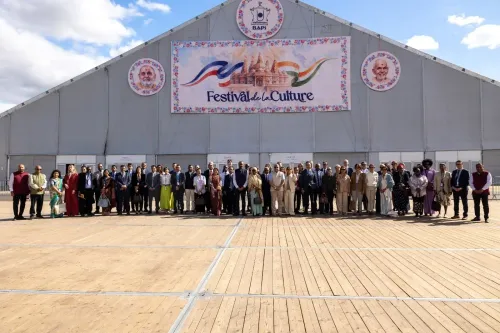
Local and national dignitaries, along with community leaders, gathered for the ceremony, acknowledging the profound significance of the project for France and its potential to enhance intercultural understanding.
Sanjay Kara, CEO of the Paris Mandir construction initiative and trustee of BAPS UK & Europe, stated, “The arrival of the first stones from India signifies a historic moment. Each stone embodies heritage, care, and intention, symbolizing the fusion of Indian traditions with French engineering through mutual respect and collaboration. Guided by the ideals of Mahant Swami Maharaj, whose teachings promote service, humility, and harmony, it is a privilege to contribute to a project that will serve not just worshippers but the broader community as a center for culture, learning, and harmony.”
Indian Ambassador to France Sanjeev Kumar Singla was present at the special gathering. Reflecting on the occasion, Singla remarked, “This Mandir symbolizes a distinctive partnership. The stones have been carved in India by master artisans and will be assembled in France by French stonemasons—some of whom also participated in the Notre-Dame restoration. This represents the confluence of two esteemed traditions of sacred architecture, united by excellence and a shared pride in craftsmanship.
The collaboration between Indian and French artisans, symbolized today by the exchange of friendship bracelets, showcases the cooperation, respect, and camaraderie between our peoples. This moment is a tribute to culture, heritage, and universal human values.”
Ambassador Jean-Christophe Peaucelle, Advisor for Religious Affairs at the French Ministry of Foreign Affairs, commented, “The initiation of this project, this Mandir, signifies something novel and innovative. This is the first instance of a temple of this nature being built in France. The alliance between our two nations is both spiritual and human.”
Alain Ngouoto, Sous-Préfet de Torcy, added, “Today represents a ‘stone in the edifice’ — a foundational element of this French-Indian friendship that I am promoting through this ceremony. We are receiving ancestral stones from a time-honored art form, to be assembled with inventive French expertise. I believe this fusion will demonstrate how two ‘geniuses’, two intelligences, can collaboratively build not just a friendship but also a magnificent structure.”
Point of View
This initiative showcases the power of cultural collaboration, as the construction of the Mandir serves to enhance understanding and respect between communities in France and India. It is a significant step towards fostering intercultural dialogue and cooperation in an increasingly globalized world.
NationPress
18 Sept 2026
Frequently Asked Questions
What is the significance of the Mandir being built in France?
The Mandir represents a unique cultural collaboration between India and France, embodying shared values, heritage, and craftsmanship.
Who are the artisans involved in this project?
The project features Indian artisans who have carved the stones in India, working alongside French stonemasons, including those involved in the Notre-Dame restoration.
What will the Mandir serve as once completed?
The Mandir will serve as a place of worship, cultural exchange, education, and community engagement.
When is the Mandir expected to be completed?
While a specific completion date has not been announced, the project is currently underway and progressing.
How does this project enhance intercultural understanding?
By showcasing the collaboration between two distinct cultures, the Mandir fosters dialogue, respect, and friendship between Indian and French communities.