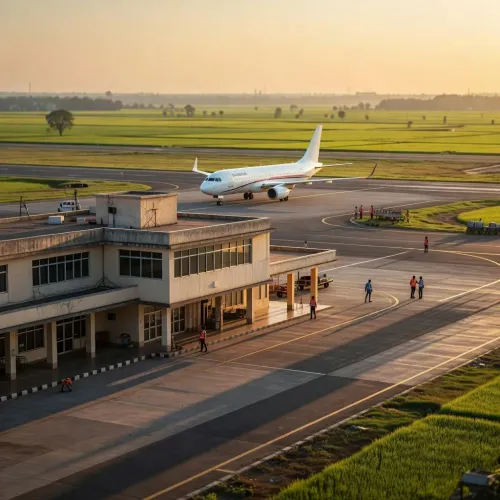
Bihar CM Office Backs Gaya–Bangkok Direct Flights

Synopsis
The Chief Minister's Office of Bihar has announced a twice-weekly direct flight between Gaya and Bangkok, operating every Monday and Thursday. The service aims to boost pilgrim traffic to the Mahabodhi Temple UNESCO site and energise Bihar's Buddhist Circuit economy.
Key Takeaways
The Chief Minister's Office of Bihar announced a direct Gaya–Bangkok flight service on 26 October 2026 .
Flights will operate twice a week — every Monday and Thursday .
Gaya is home to the Mahabodhi Temple , a UNESCO World Heritage Site and Buddhism's most sacred pilgrimage destination.
The route is expected to benefit tourism, cultural exchange, and economic activity in Bihar, particularly in the Buddhist Circuit comprising Bodh Gaya, Rajgir, Nalanda, and Vaishali.
Bangkok serves as a major Southeast Asian aviation hub, giving the route onward reach to Buddhist-majority nations across the region.
Gaya airport has historically run only seasonal or charter services to Bangkok; a scheduled twice-weekly frequency marks a significant step up.
A direct air link between Gaya and Bangkok is set to put Bihar's most celebrated pilgrimage city on Southeast Asia's aviation map — two days a week, every week. The Chief Minister's Office of Bihar confirmed on Monday, 26 October 2026 that the service will operate on Mondays and Thursdays, opening a scheduled international corridor from one of India's most historically significant airports.
The CMO stated that this direct air service, operating twice a week between Gaya and Bangkok, 'paryatan, sanskritik aadan-pradan aur aarthik gatividhiyon ko nayi gati pradaan karegi' — 'will give new momentum to tourism, cultural exchange, and economic activities in Bihar.'Gaya's moment on the international map
Gaya is home to the Mahabodhi Temple, a UNESCO World Heritage Site and the spot where Gautama Buddha is said to have attained enlightenment. For Buddhist pilgrims from Thailand, Myanmar, Sri Lanka, and across Southeast Asia, it is arguably the single most sacred address on earth. Yet for years, reaching Gaya from Bangkok required a connection through Delhi, Mumbai, or Kolkata — adding hours and friction to a journey that millions make on faith alone. A direct Monday–Thursday schedule collapses that detour entirely.
Bihar's Buddhist circuit and the push for direct connectivity
Bihar's tourism policy since the early 2010s has explicitly targeted international Buddhist visitors, positioning the state as the anchor of India's Buddhist Circuit — a trail linking Bodh Gaya, Rajgir, Nalanda, and Vaishali. Gaya airport has historically handled seasonal and charter flights to Bangkok and other Buddhist-majority destinations, but a structured twice-weekly scheduled service represents a step up in ambition and reliability for operators and travellers alike.
Bangkok is Southeast Asia's busiest aviation hub and a natural gateway for onward Buddhist pilgrims from Thailand and beyond. A regular Gaya–Bangkok frequency does not just move tourists — it moves temple donations, hotel bookings, local craft purchases, and guided-tour revenues into the Bihar economy. Bodh Gaya's hospitality and services sector, which has expanded steadily over the past decade, stands to be the most immediate beneficiary.
What the Monday–Thursday schedule means for travellers
Two weekly frequencies give pilgrimage groups and heritage tourists meaningful scheduling flexibility — a short visit over a long weekend becomes viable without expensive layovers. The pattern also reduces per-seat costs compared with charter operations, making the route commercially sustainable enough to survive beyond a single season. Analysts tracking Indian regional airports will watch passenger load factors on these flights closely; strong numbers could justify adding frequencies or attracting a second carrier to the route.
For Bihar, every seat filled on the Gaya–Bangkok corridor is a small wager on a larger proposition: that world-class pilgrimage infrastructure, not just faith, can turn a UNESCO heritage site into a year-round economic engine. The flight schedule is the latest move in that bet.
Point of View
The state signals it is building for consistent pilgrim traffic rather than one-off surges. The move also fits a broader national pattern of smaller-city airports being deployed as instruments of regional economic diplomacy, particularly with Southeast Asian Buddhist nations. Whether the route endures will depend on load factors — but the political and symbolic bet is clearly on.
NationPress
26 Oct 2026
Frequently Asked Questions
When will the Gaya to Bangkok direct flight start?
The Chief Minister's Office of Bihar announced the twice-weekly Gaya–Bangkok service on 26 October 2026. The exact launch date and airline operator have not been officially confirmed in the public announcement.
How many days a week will Gaya Bangkok flights operate?
The direct Gaya–Bangkok service will operate twice a week — on Mondays and Thursdays.
Why is a Gaya to Bangkok flight significant for Bihar?
Gaya is home to the Mahabodhi Temple UNESCO World Heritage Site, the holiest site in Buddhism. A direct flight to Bangkok — Southeast Asia's biggest aviation hub — makes it far easier for Thai and regional pilgrims to reach Bodh Gaya without a stopover, which is expected to boost tourism and local economic activity.
Which Buddhist sites can tourists visit near Gaya airport?
Gaya airport serves the Buddhist Circuit, which includes Bodh Gaya's Mahabodhi Temple, Rajgir, Nalanda's ancient university ruins, and Vaishali — all key sites in the life of the Buddha and early Buddhism.
Does Gaya airport already have international flights?
Gaya airport has historically operated seasonal and charter international services to Buddhist destinations including Bangkok, but a regular twice-weekly scheduled service represents a more structured and sustained level of international connectivity.