Giriraj Singh flags Modi-Prabowo UPI linkage push
Synopsis
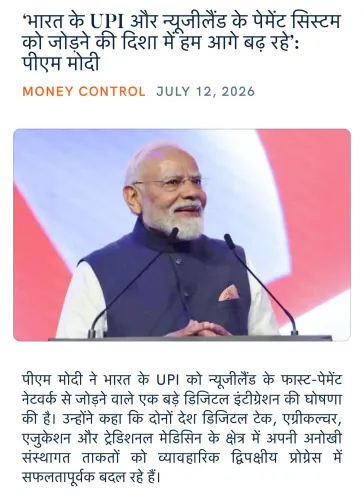
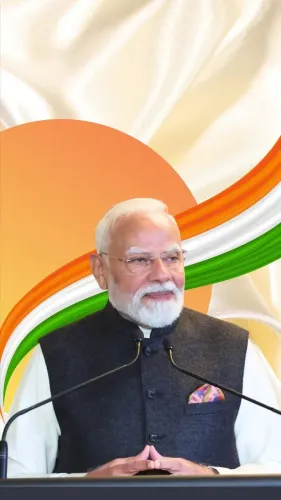
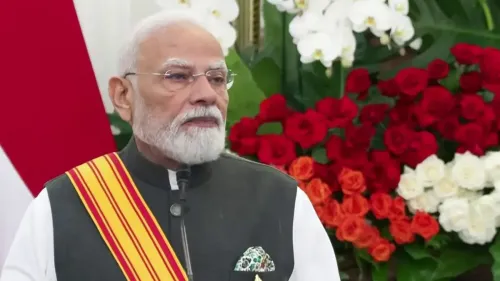
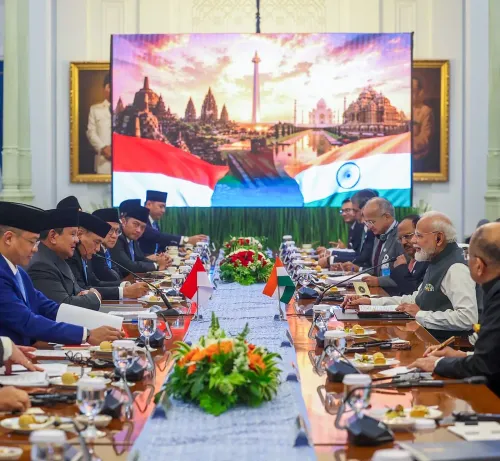
Union Textiles Minister Giriraj Singh amplified reports that PM Modi and Indonesian President Prabowo Subianto discussed QR code and UPI payment linkages, a move that could significantly deepen digital and economic ties between India and Indonesia as part of India's wider push to internationalise its payments infrastructure.
Key Takeaways
Giriraj Singh shared a report on 8 July 2026 highlighting QR-UPI payment linkage talks between India and Indonesia.
PM Modi and President Prabowo Subianto discussed deepening economic ties through digital payment integration.
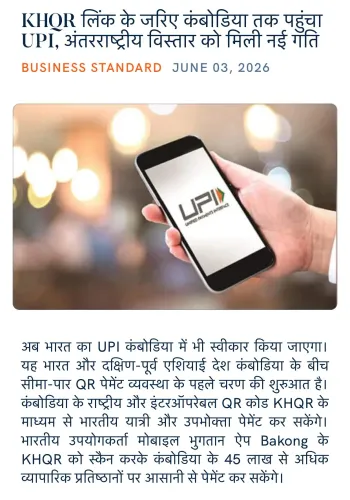
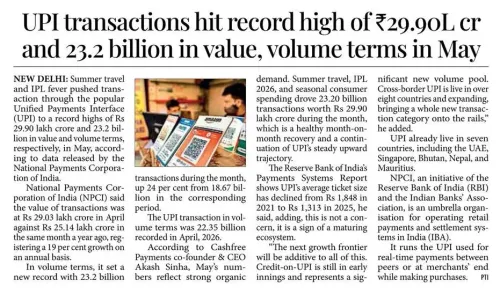
India's UPI , launched in 2016 , has already been linked with payment systems in Nepal, Bhutan, UAE, and Singapore .
An India-Indonesia linkage would be a significant extension of UPI into Southeast Asia's largest economy .
MSME traders and fintech firms on both sides are the primary beneficiaries of reduced transaction costs.
Implementation timelines and formal rollout details are yet to be announced by either government.
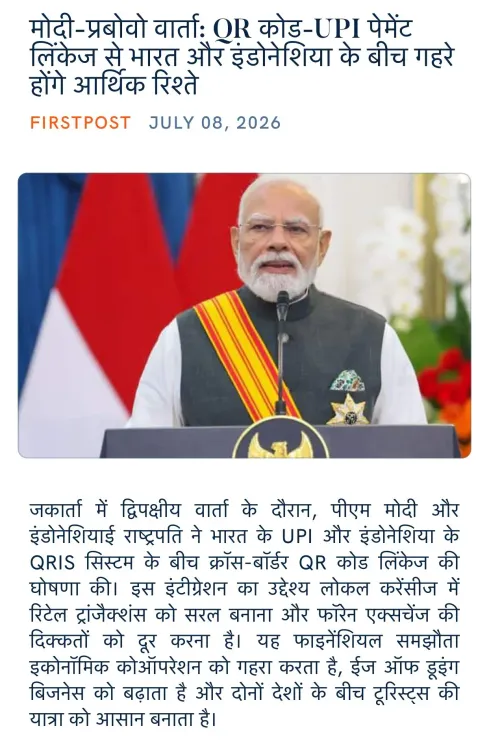
Union Textiles Minister Giriraj Singh on Wednesday, 8 July 2026 shared a report highlighting that talks between Prime Minister Narendra Modi and Indonesian President Prabowo Subianto have paved the way for deeper economic ties through QR code and UPI payment linkages between the two countries.
Context
Singh shared the report via the NaMo App, signalling the ruling party's intent to amplify the diplomatic and digital-economy outcomes of the Modi-Prabowo bilateral talks. The post's headline — 'Modi-Prabowo varta: QR code-UPI payment linkage se Bharat aur Indonesia ke beech gehre honge arthik rishte' (Modi-Prabowo talks: QR code-UPI payment linkages will deepen economic ties between India and Indonesia) — frames the development as a structural upgrade to bilateral commerce.
Indonesia is a key partner under India's Comprehensive Strategic Partnership, upgraded in 2018, covering trade, defence, and the digital economy. The two nations have steadily expanded cooperation across multiple ASEAN-India summits in the years since.
Policy Backdrop
India's Unified Payments Interface (UPI), launched by the National Payments Corporation of India (NPCI) in 2016, has become a flagship export of India's digital public infrastructure. Cross-border QR and UPI linkages were first extended to Nepal and Bhutan in 2022, followed by the UAE and Singapore in 2023 under frameworks set by the Reserve Bank of India and NPCI.
An India-Indonesia payment linkage would continue this expansion into Southeast Asia, complementing existing integrations in the Gulf region. The approach is designed to enable real-time cross-border transactions without dependence on third-party payment networks, directly lowering costs for traders and remitters on both sides.
Stakeholders and Impact
MSME traders and fintech firms operating between India and Indonesia stand to benefit most immediately from a QR-UPI linkage. Reduced transaction costs and faster settlement cycles could meaningfully boost bilateral commerce, which has grown steadily under successive India-ASEAN trade frameworks.
For Indian fintech companies already operating in Southeast Asia, the linkage represents an opportunity to deepen market presence. On the Indonesian side, the integration aligns with President Prabowo's stated priority of expanding economic and trade cooperation with India during the early phase of his administration.
What's Next
Implementation timelines for the QR-UPI linkage rollout between India and Indonesia are yet to be formally announced. Observers will watch for follow-up details at the next India-Indonesia Joint Commission meeting or at upcoming ASEAN-related summits.
India's broader strategy of positioning UPI as exportable digital infrastructure suggests further bilateral payment integrations across the ASEAN bloc are likely, with the Indonesia linkage potentially serving as a template for similar agreements with other regional partners.
Point of View
Each step building diplomatic capital alongside commercial utility. For the Prabowo administration, embracing UPI integration signals an early alignment with India's digital ecosystem, which carries strategic weight beyond mere fintech convenience. The announcement, however thin on implementation specifics, positions both leaders as architects of a modernised bilateral relationship ahead of any formal ASEAN-India engagement.
NationPress
7 Oct 2026
Frequently Asked Questions
What did Modi and Prabowo agree on regarding UPI?
Reports highlighted in Giriraj Singh's post indicate that talks between PM Modi and Indonesian President Prabowo Subianto covered the linking of QR code and UPI payment systems to deepen economic ties, though formal implementation details have not yet been announced.
What is UPI and how does it work across borders?
UPI, or Unified Payments Interface, is a real-time payment system launched by NPCI in 2016. Cross-border UPI linkages allow users in partner countries to transact via QR codes without using third-party international payment networks, lowering costs and settlement times.
Which countries are already linked with India's UPI?
As of the available policy record, India has operational UPI cross-border linkages with Nepal, Bhutan, the UAE, and Singapore. An India-Indonesia linkage, if formalised, would extend this network into Southeast Asia's largest economy.
Why is India pushing UPI internationally?
India is promoting UPI as exportable digital public infrastructure to reduce dependence on third-party payment networks, lower transaction costs for traders and remitters, and deepen bilateral economic relationships with key partners across South Asia, the Gulf, and ASEAN.
What is India's relationship with Indonesia?
India and Indonesia share a Comprehensive Strategic Partnership upgraded in 2018, covering trade, defence, and the digital economy. The two countries have strengthened cooperation through multiple ASEAN-India summits and bilateral ministerial engagements.