Giriraj Singh: India targets 120 products to cut China import reliance
Synopsis
Union Textiles Minister Giriraj Singh has highlighted India's identification of 120 critical products to reduce Chinese import dependence, combining company incentives and indigenous technology development under the Atmanirbhar Bharat framework.
Key Takeaways
120 critical products have been identified by the government as targets for domestic manufacturing to reduce import reliance on China.
Minister Giriraj Singh linked the push to three pillars: product identification, corporate incentives, and indigenous technology development.
The policy lineage traces to the Atmanirbhar Bharat package of May 2020 , accelerated after the Galwan border clash with China.
The Production Linked Incentive (PLI) scheme provides the institutional architecture for company-level incentives across sectors.
Technology development for complex manufacturing remains the hardest and longest part of the import-substitution agenda.
Progress on incentivised product categories is expected to feature in the next Economic Survey or Union Budget .
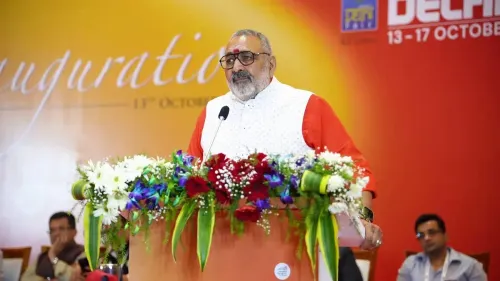
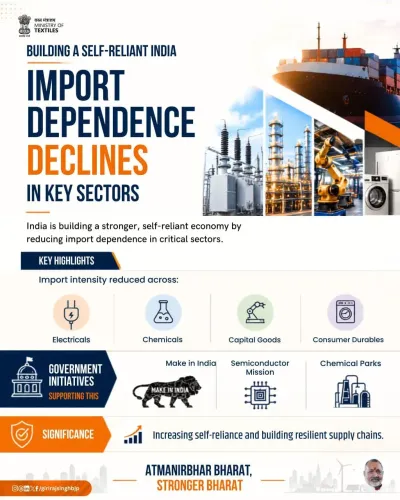
India's push to shrink its manufacturing dependence on China is moving from ambition to arithmetic — and Union Textiles Minister Giriraj Singh has put a number on it. On Wednesday, 28 October 2026, Singh took to X to assert that the identification of 120 critical products, paired with corporate incentives and indigenous technology development, will sharpen India's domestic production capacity and advance the Atmanirbhar Bharat goal.
Posting in Hindi, the minister wrote: 'चीन पर आयात की निर्भरता घटाने और घरेलू विनिर्माण को नई गति देने की दिशा में भारत आगे बढ़ रहा है' — 'India is moving forward in the direction of reducing import dependence on China and giving new momentum to domestic manufacturing.' He added that the three-pronged focus on product identification, company-level incentives, and home-grown technology will strengthen the country's production capacity and carry the Atmanirbhar Bharat mission forward.The 120-product list and what it signals
The reference to 120 identified products is the sharpest detail in Singh's statement. While the specific ministry list is recent, the underlying logic stretches back to May 2020, when the Atmanirbhar Bharat economic package was first announced — a direct policy response to twin pressures: the economic shock of the pandemic and heightened strategic wariness toward China following the Galwan Valley border clash. That moment rewired India's trade calculus in ways that are still unfolding.
China has historically been India's largest single-country source of imports across manufacturing categories — from electronics components to chemicals to textiles inputs. The logic of import substitution is therefore not merely economic but strategic: reduce critical chokepoints, build domestic alternatives, and ensure supply-chain resilience.
PLI schemes: the incentive architecture behind the rhetoric
The 'incentives for companies' Singh refers to have a well-established institutional home: the Production Linked Incentive (PLI) scheme, rolled out from 2020 onwards across sectors including electronics, pharmaceuticals, textiles, and several others. PLI ties government payouts directly to incremental production, rewarding scale and discouraging the import-and-assemble approach that had kept domestic value addition low.
For the MSME sector and domestic manufacturers — the real audience for this kind of ministerial signal — the extension of this framework to additional product categories is consequential. Each new category on an import-substitution list is, in effect, an invitation to invest. Singh's post suggests the government is actively expanding that invitation list.
Technology development: the hardest part of self-reliance
Fiscal incentives alone cannot build what India does not yet know how to make. The minister's explicit mention of 'swadeshi technology development' — indigenous technology — acknowledges the deeper challenge. Many of the products on import-substitution lists involve components or processes where China holds significant manufacturing know-how built over decades. Bridging that gap requires R&D investment, skill development, and patient capital — none of which move as fast as a policy announcement.
That tension — between the urgency of the goal and the long timelines of technology development — will likely surface in the next Economic Survey or Union Budget, where progress on incentivised product categories is expected to be reported.
India is no longer just talking about self-reliance — it is mapping the exact products where that self-reliance has to be built, one factory at a time.
Point of View
The government signals it is moving from framework to execution. The explicit mention of indigenous technology development is notable: it implicitly concedes that incentives alone cannot close the capability gap with China, and that the harder, longer work of building domestic know-how is now on the agenda. For the textiles sector specifically, where Chinese inputs remain significant, this framing positions Singh's own ministry as a front-line actor in the larger self-reliance mission.
NationPress
28 Oct 2026
Frequently Asked Questions
What are the 120 products India has identified to reduce China imports?
The government has identified 120 critical products as priorities for domestic manufacturing to reduce import dependence on China. The specific list is linked to a recent ministry exercise; full details are expected to be reported in upcoming budget or economic survey documents.
What is the Atmanirbhar Bharat scheme?
Atmanirbhar Bharat is India's self-reliance initiative launched in May 2020 , designed to promote domestic manufacturing, reduce import dependence — particularly from China — and strengthen supply chains through incentives and policy support.
What is the PLI scheme and how does it help reduce China import dependence?
The Production Linked Incentive (PLI) scheme , introduced from 2020 onwards, ties government payouts directly to incremental domestic production, making it financially attractive for companies to manufacture in India rather than import from China across sectors like electronics, pharmaceuticals, and textiles.
Why did India start reducing imports from China?
India accelerated import reduction from China following the Galwan Valley border clash in 2020 , which combined with the pandemic to highlight strategic and supply-chain risks of overdependence on Chinese manufacturing. The Atmanirbhar Bharat push formalised this shift into policy.
What is Giriraj Singh's role in India's manufacturing policy?
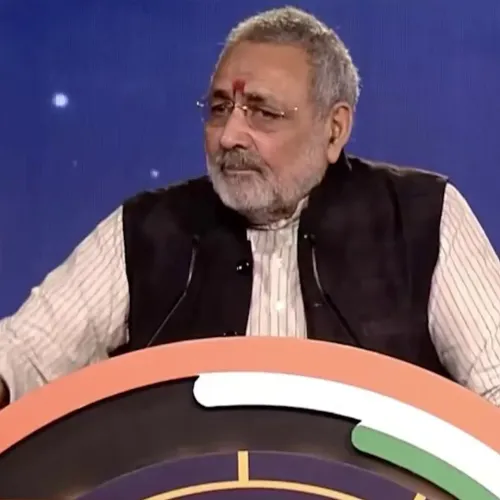
Giriraj Singh is the Union Minister of Textiles and a senior BJP leader and Lok Sabha MP from Begusarai, Bihar . His ministry oversees textile sector policy and is directly involved in import substitution and domestic production initiatives under Atmanirbhar Bharat.