Giriraj Singh highlights Arunachal weaver Debia Yadik's success
Synopsis
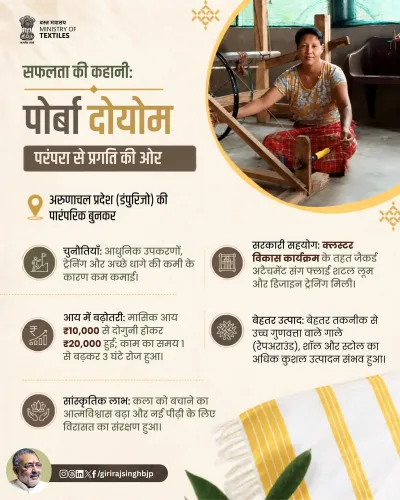
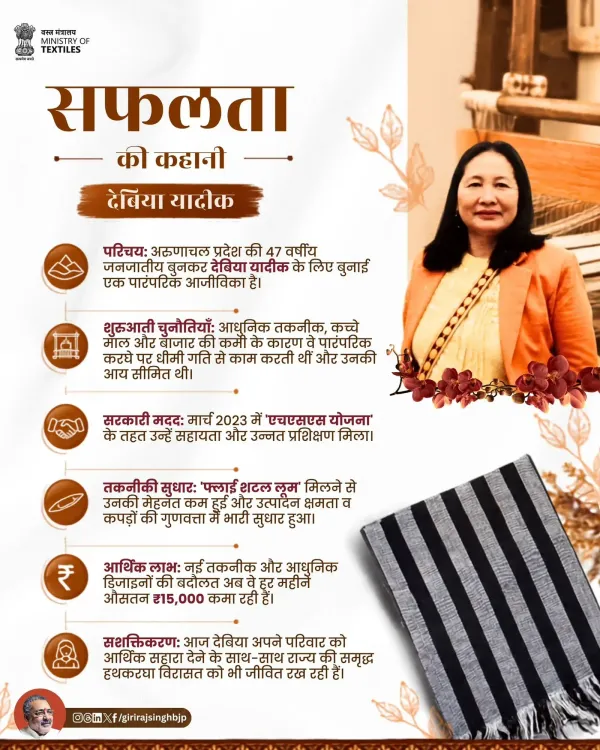
Union Textiles Minister Giriraj Singh on 13 July 2026 highlighted Arunachal Pradesh weaver Debia Yadik as an example of how government training, modern technology, and Vocal for Local support can make traditional handloom skills a path to self-reliance and cultural preservation.
Key Takeaways
Union Textiles Minister Giriraj Singh spotlighted Debia Yadik , a handloom weaver from Arunachal Pradesh , on 13 July 2026 .
The minister credited 'right training, modern technology, and government support' with helping her become self-reliant and increase her income.
The post invoked the #VocalForLocal and #Handloom hashtags and the slogan 'Empowered Weavers, Prosperous India.' The National Handloom Development Programme (since 2015 ) and Atmanirbhar Bharat (since 2020 ) form the policy backbone of this push.
India's handloom sector employs an estimated 35 lakh weavers, with the Northeast home to a disproportionately large share of handloom households.
Analysts will watch for new handloom clusters or budget allocations targeting Arunachal Pradesh weavers in coming months.
Union Textiles Minister Giriraj Singh on Monday, 13 July 2026 highlighted the story of Debia Yadik, a handloom weaver from Arunachal Pradesh, as an example of how government support and modern training can transform traditional craft into sustainable livelihood.
Context
In his post on X, the minister wrote — translated from Hindi — that 'sahi prashikshan, aadhunik takneek aur sarkari sahyog se paramparik hunar ko nayi pehchaan mil sakti hai' ('with the right training, modern technology, and government support, traditional skills can gain a new identity'). He noted that Debia Yadik has not only increased her income and become self-reliant, but is also carrying forward Arunachal Pradesh's rich textile tradition through her weaving. The post carried the hashtags #VocalForLocal and #Handloom, and the phrase 'Sashakt Bunkar, Samridh Bharat' — 'Empowered Weavers, Prosperous India'.
Policy Backdrop
The minister's post draws on two overlapping policy pillars. The National Handloom Development Programme, operational since 2015, provides training, technology upgradation, and market linkages to weavers across India, with a particular emphasis on the northeastern states where handloom is a primary livelihood. The Vocal for Local and Atmanirbhar Bharat initiatives, launched in 2020, extended this push by encouraging domestic consumption of indigenous crafts and reducing dependence on imported textiles.
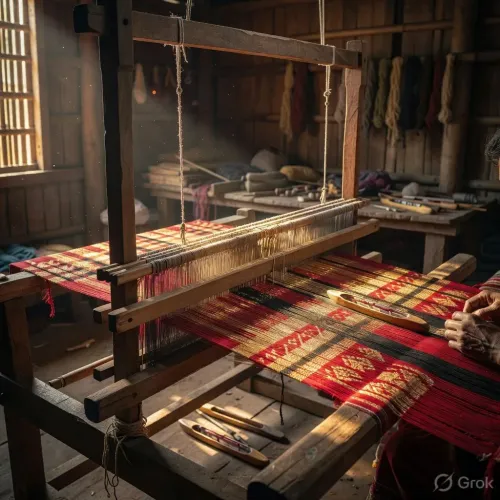
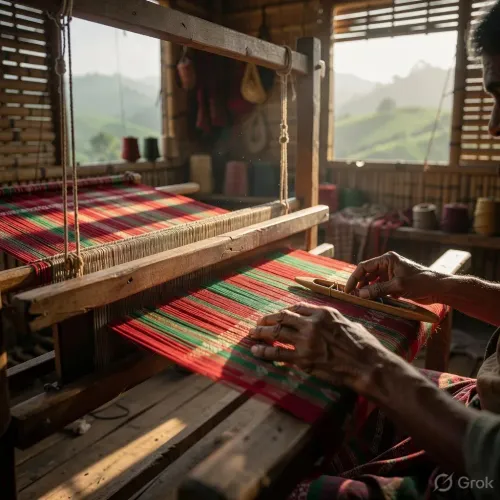
Arunachal Pradesh is home to dozens of tribal communities, each with distinct weaving traditions. The state's weavers — predominantly women — produce textiles that carry cultural and ceremonial significance, making the preservation of these skills a dual goal of economic development and heritage conservation.
Stakeholders and Impact
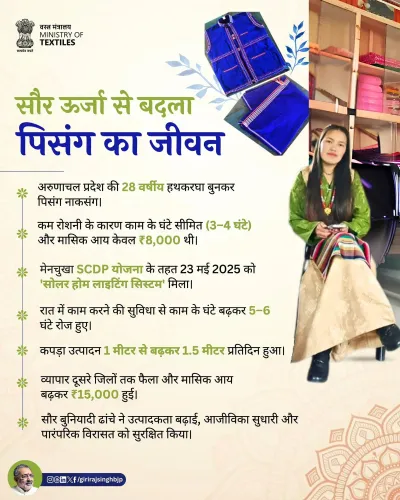
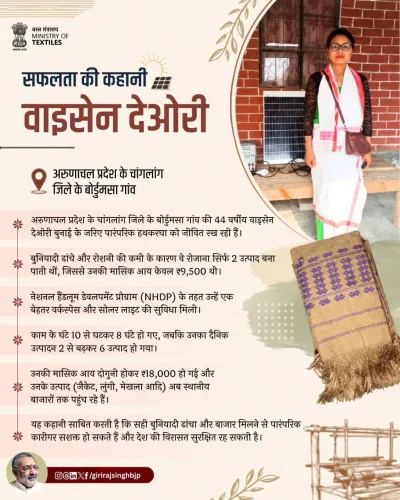
Women artisans in the Northeast stand at the centre of this policy narrative. Government-backed skilling programmes aim to equip weavers with design upgradation, loom technology, and e-commerce access so their products can reach national and international markets. When a weaver like Debia Yadik achieves income growth, the ministry frames it as proof of concept for the broader model of linking traditional craft to modern economic opportunity.
The handloom sector employs an estimated 35 lakh weavers across India, making it the second-largest employer in the textile value chain after agriculture. A significant share of these weavers are women in rural and semi-urban areas, and the Northeast accounts for a disproportionately large concentration of handloom households relative to its population.
What's Next
Observers of textile policy will watch for the rollout of state-level handloom clusters or dedicated skill programmes in Arunachal Pradesh, as well as any budget allocations that expand weaver welfare schemes. The minister's public spotlight on individual success stories is also seen as part of a wider communication strategy to build demand for handloom products under the Vocal for Local brand. Sustained market linkage — not just training — will be the test of whether such initiatives translate into durable income gains for weavers across the Northeast.
Point of View
Human-scale results. The move also reinforces the government's broader narrative of women's economic empowerment as a pillar of Atmanirbhar Bharat. Whether the spotlight translates into scalable programme expansion in Arunachal Pradesh, or remains largely symbolic, will determine its longer-term policy significance.
NationPress
12 Oct 2026
Frequently Asked Questions
What is the National Handloom Development Programme?
The National Handloom Development Programme, running since 2015, provides training, technology upgradation, and market linkages to handloom weavers across India, with a focus on enhancing incomes and preserving traditional textile heritage.
What does Vocal for Local mean for handloom weavers?
Vocal for Local, launched in 2020 under the Atmanirbhar Bharat initiative, encourages Indian consumers and institutions to buy domestically made products, including handloom textiles, thereby creating wider markets and better incomes for weavers.
Why is Arunachal Pradesh significant for handloom?
Arunachal Pradesh is home to diverse tribal communities whose distinct weaving traditions carry cultural and ceremonial importance; handloom is a primary livelihood for many women in the state, making it a key focus for government skill and welfare programmes.
How many weavers does India's handloom sector employ?
India's handloom sector employs an estimated 35 lakh weavers, making it the second-largest employer in the textile value chain after agriculture, with women and rural artisans forming a large share of the workforce.