Giriraj Singh Hails TEXPROCIL Export Award Winners, Pitches Kasturi Cotton
Synopsis
Union Textiles Minister Giriraj Singh congratulated TEXPROCIL Export Award winners in Mumbai for their 2023-24 performance and highlighted the Kasturi Cotton Bharat programme as a flagship effort to brand Indian cotton globally and raise farmer incomes under PM Modi's leadership.
Key Takeaways
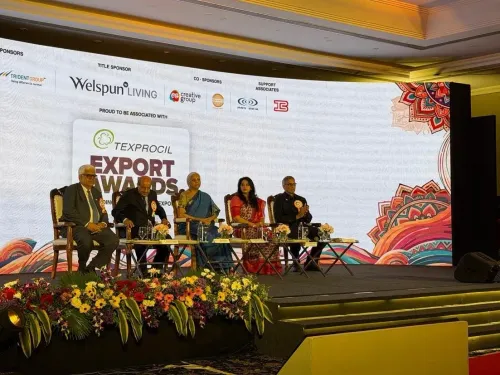
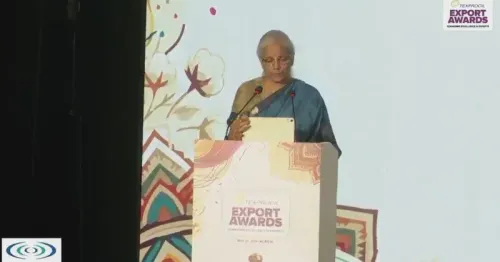
Union Textiles Minister Giriraj Singh congratulated all winners of the TEXPROCIL Export Award Function held in Mumbai on 25 May 2026 .
The awards recognised outstanding export performance in 2023-24 by Indian cotton textile exporters.
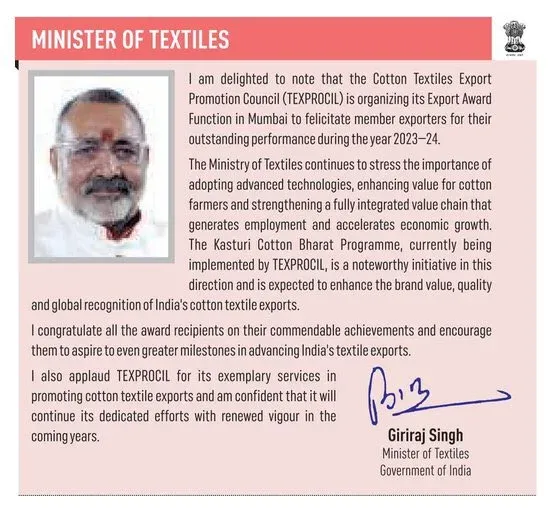
Singh reaffirmed the ministry's three-pronged focus: advanced technology adoption, higher cotton farmer incomes , and an integrated textile value chain.
The Kasturi Cotton Bharat programme , launched in 2021 , was cited as a 'historic step' to give Indian cotton a distinct global brand identity and premium pricing.
The initiative is part of the broader Atmanirbhar Bharat push to build domestic value chains from farm to export.
Release of 2024-25 textile export data and any expansion of the Kasturi Cotton certification network are the next key milestones to watch.
Union Textiles Minister Giriraj Singh on Monday, 25 May 2026 congratulated all winning exporters at the TEXPROCIL Export Award Function held in Mumbai, citing their outstanding performance in 2023-24 and reaffirming the Ministry of Textiles' commitment to building an integrated cotton value chain under Prime Minister Narendra Modi.
Context
Posting in Hindi on X, Minister Singh extended warm congratulations — 'हार्दिक बधाई' (heartfelt congratulations) — to the award recipients, acknowledging their 'excellent performance' during 2023-24. The annual TEXPROCIL function recognises top-performing cotton textile exporters and serves as a key industry gathering that brings together manufacturers, traders, and policymakers.
TEXPROCIL, the Cotton Textiles Export Promotion Council, is a government-backed body that has for decades channelled export promotion support to India's cotton textile sector. Its annual awards are among the most closely watched benchmarks of export competitiveness in the industry.
Policy Backdrop
Singh used the occasion to articulate three pillars of the ministry's current agenda: adoption of advanced technologies, raising the income of cotton farmers, and creating a 'strong and integrated value chain.' He specifically highlighted the Kasturi Cotton Bharat programme as a 'historic step' in this direction — one designed to give Indian cotton 'a new identity and brand value on the global stage.'
The Kasturi Cotton Bharat initiative was launched by the Ministry of Textiles in 2021 to brand and certify Indian cotton, enabling premium pricing and improved global recognition. The programme draws on traceability mechanisms to assure international buyers of quality, origin, and sustainability credentials — mirroring similar branding efforts for Indian spices and organic produce under the broader Atmanirbhar Bharat framework.
Successive textile policies and Union Budgets since 2014 have emphasised technology upgradation, farmer income support, and export incentives as interlocking levers for sector growth. The minister's remarks at the TEXPROCIL function signal that this policy architecture remains firmly in place.
Stakeholders and Impact
Cotton farmers stand to benefit most directly from the Kasturi Cotton certification network, which is intended to translate stronger global brand equity into better farmgate prices. India is among the world's largest cotton producers, and income volatility for cotton growers has been a persistent policy concern.
Textile exporters — particularly those competing in premium segments of the global market — gain a differentiated product story when selling certified Kasturi Cotton. For the export community assembled at the Mumbai function, the minister's remarks reinforced that government backing for their sector is sustained and strategic, not episodic.
What's Next
Industry observers will watch for the release of 2024-25 textile export figures, which will indicate whether the sector has maintained the momentum recognised at the TEXPROCIL awards. Any parliamentary or Union Budget announcements expanding the Kasturi Cotton certification network — in terms of geographic coverage, certifying agencies, or international market linkages — will be the clearest signal of how far the programme has scaled since its 2021 launch.
With global buyers increasingly demanding supply-chain transparency and sustainability credentials, India's ability to position Kasturi Cotton as a traceable, premium fibre could prove decisive in capturing higher-value orders that currently flow to competing origins.
Point of View
The minister is signalling that branding and certification, not just volume, are now the metrics of success for Indian textiles. This fits a broader arc in which the Modi government has sought to move India up the value chain in labour-intensive sectors rather than compete purely on price. The political subtext is equally clear: with cotton-growing constituencies concentrated in states like Gujarat, Maharashtra, and Telangana, linking export prestige to farmer income is a message calibrated for multiple audiences simultaneously.
NationPress
9 Oct 2026
Frequently Asked Questions
What is the TEXPROCIL Export Award and who won in 2023-24?
The TEXPROCIL Export Award is an annual recognition by the Cotton Textiles Export Promotion Council for India's top-performing cotton textile exporters. The specific winners of the 2023-24 edition were felicitated at the Mumbai function on 25 May 2026; individual winner details were not disclosed in the minister's post.
What is the Kasturi Cotton Bharat programme?
Kasturi Cotton Bharat is a Ministry of Textiles initiative launched in 2021 to brand and certify Indian cotton, providing traceability and quality assurance that enables premium pricing and stronger global recognition for Indian-origin cotton.
How does Kasturi Cotton help cotton farmers in India?
By establishing a certified, traceable brand for Indian cotton, the programme aims to command higher prices in global markets, which is intended to translate into better farmgate income for cotton growers across major producing states.
What is TEXPROCIL and what does it do?
TEXPROCIL, the Cotton Textiles Export Promotion Council, is a government-backed body that promotes exports of Indian cotton textiles, organises trade events, and provides support services to exporters targeting international markets.
What is the government's broader plan for India's textile sector?
The Ministry of Textiles, under the Atmanirbhar Bharat framework, is focused on technology upgradation, integrated value chains from farm to finished product, farmer income support, and export promotion — with schemes like Kasturi Cotton Bharat and PM MITRA parks as flagship interventions.