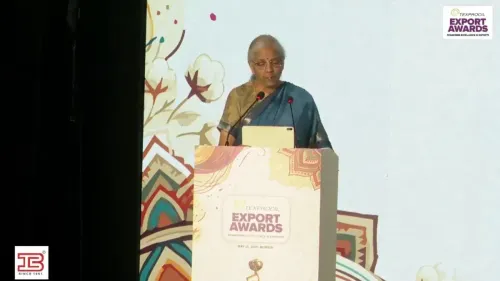
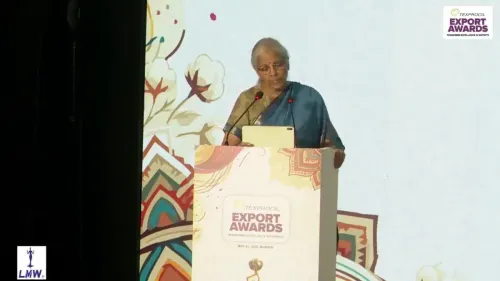
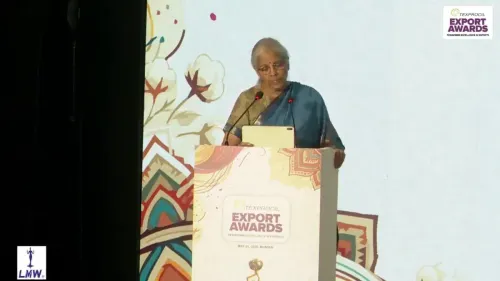
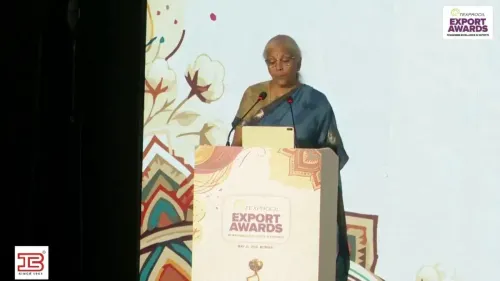
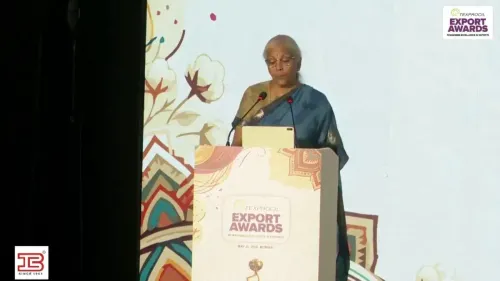
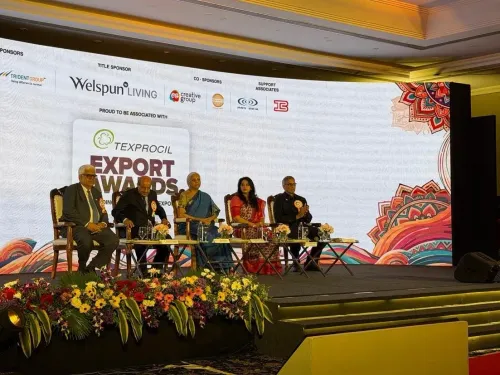
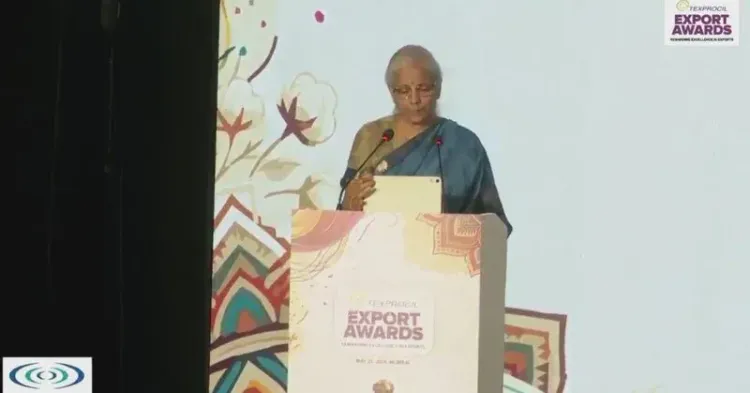
Sitharaman addresses TEXPROCIL Export Awards in Mumbai
Synopsis
Union Finance Minister Nirmala Sitharaman addressed the TEXPROCIL Export Awards in Mumbai on 25 May 2026, reinforcing the government's fiscal commitment to India's cotton textile export sector amid global supply-chain shifts and competition from Bangladesh and Vietnam.
Key Takeaways
Union Finance Minister Nirmala Sitharaman addressed the TEXPROCIL Export Awards in Mumbai on 25 May 2026 .
TEXPROCIL is the apex body under the Ministry of Textiles for promoting Indian cotton textile exports globally.
The government launched the PLI scheme for textiles in 2021 to boost investment in man-made fibre and apparel manufacturing.
The RoSCTL scheme was extended in 2022 to keep Indian textile exporters competitive against Bangladesh and Vietnam .
The textile sector is a key driver of foreign-exchange earnings and labour-intensive manufacturing employment in India.
Industry will watch for any new scheme extensions or budget allocations for textiles in the upcoming Union Budget .
Union Finance Minister Nirmala Sitharaman addressed the TEXPROCIL Export Awards ceremony in Mumbai, Maharashtra on Monday, 25 May 2026, lending the weight of the Finance Ministry to one of the cotton textile sector's most prominent annual recognition events.
Context
The Cotton Textiles Export Promotion Council (TEXPROCIL) is an apex body under the Ministry of Textiles mandated to promote Indian cotton textile exports in global markets. Its annual Export Awards recognise outstanding performance by exporters across categories ranging from yarn and fabric to made-ups and garments. Mumbai, as the financial capital of India and the historic hub of the country's textile trade, regularly hosts the event.
Sitharaman's participation signals the Finance Ministry's continued engagement with the export sector at a time when global supply-chain realignments are reshaping trade flows across Asia. The presence of a senior Union Cabinet minister at a sector-specific awards function is a customary but symbolically significant gesture of policy continuity.
Policy Backdrop
Indian textile exports have been supported by a layered set of fiscal measures in recent years. The government launched the Production-Linked Incentive (PLI) scheme for textiles in 2021 to attract investment in man-made fibre and technical textiles manufacturing. Separately, the Rebate of State and Central Taxes and Levies (RoSCTL) scheme was extended in 2022 to ensure that exporters remain cost-competitive against rivals in Bangladesh and Vietnam.
Finance ministers have historically used such platforms to reinforce the government's commitment to export-led manufacturing growth and to flag incremental budgetary support for the sector. Textile exports are regarded as a critical driver of both foreign-exchange earnings and labour-intensive manufacturing employment across states.
Stakeholders and Impact
The primary beneficiaries of TEXPROCIL's advocacy and the government's textile export incentives are cotton textile MSMEs and large integrated exporters who depend on stable rebate mechanisms and market-access support. The sector employs tens of millions of workers, making it politically and economically significant beyond its share of merchandise exports.
Global buyers, particularly from the European Union and the United States, have been diversifying sourcing away from single-country dependence, creating an opening for Indian exporters that the government has been keen to capitalise on through promotional events and policy signalling.
What's Next
Attention will now turn to the Ministry of Commerce's forthcoming textile export data release, which will indicate whether recent policy measures have translated into sustained growth in shipment volumes. Any fresh scheme extension or budgetary allocation for the textile sector in the next Union Budget will be closely watched by industry bodies including TEXPROCIL. Sitharaman's address at this forum may offer early signals about the government's fiscal posture toward the sector ahead of the budget cycle.
Point of View
Functioning as both a morale signal and a soft policy announcement platform. With India actively positioning itself to capture supply-chain diversification away from China and Bangladesh, such forums carry more strategic weight than their ceremonial framing suggests. The address also reflects the BJP government's broader emphasis on manufacturing-led growth and employment generation in labour-intensive sectors. How the sector responds — in terms of investment commitments and export volume — will be an early indicator of whether the policy messaging is translating into on-ground momentum.
NationPress
9 Oct 2026
Frequently Asked Questions
What is TEXPROCIL and what does it do?
TEXPROCIL, the Cotton Textiles Export Promotion Council, is an apex body under India's Ministry of Textiles that promotes the export of Indian cotton textiles, yarn, fabric, and made-ups in global markets and organises annual export awards to recognise top performers.
Why did Nirmala Sitharaman attend the TEXPROCIL Export Awards?
As Union Finance Minister, Sitharaman's attendance signals the government's continued fiscal support for the textile export sector; Finance Ministry participation in such events is a customary way to reinforce policy continuity and engage key industry stakeholders.
What government schemes support Indian textile exports?
Key schemes include the Production-Linked Incentive (PLI) scheme for textiles launched in 2021, which incentivises investment in man-made fibre and apparel, and the RoSCTL scheme extended in 2022, which rebates state and central taxes on textile exports to improve cost competitiveness.
How do Indian textile exports compare with Bangladesh and Vietnam?
Bangladesh and Vietnam are India's primary competitors in global cotton and apparel export markets; India has introduced incentive schemes like RoSCTL and PLI specifically to narrow the cost and scale gap with these countries and attract global buyers diversifying their sourcing.
What should the textile industry watch for after this event?
Industry stakeholders should track the Ministry of Commerce's next textile export data release and any fresh allocations or scheme extensions for the sector in the forthcoming Union Budget, which could shape export competitiveness over the next financial year.