HP CM Office: 1% interest loan builds student accountability

Synopsis
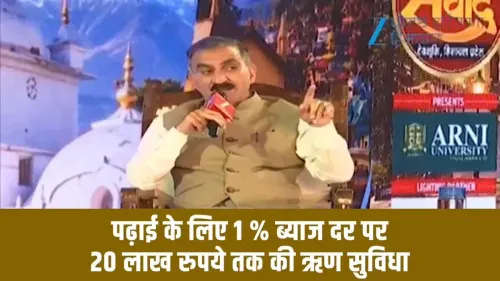
The Chief Minister's Office of Himachal Pradesh has clarified that the 1% interest on its education loan scheme is intended to foster accountability among beneficiaries and ensure that no student from an ordinary family is denied access to premier institutions for financial reasons.
Key Takeaways
The Chief Minister's Office of Himachal Pradesh posted on 9 July 2026 explaining the rationale for a 1% interest education loan.
The government states the interest charge is not for financial gain but to build accountability and responsibility among loan beneficiaries.
The stated goal is to produce 'capable, honest and responsible citizens' rather than create dependency through zero-interest waivers.
The scheme targets students from ordinary families who aspire to study at large, competitive institutions but face economic barriers.
The policy aligns with a broader Indian trend of combining education access with financial responsibility under the National Education Policy framework.
Rollout metrics and any budget expansions of the scheme in the next academic session will be key indicators of its reach.
The Chief Minister's Office of Himachal Pradesh clarified on Thursday, 9 July 2026 the rationale behind a 1% interest education loan initiative, stating that the charge is designed to instil accountability and responsibility among beneficiaries rather than generate revenue for the state.
The post, shared on the official CMO Himachal Pradesh handle, states: '1% ब्याज का उद्देश्य लाभार्थी में जवाबदेही और जिम्मेदारी की भावना को मजबूत करना है' — 'The purpose of 1% interest is to strengthen the sense of accountability and responsibility in the beneficiary.' The office added that the state government's intent is not financial gain but to produce 'capable, honest and responsible citizens.'
The post also signals a commitment that no child from an ordinary family should be denied entry to premier institutions for economic reasons — a sentence that appears to have been cut off in the original post but conveys the government's stated intent clearly.
Context
Education financing in India has long oscillated between full-subsidy models and interest-bearing loan structures. The Central Sector Interest Subsidy Scheme, introduced in 2009, provided interest relief during the study period for economically weaker students, establishing the principle that the state can absorb part of the cost without eliminating the loan structure entirely.
The Himachal Pradesh government's framing departs from that model by retaining a nominal 1% interest charge even for beneficiaries, positioning it as a pedagogical tool rather than a fiscal instrument. The argument is that a zero-interest waiver can breed dependency, whereas a token charge builds a sense of ownership over the investment in one's own education.
Policy Backdrop
Across Indian states, there has been a visible shift away from pure subsidy approaches toward models that combine access with financial responsibility. This trend aligns with the National Education Policy framework, which emphasises raising gross enrolment ratios without creating long-term dependency on state support.
Himachal Pradesh, a hill state with a significant proportion of students who aspire to professional and technical education outside the state, faces particular pressure to ensure that the cost of admission to IITs, NITs, AIIMS and other premier institutions does not become a barrier for middle-income households. A low-interest loan model attempts to bridge that gap while keeping beneficiaries engaged with the repayment process.
The government's explicit framing — that the goal is to create 'सक्षम, ईमानदार और जिम्मेदार नागरिक' ('capable, honest and responsible citizens') — reflects a welfare philosophy that ties financial assistance to civic character-building, a narrative increasingly common in Indian state-level education policy communications.
Stakeholders and Impact
The primary beneficiaries are students from ordinary or middle-income families in Himachal Pradesh who seek admission to large, competitive institutions but lack the upfront capital to pay fees or secure commercial loans. For such families, even a subsidised loan at 1% interest represents a far lower burden than market rates, which typically range between 8% and 12% per annum for education loans from commercial banks.
The policy also carries implications for higher education institutions within the state, as improved access financing can influence whether students opt for local colleges or seek seats elsewhere. Lenders and banks partnering with the state scheme would need to align their disbursement and recovery mechanisms with the government's accountability framework.
What's Next
Observers will watch for the rollout metrics of this scheme in the upcoming academic session, including the number of beneficiaries, the total loan corpus deployed, and whether the state budget expands eligibility or revises repayment terms. The government's stated focus on accountability suggests that performance-linked or income-linked repayment conditions could be introduced in future iterations.
If the model demonstrates low default rates alongside high enrolment at premier institutions, it could serve as a template for other hill and smaller states looking to balance fiscal prudence with equitable access to higher education.
Frequently Asked Questions
What is the Himachal Pradesh 1% interest education loan scheme?
It is a state government education loan initiative in Himachal Pradesh that charges a nominal 1% interest rate, with the government stating the charge is meant to build accountability among beneficiaries rather than generate revenue.
Why does Himachal Pradesh charge 1% interest instead of giving a free loan?
The Chief Minister's Office has stated that a token 1% interest strengthens the sense of responsibility and accountability in the beneficiary, and that a zero-interest model could foster dependency rather than self-reliance.
Who benefits from the Himachal Pradesh education loan scheme?
Students from ordinary or middle-income families in Himachal Pradesh who wish to gain admission to premier higher education institutions but cannot afford commercial loan rates are the primary target beneficiaries.
How does HP's education loan compare to central government schemes?
The Central Sector Interest Subsidy Scheme of 2009 waives interest during the study period for economically weaker students, whereas Himachal Pradesh retains a 1% charge even for beneficiaries, framing it as a character-building measure.
What is the government's goal behind the Himachal Pradesh student loan policy?
The government says its goal is not financial gain but to create capable, honest and responsible citizens, and to ensure that no child from an ordinary family is denied entry to a premier institution due to economic reasons.