Giriraj Singh backs scientist-farmer dialogue for Assam silk
Synopsis
Union Textiles Minister Giriraj Singh spotlighted a scientist-farmer dialogue in Kokrajhar, Assam under MRMA 2.0, aiming to elevate Muga and Eri silk production through direct coordination between researchers and rearing communities in the Bodoland Territorial Region.
Key Takeaways
A scientist-farmer dialogue programme was held in Kokrajhar, Assam under the Mera Resham Mera Abhiman 2.0 (MRMA 2.0) scheme on 21 August 2026 .
Union Textiles Minister Giriraj Singh described the event as a commendable effort to improve coordination between scientists and silk cocoon farmers.
The programme targets Muga and Eri sericulture — two silk varieties native to Assam and the broader northeast, distinct from mainstream mulberry silk.
Kokrajhar is located in the Bodoland Territorial Region , a traditional sericulture belt where these silk varieties are both an economic livelihood and a cultural practice.
The Central Silk Board and Ministry of Textiles have supported northeastern sericulture for decades; MRMA 2.0 represents the latest structured push to raise productivity through scientific outreach.
In the heart of Bodoland, where Muga silk has been woven into daily life for centuries, a new push is underway to bridge the gap between laboratory science and the silkworm rearing shed. Union Textiles Minister Giriraj Singh on Friday, 21 August 2026, highlighted a scientist-farmer dialogue programme held in Kokrajhar, Assam under the 'Mera Resham Mera Abhiman 2.0' (MRMA 2.0) initiative — a Ministry of Textiles effort to lift Muga and Eri sericulture to new heights through structured coordination between researchers and rearers.
What MRMA 2.0 is doing in Kokrajhar
The programme brought together scientists and silk cocoon farmers in a direct exchange — the kind of conversation that rarely happens organically in traditional rearing clusters. Singh described the event as 'ek sarahniya prayas' (a commendable effort) to build better coordination between the two groups. The goal: translate scientific advances in sericulture into on-ground productivity gains for farmers who depend on Muga and Eri silk as a livelihood.
Kokrajhar sits within the Bodoland Territorial Region, a belt where Eri and Muga rearing are not just economic activities but cultural inheritances. Targeting this district signals an intent to reach farmers in clusters that have historically been underserved by mainstream agricultural outreach.
Muga and Eri: India's northeastern silk identity
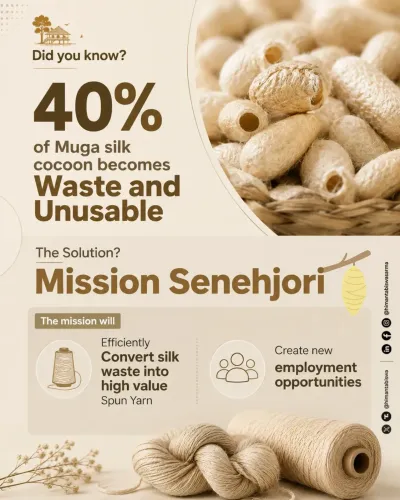
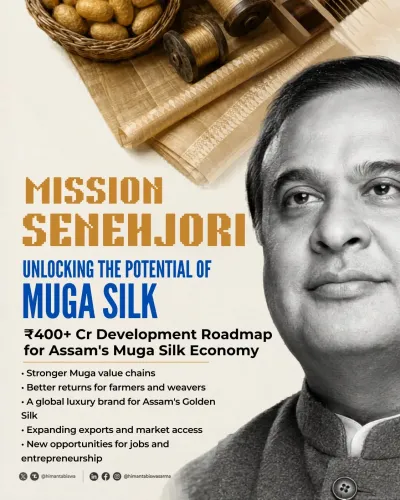
Muga silk — golden, lustrous, and produced only in Assam — and Eri silk, known for its warmth and ethical 'peace silk' credentials, are among India's most distinctive textile assets. The Central Silk Board and the Ministry of Textiles have run sericulture development programmes across the northeast for decades, but productivity in these varieties has long lagged behind mulberry silk grown in Karnataka and West Bengal.
MRMA 2.0 is the government's latest attempt to close that gap — not through infrastructure alone, but by making scientific knowledge directly accessible to the farmer at the rearing stage. District-level dialogues like the one in Kokrajhar are the mechanism: scientists explain improved rearing techniques, disease management, and host-plant cultivation; farmers flag ground-level constraints that lab conditions never surface.
A pattern of northeastern textile focus
The Textiles Ministry under Singh has consistently framed northeastern silk as a priority, positioning Muga and Eri not just as regional products but as globally marketable luxury fibres with GI-tag protection and a sustainability story. The MRMA 2.0 rollout in Assam fits a broader pattern of state-specific outreach designed to raise both output volumes and farmer incomes in traditional rearing belts.
Whether district-level dialogues translate into measurable yield improvements will be the real test — and Assam's Muga and Eri output figures in the coming seasons will be the scorecard to watch.
For Kokrajhar's silkworm farmers, the message from New Delhi is clear: the science is coming to them, not the other way around.
Point of View
The government is tacitly acknowledging that top-down scheme design has historically failed to move the needle on Muga and Eri productivity. For Giriraj Singh, amplifying district-level events like this serves a dual purpose: it signals grassroots delivery to a northeastern constituency that BJP has courted aggressively, and it positions India's rarest silk varieties as a premium export story. The real test is whether structured dialogue converts into verifiable output gains — or remains a well-photographed exercise in optics.
NationPress
21 Aug 2026
Frequently Asked Questions
What is Mera Resham Mera Abhiman 2.0 (MRMA 2.0)?
MRMA 2.0, or Mera Resham Mera Abhiman 2.0, is a Ministry of Textiles initiative that promotes sericulture by facilitating direct engagement between agricultural scientists and silk-rearing farmers, with a focus on improving Muga and Eri silk production in northeastern India.
What is Muga silk and why is it significant?
Muga silk is a golden, lustrous variety of silk produced exclusively in Assam. It holds a Geographical Indication (GI) tag, making it one of India's most protected and premium textile products, and is central to Assam's cultural and economic identity.
Why was Kokrajhar chosen for the MRMA 2.0 programme?
Kokrajhar is located in the Bodoland Territorial Region of Assam, a traditional sericulture belt where Muga and Eri rearing are established livelihoods. Targeting this district allows the programme to reach farmers in clusters historically underserved by mainstream agricultural outreach.
What role does the Central Silk Board play in Assam sericulture?
The Central Silk Board, under the Ministry of Textiles, has supported sericulture development in Assam and the northeast for decades through research, training, and farmer outreach programmes aimed at improving productivity and incomes in Muga and Eri rearing communities.