Giriraj Singh flags 15% merchandise export rise in Q1 FY27
Synopsis
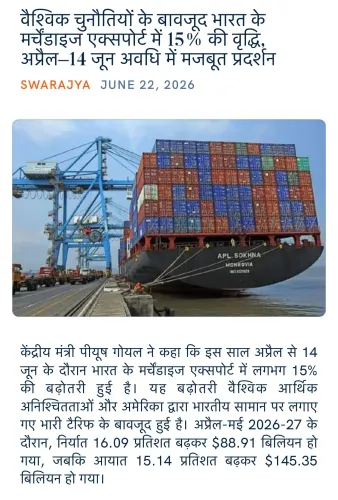
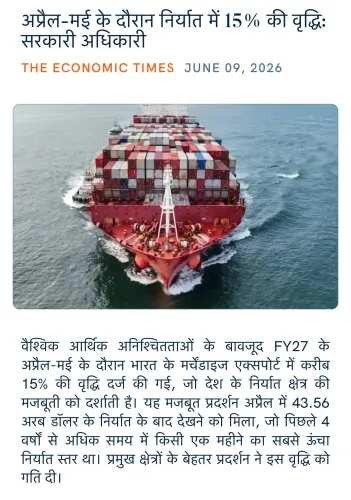
Union Textiles Minister Giriraj Singh on 4 July 2026 flagged over 15 per cent growth in India's merchandise exports for April–June 2026, linking the first-quarter performance to the government's $1 trillion FY27 export target and ongoing trade policy initiatives.
Key Takeaways
Union Textiles Minister Giriraj Singh posted on 4 July 2026 highlighting more than 15 per cent growth in merchandise exports during April–June 2026 .
India has set a $1 trillion overall export target for FY27 , with the government eyeing a roughly 17 per cent jump in merchandise shipments for the full year.
The Foreign Trade Policy 2023–28 and the PLI scheme for textiles (2021) form the core policy backbone supporting export growth.
Textile exporters and MSME manufacturers are the primary beneficiaries of sustained double-digit merchandise export growth.
Ongoing Free Trade Agreement negotiations with the EU and UK could further shape India's merchandise export trajectory in FY27.
Official quarterly data from the Commerce Ministry will be the next key indicator of whether Q1 momentum is being maintained.
Union Textiles Minister Giriraj Singh on Saturday, 4 July 2026, highlighted a more than 15 per cent increase in India's merchandise exports during April–June 2026, sharing the data via the NaMo App on X. The post underscores the ruling dispensation's emphasis on export-led growth as the country works toward an ambitious trade milestone.
Context
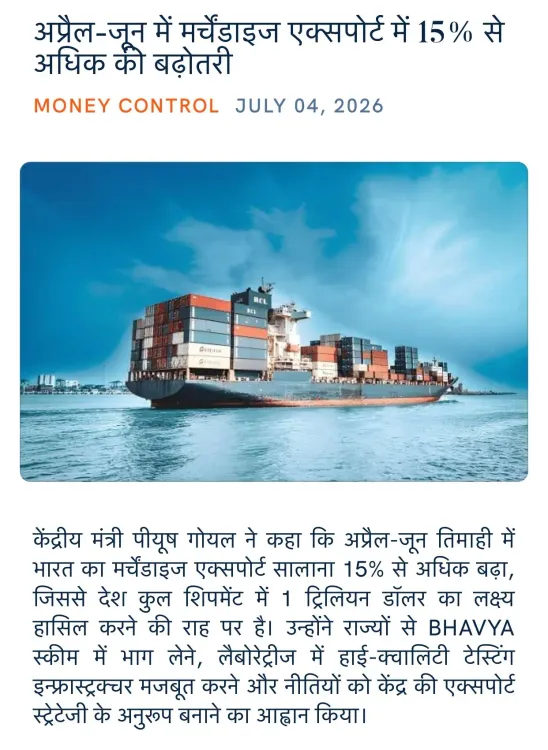
Singh's post, written in Hindi, states: 'अप्रैल-जून में मर्चेंडाइज एक्सपोर्ट में 15% से अधिक की बढ़ोतरी' — ['More than 15 per cent growth in merchandise exports in April–June']. The minister shared the update alongside a linked article reporting that India has set a $1 trillion export target for FY27 and is eyeing a roughly 17 per cent jump in merchandise shipments for the full fiscal year. The post signals that the first quarter of FY27 is tracking ahead of earlier projections.
The Commerce Ministry has framed the $1 trillion overall export target — covering both goods and services — as a defining benchmark for India's trade ambitions by FY27. A strong April–June showing in merchandise would represent a meaningful early step toward that goal, given that goods exports have historically been the more volatile component.
Policy Backdrop
India's export push draws on a layered policy architecture built over the past decade. The Foreign Trade Policy 2023–28 laid out a framework to expand India's share in global merchandise trade, while the Production Linked Incentive (PLI) scheme for textiles, notified in 2021, was designed specifically to attract fresh investment and lift shipments in a sector that employs tens of millions of workers.
These efforts sit within the broader Make in India initiative launched in 2014, which sought to improve manufacturing competitiveness across sectors. Textiles have consistently featured as a priority labour-intensive sector in government messaging, given their outsized role in rural employment and foreign-exchange earnings. Ongoing Free Trade Agreement negotiations with key markets are expected to further shape market-access conditions for Indian exporters.
Stakeholders and Impact
A sustained double-digit growth rate in merchandise exports would benefit textile exporters and MSME manufacturers most directly, as these segments account for a significant share of India's goods shipment basket. Improved order flows could translate into hiring and capacity expansion, particularly in textile hubs across Gujarat, Tamil Nadu, Maharashtra, and Uttar Pradesh.
Global supply-chain realignments — as buyers seek to diversify away from single-country sourcing — have opened a window for Indian exporters to capture incremental market share. The 15-plus per cent Q1 growth figure, if sustained, would reinforce India's positioning as a reliable alternative manufacturing and export base. The Ministry of Textiles has been actively coordinating with industry bodies to address bottlenecks in logistics, raw-material availability, and compliance costs.
What's Next
Attention will now turn to the Commerce Ministry's official quarterly export data release, which will provide a detailed breakdown by commodity and destination market. Any upward or downward revision to the FY27 merchandise shipment target in the next Union Budget will be closely watched by industry. Progress on pending Free Trade Agreement talks — particularly with the European Union and the United Kingdom — could materially alter the trajectory of textile and broader merchandise exports in the coming quarters.
If the April–June momentum holds through the remaining three quarters, India would be firmly on course to test the upper bound of its FY27 export ambitions — a result that would carry significant weight in the government's economic narrative ahead of the next electoral cycle.
Point of View
The minister reinforces the BJP's practice of routing positive economic news through party-aligned digital infrastructure, amplifying reach among the cadre. The 15-plus per cent growth figure, if corroborated by official Commerce Ministry data, would mark one of the stronger quarterly performances in recent years and lend credibility to the $1 trillion export target. More broadly, this fits a pattern in which sector ministers act as active amplifiers of trade and investment metrics, keeping the export-led growth story salient between Budget cycles.
NationPress
4 Jul 2026
Frequently Asked Questions
What did Giriraj Singh say about India's exports?
Giriraj Singh posted on 4 July 2026 that India's merchandise exports grew by more than 15 per cent in April–June 2026, sharing the update via the NaMo App on X.
What is India's export target for FY27?
India has set a $1 trillion overall export target for FY27, with the government aiming for roughly a 17 per cent jump in merchandise shipments specifically during the fiscal year.
Which ministry handles India's textile export policy?
The Ministry of Textiles, currently headed by Union Minister Giriraj Singh, oversees policy, incentives, and promotion for India's textile and apparel export sector.
What is the PLI scheme for textiles?
The Production Linked Incentive scheme for textiles was notified in 2021 to attract investment into the sector and increase India's merchandise export competitiveness in global markets.
How does the Foreign Trade Policy 2023-28 support export growth?
The Foreign Trade Policy 2023–28 outlines a set of measures — including market diversification, logistics improvements, and FTA negotiations — aimed at expanding India's share of global merchandise trade through FY28.