Giriraj Singh hails dawn of Modi-Takaichi era in India-Japan ties
Synopsis
Union Textiles Minister Giriraj Singh flagged the dawn of a 'Modi-Takaichi era' in India-Japan relations on 29 July 2026, drawing attention to the deepening Indo-Pacific strategic partnership built on two decades of summits, defence ties, and the Quad framework.
Key Takeaways
Giriraj Singh on 29 July 2026 hailed the dawn of a ' Modi-Takaichi era ' in India-Japan relations via X.
The India-Japan Strategic and Global Partnership was formalised in 2006 with annual prime ministerial summits.
Bilateral defence and security ties accelerated during the Abe era (2012-2020) through joint exercises and technology agreements.
The Quad framework was revived in 2017 with India, Japan, the US, and Australia as co-anchors of Indo-Pacific security.
India's Act East Policy has made Japan a key partner in high-speed rail, semiconductor supply chains, and maritime domain awareness.
The next India-Japan annual summit will be the first concrete test of whether the 'era' framing translates into new agreements.
A new chapter in one of Asia's most consequential bilateral relationships may be opening — and Union Textiles Minister Giriraj Singh wants India to take note. On Wednesday, 29 July 2026, the senior BJP leader and Lok Sabha MP from Begusarai shared commentary on the emerging Modi-Takaichi era in India-Japan relations, signalling that New Delhi's strategic establishment sees fresh momentum in a partnership that has long anchored the Indo-Pacific order.
Posting on X via the NaMo App, Singh wrote: 'भारत–जापान संबंधों में मोदी–ताकाइची युग की शुरुआत' — 'The dawn of the Modi-Takaichi era in India-Japan relations.' The framing is pointed: it names not just two governments, but two leaders whose political chemistry could define the next phase of bilateral ties.
Two decades of strategic architecture — and what comes next
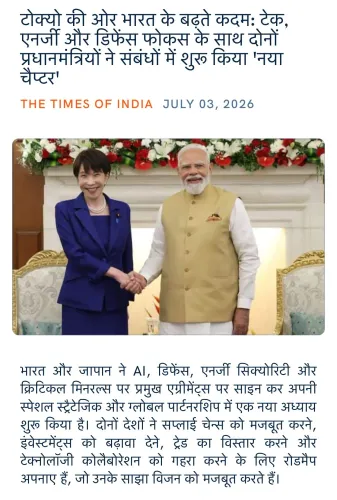
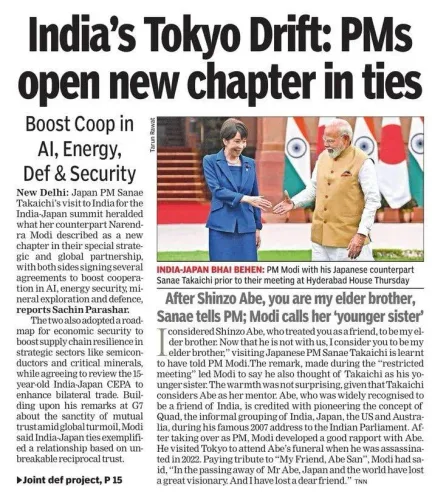
The India-Japan partnership did not arrive overnight. The Strategic and Global Partnership was formalised in 2006, locking in annual prime ministerial summits that have survived changes of government in both capitals. The real acceleration came during the Abe era (2012-2020), when joint military exercises deepened, defence technology agreements were signed, and the two nations co-anchored the revival of the Quad framework in 2017 alongside the United States and Australia. Under Prime Minister Narendra Modi's Act East Policy, Japan has become a pillar of India's eastern strategic pivot — a partner in high-speed rail, semiconductor supply chains, and maritime domain awareness. Sanae Takaichi, a senior Liberal Democratic Party figure with a portfolio spanning security and economic policy, represents continuity with that tradition of strategic ambition.Why the Indo-Pacific framing matters right now
The explicit invocation of a 'Modi-Takaichi era' is a signal, not just a salutation. India and Japan share convergent interests in a free and open Indo-Pacific — a phrase that has moved from diplomatic boilerplate to operational reality, with joint naval exercises and coordinated infrastructure financing across South and Southeast Asia. Naming a bilateral 'era' after two sitting leaders is a deliberate act of political branding: it stakes a claim that this relationship has a new anchor and a new direction. All eyes now turn to the next India-Japan annual summit and whether new defence, technology, or connectivity agreements will give the 'era' its first concrete chapter.Point of View
And now seeks to extend that legacy into a new Japanese leadership chapter. It fits a broader pattern of the ruling party using social media to domesticate foreign-policy wins for a nationalist audience. The real test will be whether the next India-Japan summit produces substantive new agreements that justify the 'era' label.
NationPress
29 Jul 2026
Frequently Asked Questions
What is the Modi-Takaichi era in India-Japan relations?
The 'Modi-Takaichi era' refers to the emerging phase of India-Japan bilateral ties under Prime Minister Narendra Modi and Japanese LDP leader Sanae Takaichi, signalling fresh momentum in strategic, defence, and economic cooperation.
Who is Sanae Takaichi and what is her role in India-Japan ties?
Sanae Takaichi is a senior Liberal Democratic Party politician in Japan with experience across security and economic policy portfolios, seen as a key figure shaping Japan's strategic direction in the Indo-Pacific.
What is the history of the India-Japan strategic partnership?
The India-Japan Strategic and Global Partnership was formalised in 2006, with annual prime ministerial summits. Ties deepened significantly during the Abe era (2012-2020) through joint military exercises, defence technology agreements, and the revival of the Quad in 2017.
Why did Giriraj Singh post about India-Japan relations?
Union Textiles Minister Giriraj Singh shared commentary on 29 July 2026 via the NaMo App, hailing the start of a new chapter in India-Japan ties — a move consistent with BJP leaders amplifying the government's foreign-policy achievements on social media.
What is India's Act East Policy and how does Japan fit in?
India's Act East Policy prioritises strategic and economic engagement with East and Southeast Asia. Japan is a central pillar, partnering with India on high-speed rail, semiconductor supply chains, maritime security, and Quad cooperation.