Giriraj Singh hails India's 29 GW solar-wind record in H1 2026
Synopsis
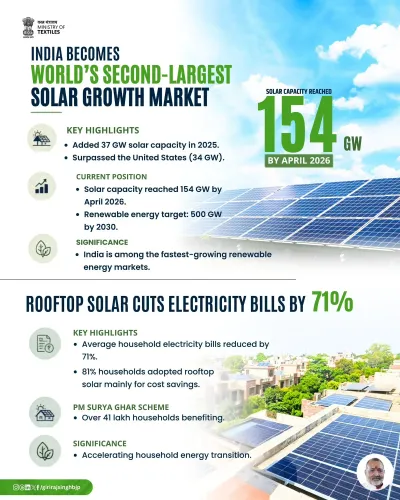
Union Textiles Minister Giriraj Singh on 16 July 2026 amplified a report crediting India with a new record of 29 GW solar and wind capacity added in the first half of 2026, underscoring the country's accelerating push toward its 500 GW non-fossil fuel target by 2030.
Key Takeaways
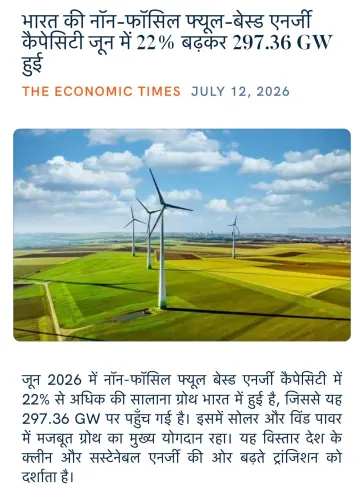
India reportedly added a record 29 GW of solar and wind capacity in the first half of 2026 , according to a report shared by Union Textiles Minister Giriraj Singh .
The minister shared the milestone on 16 July 2026 via the NaMo App , reflecting a cross-ministerial social media amplification strategy for clean energy achievements.
India pledged 500 GW of non-fossil fuel capacity by 2030 at COP26 in Glasgow in 2021 ; the H1 2026 figure would mark a significant acceleration toward that goal.
The Production Linked Incentive (PLI) scheme for solar modules , launched in 2021 , has been a key policy tool to boost domestic manufacturing and reduce import dependence.
India is the third-largest energy consumer globally , making rapid renewable deployment central to both energy security and Paris Agreement commitments.
Full-year 2026 addition data and any revision to 2030 targets will be closely tracked by developers, discoms, and climate negotiators.
Union Textiles Minister Giriraj Singh on Thursday, 16 July 2026, shared a report highlighting that India has set a new record by adding 29 gigawatts (GW) of solar and wind capacity in the first half of 2026, amplifying the milestone across his social media platforms via the NaMo App.
Context
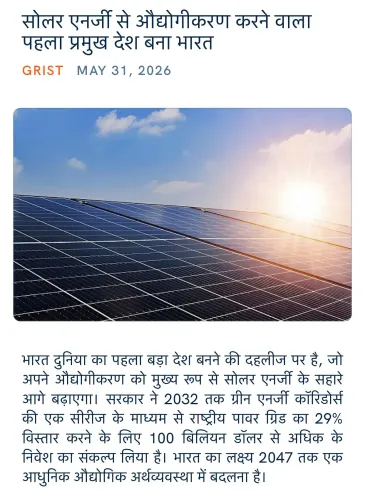
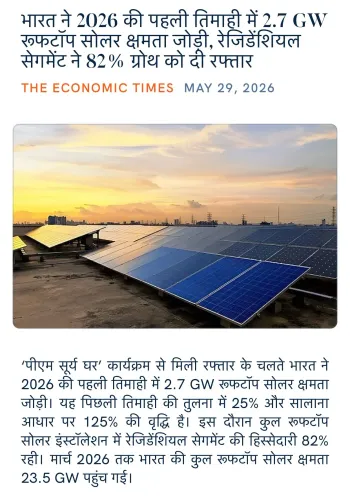
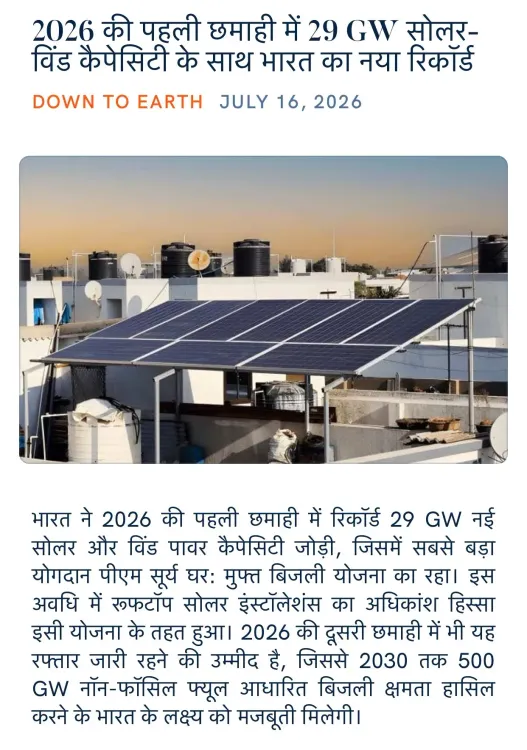
The post, shared in Hindi, translates to: '2026 ki pehli chhamaahi mein 29 GW solar-wind capacity ke saath Bharat ka naya record' — 'India sets a new record with 29 GW solar-wind capacity in the first half of 2026.' The minister linked to a detailed report and flagged the achievement as a landmark moment in India's clean energy journey. The cross-ministerial amplification underscores the ruling dispensation's strategy of projecting renewable energy milestones as a whole-of-government success story.
Policy Backdrop
India's renewable energy push traces its roots to the Jawaharlal Nehru National Solar Mission, launched in 2010 and revised in 2015, which initially set a target of 175 GW of renewable capacity by 2022. That ambition was significantly scaled up when, at the COP26 climate summit in Glasgow in 2021, India pledged to achieve 500 GW of non-fossil fuel power capacity by 2030 and reach net-zero emissions by 2070. The Ministry of New and Renewable Energy has been the nodal body driving these targets through competitive auctions, state-level policy coordination, and manufacturing incentives such as the Production Linked Incentive (PLI) scheme for solar modules, introduced in 2021 to reduce dependence on imported components.
Successive years of high capacity additions, led primarily by solar photovoltaic and wind projects, have been underpinned by sharply falling technology costs and an active pipeline of central and state-level tenders. The reported 29 GW addition in just the first six months of 2026 would represent a significant acceleration in the pace of deployment if confirmed by official data.
Stakeholders and Impact
The primary beneficiaries of rapid renewable capacity growth include independent power producers and large renewable developers who have invested heavily in project pipelines, as well as state electricity distribution companies (discoms) that procure clean power to meet Renewable Purchase Obligations. For power consumers — industrial, commercial, and residential — sustained capacity addition is expected to put downward pressure on tariffs over the medium term as solar and wind generation costs remain low. India is also the third-largest energy consumer globally, making domestic clean energy expansion a key lever for energy security and reducing fossil fuel import bills.
The milestone, if sustained through the second half of the year, would bring India considerably closer to its 500 GW non-fossil fuel target by 2030 and strengthen its standing ahead of international climate stocktake exercises.
What's Next
Attention will now turn to full-year 2026 renewable addition figures, which will be closely watched by policymakers, developers, and climate negotiators alike. Any upward revision of India's 2030 targets — in light of accelerating deployment — could be signalled ahead of upcoming global climate forums. The government is also expected to continue expanding the domestic solar module manufacturing base under the PLI scheme, aiming to reduce import dependence and create a self-sustaining clean energy supply chain within the country.
Point of View
Not a single-ministry story. The 29 GW H1 2026 figure, if validated by official data, would mark a step-change in deployment pace and substantially de-risk India's 500 GW by 2030 pledge made at COP26. Cross-ministerial social media amplification of such milestones has become a structured communications tool, with the NaMo App serving as the preferred channel to ensure messaging reaches the party's core digital base. The broader arc points to India positioning itself as a renewable energy leader in the Global South ahead of upcoming climate stocktake discussions.
NationPress
16 Jul 2026
Frequently Asked Questions
How much solar and wind capacity did India add in H1 2026?
According to a report shared by Union Textiles Minister Giriraj Singh, India added a record 29 GW of combined solar and wind capacity in the first half of 2026 .
What is India's renewable energy target by 2030?
India pledged to achieve 500 GW of non-fossil fuel power capacity by 2030 , a commitment made at the COP26 climate summit in Glasgow in 2021 .
Why is a Textiles Minister posting about solar energy?
Senior BJP leaders routinely amplify government achievements across sectors on social media as part of a coordinated communications strategy; the post was shared via the NaMo App , a platform used for party-aligned messaging.
What is the PLI scheme for solar modules?
The Production Linked Incentive (PLI) scheme for solar modules , introduced in 2021 , provides financial incentives to domestic manufacturers to scale up solar panel production and reduce India's dependence on imported components.
Which ministry oversees India's renewable energy targets?
The Ministry of New and Renewable Energy (MNRE) is the nodal ministry responsible for setting policy, managing competitive auctions, and coordinating with states to achieve India's clean energy targets.