Giriraj Singh: India is ADB's Largest Private Sector Market
Synopsis
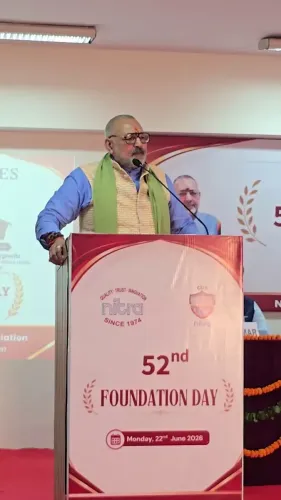
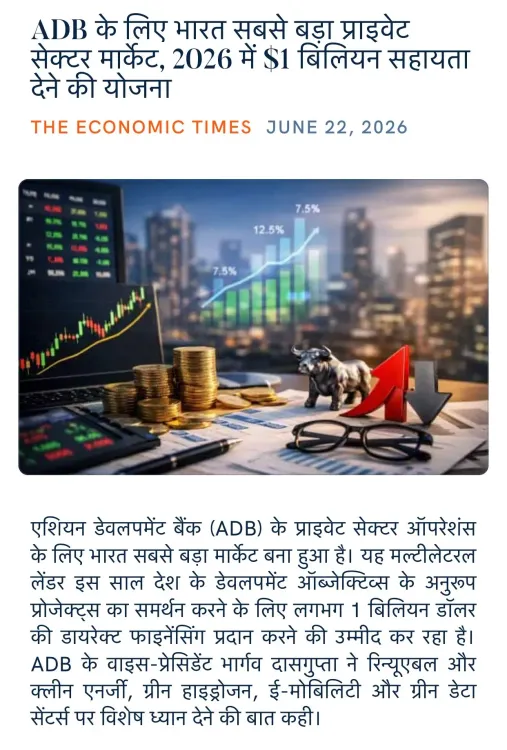
Union Textiles Minister Giriraj Singh on 22 June 2026 highlighted that India has become the Asian Development Bank's largest private-sector market, with ADB planning $1 billion in private-sector financing for the country in 2026 — a milestone the senior BJP leader amplified via the NaMo App.
Key Takeaways
India has been identified as the Asian Development Bank's largest private-sector market as of 2026.
ADB plans to deploy $1 billion in private-sector financing in India in 2026 .
Union Textiles Minister Giriraj Singh shared the development on 22 June 2026 via the NaMo App .
ADB , founded in 1966 , counts India as a founding member and one of its largest historical borrowers.
The financing is expected to benefit MSMEs , private infrastructure developers, and financial institutions through non-sovereign lending windows.
Formal project-level confirmation is awaited from an ADB Board or annual country programme announcement.
Union Textiles Minister Giriraj Singh on Monday, 22 June 2026, shared a report highlighting that India has emerged as the Asian Development Bank's (ADB) largest private-sector market, with the multilateral lender planning to deploy $1 billion in financing to the country's private sector in 2026. The minister shared the development via the NaMo App, amplifying the report as a marker of India's growing stature in multilateral development finance.
Context
The post, shared in Hindi, translates to: 'ADB ke liye Bharat sabse bada private sector market, 2026 mein $1 billion sahayata dene ki yojana' — 'India is ADB's largest private-sector market, with plans to provide $1 billion in assistance in 2026.' The minister's decision to amplify the report underscores the ruling dispensation's emphasis on positioning India as a top destination for multilateral capital.
ADB, founded in 1966, is a Manila-based multilateral development bank with a mandate to foster economic growth across the Asia-Pacific region. India is a founding member and has historically been one of the bank's largest borrowers, with financing spanning infrastructure, urban development, and private-sector operations.
Policy Backdrop
India's engagement with ADB has deepened significantly since the post-1991 economic liberalisation era. Successive Country Partnership Strategies between New Delhi and ADB have set multi-year lending envelopes, with growing emphasis on non-sovereign financing — meaning direct lending to private companies and financial institutions rather than government entities alone.
Since the 2010s, ADB has progressively expanded its non-sovereign operations in India, targeting private infrastructure developers, micro, small and medium enterprises (MSMEs), and financial intermediaries. The shift reflects a broader global trend among multilateral development banks to 'crowd in' private capital alongside traditional sovereign lending, a priority that recent Indian government policy has actively encouraged.
Stakeholders and Impact
The $1 billion private-sector financing pipeline, if confirmed, would represent a significant commitment to India's business ecosystem. MSMEs, private infrastructure developers, and financial institutions are among the primary beneficiaries of ADB's non-sovereign windows in India. Such financing typically comes in the form of equity investments, guarantees, and direct loans that do not require government guarantees.
For the BJP-led government, the designation of India as ADB's largest private-sector market serves as a validation of its ease-of-business reforms and investment-climate improvements over the past decade. The amplification of this report by a senior cabinet minister signals that the government views multilateral recognition as a political and economic asset ahead of continued reform messaging.
What's Next
Formal confirmation of the $1 billion non-sovereign pipeline for 2026 is expected to come through an official ADB Board announcement or the bank's annual country programme update for India. Observers will watch whether the financing envelope translates into specific project approvals in sectors such as clean energy, logistics, and digital infrastructure — areas where ADB has expressed strategic interest in India in recent years.
The development also feeds into India's broader ambition to position itself as the pre-eminent emerging-market partner for multilateral development banks, a narrative that has gained momentum as the country prepares for continued engagement with institutions such as the World Bank and the New Development Bank.
Point of View
If it materialises, would mark a qualitative shift in India-ADB engagement from predominantly sovereign lending toward direct private-capital catalysis, aligning with the government's broader push to reduce fiscal dependence on public investment. Giriraj Singh's choice of the NaMo App as the distribution channel also reflects the party's strategy of routing economic good-news messaging through its own digital ecosystem. The milestone fits a broader arc in which India is actively competing with other large emerging markets — notably China and Indonesia — for priority status in multilateral development bank portfolios.
NationPress
22 Jun 2026
Frequently Asked Questions
Why is India called ADB's largest private sector market?
India has been designated ADB's largest private-sector market because the Asian Development Bank has committed to deploying $1 billion in non-sovereign, private-sector financing in the country in 2026 — its biggest such allocation for any single market. India's large economy, reform trajectory, and deep pipeline of private infrastructure and MSME projects have made it ADB's top destination for direct private lending.
What is ADB's $1 billion India plan for 2026?
ADB plans to provide $1 billion in private-sector financing to India in 2026, according to the report shared by Union Textiles Minister Giriraj Singh on 22 June 2026. This financing is expected to flow through non-sovereign lending windows — direct loans, equity, and guarantees to private companies and financial institutions — rather than government-backed sovereign loans.
What is the Asian Development Bank and what is India's relationship with it?
The Asian Development Bank (ADB) is a Manila-based multilateral development bank founded in 1966 to promote economic growth across Asia-Pacific. India is a founding member and has historically been one of ADB's largest borrowers, with cumulative financing spanning infrastructure, urban development, and private-sector operations across several decades.
Who is Giriraj Singh and why did he share this ADB news?
Giriraj Singh is India's Union Minister of Textiles, a senior BJP leader and Lok Sabha MP from Begusarai, Bihar. He shared the ADB-India milestone on 22 June 2026 via the NaMo App, amplifying the development as evidence of India's rising profile as a destination for multilateral private-sector investment under the current government.
How does ADB private sector financing differ from sovereign loans?
ADB's private-sector or non-sovereign financing goes directly to private companies, MSMEs, and financial institutions without requiring a government guarantee, unlike sovereign loans which are backed by the national government. This type of financing is designed to 'crowd in' private capital and reduce the burden on public finances.