Giriraj Singh: India's solar capacity up 40x since 2014

Synopsis
Union Textiles Minister Giriraj Singh highlights India's solar installed capacity reaching 168.04 GW — a 40-fold rise since 2014 — with over 50 lakh homes enrolled under PM Surya Ghar and ₹14,007 crore in PLI incentives driving domestic solar manufacturing.
Key Takeaways
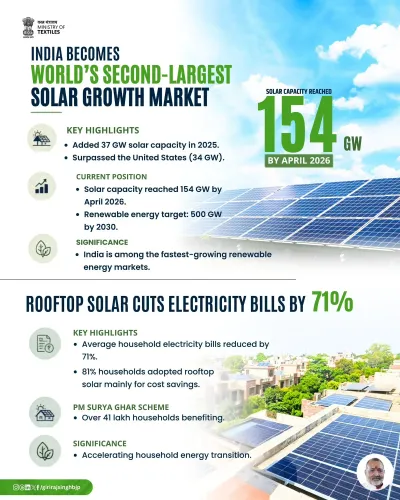
India's solar installed capacity has grown from 2.3 GW in 2014 to 168.04 GW , a nearly 40-fold increase , according to Minister Giriraj Singh's post.
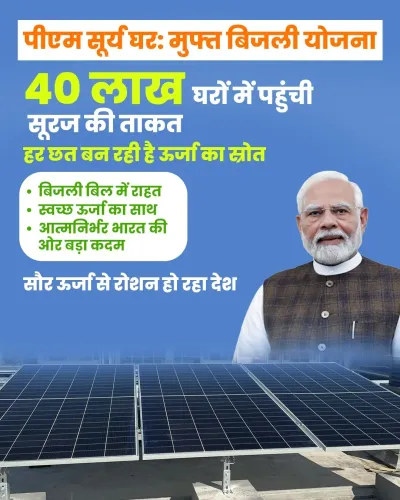
The PM Surya Ghar Muft Bijli Yojana has connected more than 50 lakh households to rooftop solar, offering up to 300 units of free electricity monthly.
The PLI scheme for solar manufacturing has disbursed ₹14,007 crore in incentives to boost domestic production of high-efficiency solar PV modules.
India's solar mission traces back to the Jawaharlal Nehru National Solar Mission (2010) and a revised 100 GW target set in 2015 under Paris Agreement commitments.
The solar push is framed within the Atmanirbhar Bharat framework, aiming to reduce dependence on imported solar panels, chiefly from China.
India's current trajectory places it well beyond its original 100 GW by 2022 benchmark and on track for its 2030 non-fossil fuel capacity targets .
From 2.3 GW to 168.04 GW — that is the arc India's solar energy story has traced in just over a decade, and Union Textiles Minister Giriraj Singh put the full sweep of it on record on Wednesday, September 30, 2026, in a post that framed the journey as a civilisational pivot toward energy self-reliance.
In the post, Minister Singh wrote: 'Bharat ki saur urja yatra ab nayi unchaiyion ko chhu rahi hai' — 'India's solar energy journey is now touching new heights.' He cited a nearly 40-fold increase in installed solar capacity since 2014, when the country had just 2.3 GW of solar power, against the current figure of 168.04 GW.
PM Surya Ghar scheme lights up 50 lakh homes
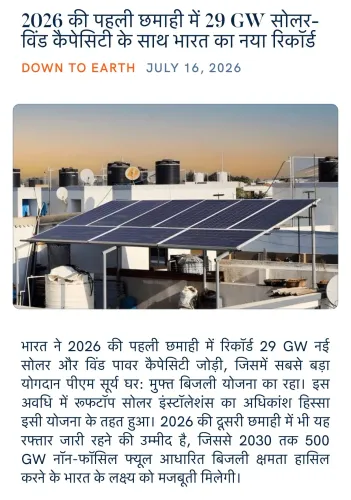
At the heart of the demand story is the PM Surya Ghar Muft Bijli Yojana, a central scheme designed to install rooftop solar panels across one crore households and deliver up to 300 units of free electricity per month to each beneficiary. Singh's post claims more than 50 lakh households — half a million short of the full crore target — have already been connected to solar power under the programme. That is a meaningful footprint: real families in real towns and villages whose electricity bills have been restructured by rooftop panels, not just a government dashboard number.
₹14,007 crore PLI push to build India's solar supply chain
The second pillar Singh highlighted is the Production Linked Incentive (PLI) scheme for solar manufacturing, with ₹14,007 crore in incentives cited as fuel for domestic production of high-efficiency solar PV modules. The PLI architecture here is deliberate: India's rapid capacity addition had for years been powered largely by imported panels, chiefly from China. The PLI scheme, which received Cabinet approval in 2021 with an initial outlay of ₹4,500 crore before subsequent expansion, was designed precisely to close that gap — building a local supply chain that can sustain the renewable build-out without chronic import dependence.
The policy lineage runs deeper. India's solar ambition was formally launched under the Jawaharlal Nehru National Solar Mission in 2010, and the target was sharpened to 100 GW by 2022 as part of India's climate commitments under the Paris Agreement. The current trajectory — if the figures Singh cites hold — would mean India has blown past that original 100 GW ceiling and is now running at nearly 1.7 times that benchmark.
Atmanirbhar energy: the strategic frame behind the numbers
Singh's post closes with an explicitly strategic register: 'Atmanirbhar urja se satat bhavishy ki or Bharat ki raftar lagatar badh rahi hai' — 'India's momentum toward a self-reliant energy and sustainable future keeps growing.' The phrase 'Atmanirbhar' — self-reliant — is no accident. It places the solar push squarely inside the broader Atmanirbhar Bharat framework, India's governing doctrine of reducing strategic vulnerabilities through domestic production across sectors from semiconductors to defence.
For India's 2030 non-fossil fuel targets — a pledge to derive 50 percent of installed electricity capacity from non-fossil sources — the solar sprint is the single largest variable. Every gigawatt added domestically and manufactured locally is one fewer import bill and one step closer to that commitment on the world stage.
The numbers Singh has put into circulation are large and consequential. They deserve scrutiny as official capacity-addition data is released through quarterly reporting cycles. But the directional story — a country that barely had a solar sector a decade ago now operating one of the world's largest solar fleets — is not in question. India is running, and it is not slowing down.
Point of View
The communication benchmarks performance against the pre-2014 baseline, a rhetorical device that has become a standard BJP governance-messaging template. The PLI angle matters most strategically — India's solar build-out was long criticised as merely a conduit for Chinese panel imports, and sustained PLI disbursements would represent a genuine structural shift if the manufacturing scale-up holds. Watch whether the 50 lakh PM Surya Ghar figure translates into verifiable grid-connected installations in MNRE quarterly data, as rooftop solar uptake has historically lagged behind headline registration numbers.
NationPress
30 Sept 2026
Frequently Asked Questions
What is India's total solar energy capacity in 2026?
Union Textiles Minister Giriraj Singh stated on September 30, 2026 that India's installed solar capacity has reached 168.04 GW , up from just 2.3 GW in 2014 — a nearly 40-fold increase.
What is PM Surya Ghar Muft Bijli Yojana and how many homes have benefited?
The PM Surya Ghar Muft Bijli Yojana is a central government scheme that installs rooftop solar panels in households and provides up to 300 units of free electricity per month . Minister Singh's post states that over 50 lakh households have been connected under the scheme so far.
How much PLI incentive has been given for solar manufacturing in India?
According to Minister Giriraj Singh's post, ₹14,007 crore in PLI (Production Linked Incentive) incentives have been disbursed to boost domestic manufacturing of high-efficiency solar PV modules and reduce import dependence.
What was India's original solar energy target and has it been met?
India set a target of 100 GW of solar capacity by 2022 as part of its Paris Agreement commitments. The figures cited by Minister Singh — 168.04 GW — suggest India has significantly exceeded that benchmark, though the 2022 deadline was not met on schedule.
What is the Jawaharlal Nehru National Solar Mission?
The Jawaharlal Nehru National Solar Mission was launched in 2010 as India's first major policy framework to promote grid-connected and off-grid solar energy deployment, forming the foundation for all subsequent solar capacity targets and schemes.